Silver Dollars & Trade Dollars of the United States - A Complete Encyclopedia
Q. David Bowers
1878 Trade Dollar: Market Values
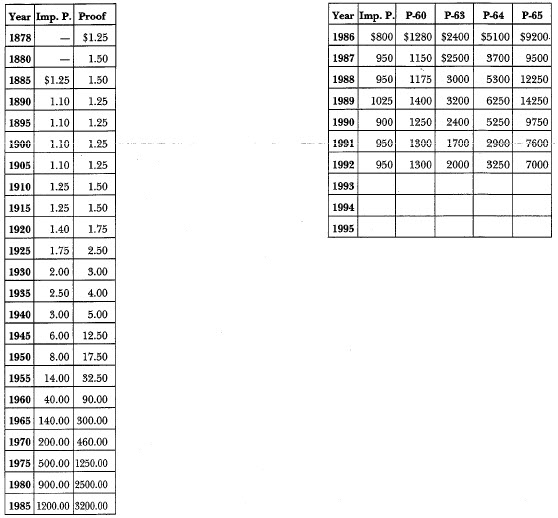
1878: Summary of Characteristics
Proofs:
Enabling legislation: Act of February 12, 1873
Business strike mintage: None
Designer: William Barber
Weight: 420 grains
Composition: .900 silver, .100 copper Melt-down (silver value) in year minted: $0.9070
Dies prepared: Obverse: Unknown; Reverse: Unknown
Proof mintage: 900. 683 sold in 1878, 217 sold for bullion or face value in 1879;(Per the research of R. W. Julian published in 1986.) Proofs only. Delivery figures by month: January: 300; February: 200; March: 200; April: none; May: 200; June-December: none.
Characteristics of striking: Usually well struck
Approximate population Proof-65 or better: 50+/-(URS-7)
Approximate population Proof-64: 132+/- (URS-9)
Approximate population Proof-63: 177+/- (URS-9)
Approximate population Proof-60 to 62: 126+/- (URS-7)
Additional Information
The Status of the Trade Dollar in 1878
In March 1878, the Morgan standard silver dollar became a reality, and the Bland-Allison Act (February 28, 1878) forced the Treasury Department to buy millions of ounces of silver each year to coin into silver dollars which were neither wanted nor needed in the channels of commerce. Thus, with a market assured for silver, the Western mining interests diminished their agitation for continuation of the trade dollar, even though at this time the American trade dollar had achieved wide acceptance in Chinese ports, and trade dollar mintages of recent years had attained all-time highs (the very highest being 1877-S with 9,519,000).
When read today, the report of congressional hearings before the Committee of Coinage, Weights and Measures in the House of Representatives in March 1878 gives an insight into the utility of the trade dollar, its acceptance, and other matters, and for the present-day numismatist and historian provides a fascinating contemporary account: (Reprinted from Misc. Document No. 44, 45th Congress, 2nd Session, Committee of Coinage, Weights and Measures.)
"ARGUMENTS BEFORE THE COMMITTEE ON COINAGE, WEIGHTS, AND MEASURES, relative to the continuance of the coinage of the silver trade dollar.
"MARCH 22, 1878. Recommitted to the Committee on Coinage, Weights and Measures and ordered to be printed.
"ARGUMENTS OF HON. HORACE DAVIS, REPRESENTATIVE FROM CALIFORNIA, AND HON. THOMAS WREN, REPRESENTATIVE FROM NEVADA, IN FAVOR OF THE CONTINUANCE OF THE COINAGE OF THE SILVER TRADE DOLLAR.
"Washington, D.C., March 19, 1878.
"Mr. DAVIS said: Mr. Chairman and gentlemen of the committee, I appear before you with reference to the coinage of the trade dollar. I have seen it stated that there was a proposition before this committee for the abolition of the coinage of the trade dollar, and I desire to show the committee the necessity that exists for its continuance. First, I shall try and show the committee the condition of our trade exchange in China in early times, and the difficulties which we labored under. Then I will show you how we tried to get over those difficulties by coining the standard dollar, and how we failed in that attempt, and then how the trade dollar came to be coined; how it was adapted for that purpose; the benefit which has come by it, and the detriment which would come from the abolition of it.
"Prior to 1858 our bullion production was nine-tenths gold, and it all went by way of Panama to New York and London. In 1858 came the discovery of the Comstock ledge, and with it came a glut of silver in our state.
"At that time the exchanges were made in this way: We were trading with China, and in order to pay our debts to China we shipped Mexican dollars there at a great loss, and made up for the balance (which we could not ship in Mexican dollars) by exchanges on London. The Mexican dollar is about the size and value of our trade dollar. It is very popular in China. It has been found very uniform and very steady in value, and it had become at that time the standard coin of China in all trade transactions. But the Mexican government had put export duty upon it, and in order to ship Mexican dollars to China we had to pay that export duty; we had to pay its transportation from Acapulco to San Francisco, and we had to pay the profits of those who exported it, and, besides, occasionally a speculation was produced by a corner in Mexican dollars.
"Mr. DWIGHT. What had you to pay for Mexican dollars? "Mr. DAVIS. The price was very variable. It was rarely less than 8% premium, and it would run up from that to 22% premium. But I ought to say to the committee that at that time the 412-1/2-grain dollar was at 3% premium, It contained 3% more silver than the dollar was worth as silver was rated at that time; and on the trade dollar itself we would have to pay 4-1/2 or 5% legitimate premium by its weight.
"Mr. DWIGHT. You mean premium over the silver dollar of 412-1/2 grains?
"Mr. DAVIS. No, sir; but over the gold dollar. I am putting everything upon the gold standard as it stood at that time. In 1858 our people, being thus glutted with silver, undertook to get relief by shipping standard dollars of 412-1/2 grains to China. These dollars were at that time out of circulation. Our people obtained from the government permission to put the San Francisco Mint on these dollars, and during the years 1859, 1860, 1861 there were coined about $1.3 million of these standard dollars at San Francisco,(This is incorrect. The only San Francisco coinage of silver dollars during this period consisted of 20,000 examples of 1859-S. Presumably, Davis was referring to the combined coinages of Philadelphia, New Orleans, and San Francisco, which in the aggregate totaled about 1.4 million pieces. Willem (for one) states that most of these were shipped to China.) and these were shipped to China. I call attention particularly to this fact, because Secretary Sherman has said in the printed notes of his conference with this committee that the 412-1/2 grain dollars can be substituted for the trade dollars. I repeat, that during the years 1859, 1860, and 1861 we shipped over a million and a quarter of these 412-1/2 grain dollars to China, and the experiment was an utter and absolute failure.