Silver Dollars & Trade Dollars of the United States - A Complete Encyclopedia
Q. David Bowers
1874-S Trade Dollar
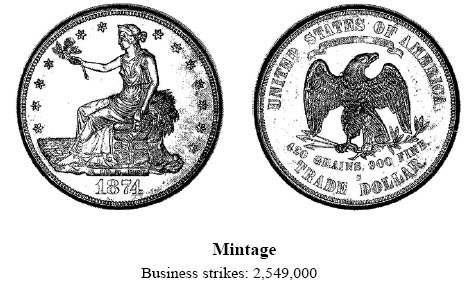
Coinage Context
Large commercial demand: The year 1874 saw a great demand for trade dollars to be used in the China trade, and by the end of December some 2,549,000 coins were struck at the San Francisco facility, a record coinage which surpassed what had been done at all three mints the year before in 1873. With the exception of January, when no trade dollars were coined, and November, when 95,000 were struck, the mintage each month topped the 100,000 mark, hitting a high in May with 366,000 pieces.
True to the purpose for which they were coined, nearly all 1874-S trade dollars were shipped to the Orient. There they saw extensive service in commerce.
Numismatic Information
Circulated grades: Worn coins are moderately scarce but enough are around that examples are readily obtainable. In grades from VF-20 through AU-58 this is the most plentiful San Francisco Mint trade dollar (not including 1875-S/CC). Probably 2,500 to 5,000 exist.
Countless thousands of 1874-S trade dollars were chopmarked by merchants and bankers in Chinese ports, and many of these survive today. In terms of surviving pieces, this is the third most common variety existing with chopmarks.
Mint State grades: At the MS-65 level the 1874-S is one of those coins that should be readily available. After all, well over two million were minted. Surprisingly, it is a formidable rarity-one that was not recognized as such until relatively recent times. I have never seen an MS-65 coin, and as of April 1992, neither NGC nor PCGS had certified an example.
In MS-64 condition the 1874-S exists to the extent of about 20 to 40 coins, making it quite elusive. At the MS-63 level about 30 to 50 are believed to exist. Finally, in the MS-60 to 62 range the 1874-S approaches availability. Here, there will be no problem in finding one. About 400 to 800 exist.
In general, the 1874-S will win no prizes for sharp striking; many if not most show some weakness at the top of the obverse and/or on the reverse at the eagle's sinister claws.
Mintmark size varieties: While most collectors, indeed the overwhelming majority of them, opt to acquire but a single example to illustrate the 1874-S, there are three distinct sizes of mintmarks-the minute (called "micro" by Breen) s, medium S, and large S. From the 1850s through the 1870s various silver denominations were made with different mintmark sizes, the most publicized of which are the half dollars of the 1860s.
Something to watch for: Some medium S coin (No.2 below) have the reverse rotated about 15° counterclockwise. In the past these have sold for no additional premium. However, the variety would lend interest to any collection'.
Varieties
OBVERSE TYPE I: RIBBON ENDS POINT LEFT, 1873-1876REVERSE TYPE I: BERRY BELOW CLAW, 1873-1876
Business Strikes: As noted, the 1874-S exists with "micro," medium and large S mintmarks. Most extant trade dollars of this date have mintmarks of the medium size. The micro and large issues are considered to be elusive. Varieties areas follows:
1. Minute s: Breen-5783. Mintmark.9 mm high. Very scarce.
2. Medium S: Breen-5784. Normal. Mintmark 1.1 mm high. Common. Often chopmarked. Many (all?) have broken letters. See, for example, top of E in UNITED. Some have the reverse rotated about 15° counterclockwise.
3. Medium S, doubled reverse die: Mintmark 1.1 mm high. One variety shows doubled reverse die, plainest (not very) at bases of TRADE DOLLAR. (With broken letters?)
4. Large S: Breen-5785. Mintmark 1.17 mm high.
Serifs of mintmark far from middle curve. With period after FINE. Often chopmarked. Much scarcer than No. 2.·
5. Large S: Breen-5785. Mintmark 1.17 mm high.
No period after FINE (from damaged hub). (Broken letters?)