Silver Dollars & Trade Dollars of the United States - A Complete Encyclopedia
Q. David Bowers
1874 Trade Dollar: Market Values
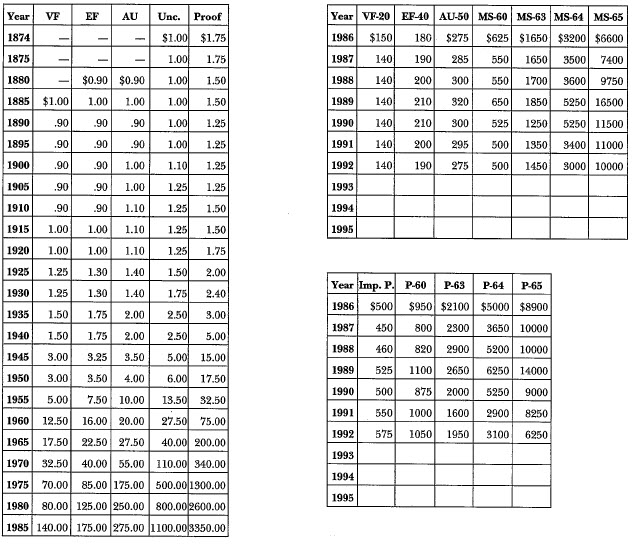
1874 Trade Dollar: Summary of Characteristics
Business Strikes:
Enabling legislation: Act of February 12, 1873 Designer: William Barber
Weight: 420 grains
Composition: .900 silver, .100 copper
Melt-down (silver value) in year minted: $1.00581
Dies prepared: Obverse: Unknown; Reverse: Unknown
Business strike mintage: 987,100. Delivery figures by month: January: 19,000; February: 134,800; March: 199,900; April: 105,000; May: 97,800; June: 103,600;July: 100,000; August: 96,000; September: 131,000; October-December: none.
Approximate population MS-65 or better: 6 to 10 (URS-4)
Approximate population MS-64: 50 to 100 (URS-7)
Approximate population MS-63: 60 to 100 (URS-7)
Approximate population MS-60 to 62: 150 to 250 (URS-9)
Approximate population VF-20 to AU-58: 2,500- 4,500+ (URS-13)
Characteristics of striking: Some have weakness on the obverse on Miss Liberty's head and at stars 6 and 7; on some the weakness extends to stars left and right of these. Some have light striking on eagle's sinister leg.
Known hoards of Mint State coins: None.
Rarity with original Chinese chopmark(s): The most common chopmarked Philadelphia Mint trade dollar; one of the most common of all chopmarked trade dollars.
Proofs:
Dies prepared: Obverse: Unknown; Reverse: Unknown
Proof mintage: 700; Delivery figures by month:
January: 100; February: 200; March: 100; April: 100; May: none; June: 100; July: none; August: none; September: 50; October: none; November: none; December: 50; 175 pieces distributed for face value on January 9, 1875.
Approximate population Proof-65 or better: 12+/- (URS-5)
Approximate population Proof-64: 102+/- (URS-8)
Approximate population Proof-63: 100+/- (URS-8)
Approximate population Proof-60 to 62: 210+/- (URS-9)
Commentary
Mostwere shipped to the China. With chopmarks, the 1874 is the most common Philadelphia Mint trade dollar. Unchopmarked and in Mint State the 1874 is rare.
Additional Information
Trade Dollars Accepted in China
The American journal of Numismatics, April 1874, reprinted this item from the Boston Daily Advertiser, which told of the acceptance of the new trade dollar denomination in China:
"THE TRADE DOLLAR THE STANDARD IN CHINA:
The Treasury Department has received advices from Peking, China, that the new trade dollar of the United States has been assayed by the commissioner of the Chinese empire, and reported to be of more intrinsic value than the Mexican or Dutch dollars, which have been the standard coin among the Chinese for more than a century, and an imperial edict has consequently been issued making the United States silver [trade] dollar a dollar for all the Chinese. The demand in this country for Mexican silver dollars to use in the China trade has sometimes been so great that they have sold higher than gold, and are now at par and a little better in San Francisco, being exported to China and Japan by every steamer."
Comments from the Mint Report
The Annual Report of the Director of the Mint, 1874, reprinted the comments of Director Henry Richard Linderman concerning production during the past fiscal year (July 1, 1873 to June 30, 1874) and other matters, including the observations of O.H. LaGrange, superintendent of the San Francisco Mint:
"THE TRADE DOLLAR: The coinage of trade dollars during the fiscal year amounted to $3,588,900, the greater portion of which were exported to China, where they found a ready market, and continue to grow in favor for trade and exchange purposes. Owing to the limited capacity of the mints on the Pacific coast, we have not been able to meet the demand for these coins. The increased capacity of the new mint in San Francisco, to which operations will soon be transferred, and the additionof new machinery and appliances at the Carson mint, will enable us to meet the demand for all the coin, both gold and silver, which may be required on that coast for circulation and export.
"The total issue of silver dollars from the organization of the mint to the 1st of April, 1873, at which time, under the provisions of the coinage act, their coinage was discontinued, amounts to a little over $8,000,000. Adding $1,378,500, the amount of trade dollars coined during the first quarter of the current fiscal year, to the coinage for the year ended June 30, 1874, gives the issue as more than half of the total coinage of the old silver dollar during a period of nearly 80 years. Attention is invited to a memorandum in the appendix from the superintendent of the San Francisco Mint, containing some interesting information in relation to the course of the trade dollar." (See under Additional Information, 1874-S below.)
Trade Dollars Become Popular
The American Journal of Numismatics, October 1874, stated this:
"THE AMERICAN TRADE DOLLAR. The American trade dollars have gained a wide circulation. At the Calcutta Mint 233,000 of them had been received during three months of the present year."
Not mentioned at the time was the fact that these coins were sent to India to buy opium (see article reprinted below under Additional Information, 1875) and were melted to be recoined into Indian issues.