Silver Dollars & Trade Dollars of the United States - A Complete Encyclopedia
Q. David Bowers
1875-S/CC Trade Dollar
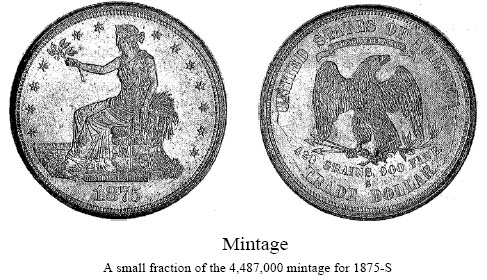
Coinage Context
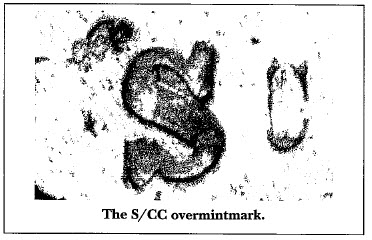
Mintage unknown: The 1875-S/CC was included as part of the regular 1875-S mintage, and no separate Mint records exist concerning its production. For some reason at least two Carson City reverse dies of the Type I style, with tall CC letters, had the CC mintmark partially effaced and overpunched with an S mintmark.
Numismatic Information
Discovery of the variety: This issue was generally unknown to numismatists until the early 1960s. One of the earliest market appearances of the variety was in New Netherlands Coin Company's sale of December 10-11, 1963; a coin described as follows:
1875-S over CC. Brilliant Unc.; magnificent light iridescent toning. Unfortunately, this otherwise beautiful piece has some scattered pitting in the r. obverse field, where corrosion was removed. The reverse, however, is virtually free of defect, unless we mention the couple of microscopic pits which are only discernible under a good lens, and a hairmark (as made, of course), Undoubtedly the sharpest of the three specimens verified, and the only one which has not seen circulation. Judging from the meteoric rise of the 1938 Dover S nickels (of which many thousands exist), this interesting blunder should be worth a high three-figure price. The second C is visible to the right of the S, and the small oval back of the first C to the left of S. The CC mintmark can be clearly seen with the naked eye, and a 10x lens further discloses that the S has been double-punched; the first figure tilts slightly to the r. and is clearly visible, pecking out from behind the lower serif and in front of the higher one. This variety was discovered by Texan Bob Medlar, and then authenticated by our firm. Don Taxay illustrated Medlar's piece on p. 184 of his recent book, (QDB note: Counterfeit, Mis-struck and Unofficial US. Coins, Arco Publishing Co., 1963; there called unique. In his Encyclopedia, p. 468, Walter H. Breen credits the discovery to C.H. Farrar, who published the variety in the Numismatic Scrapbook, February 1965-but this was two years after the citation given here.) and that plate is reproduced in this catalogue. The second specimen, found by Hank Bieciuk of Kilgore, Texas, was illustrated in Coin World, May 31,1963, and was simply described as having been cleaned before the discovery could be made. A couple of others have been reported. [Price realized: $250.]
In 1962-3, the 1875-S/CC overmintmark was considered to be a great rarity, but over a period of time (QDB note: Counterfeit, Mis-struck and Unofficial US. Coins, Arco Publishing Co., 1963; there called unique. In his Encyclopedia, p. 468, Walter H. Breen credits the discovery to C.H. Farrar, who published the variety in the Numismatic Scrapbook, February 1965-but this was two years after the citation given here.)additional specimens came to light. Today, it is considered to be moderately scarce in lower grades and quite rare in Mint State. As it is the most significant die variety in the trade dollar series, apart from regular dates and mintmarks, the 1875-S/CC is highly prized in all grades. All seen are Type III.
In Mint State, the 1875-S/CC is considered to be slightly rarer than the famous 1878-CC, although I suspect that at least a few Mint State 1875-S trade dollars are unattributed 1875-S/CC coins. Hence, I expect that the relative rarity of this issue will decline slightly (the variety will be recognized as more common as more are discovered) as years pass. Most likely the majority of these will be late die states showing only faint traces of the CC.
Chopmarked pieces exist in various grades, including a Mint State coin handled by Bowers and Merena Galleries, Inc. in 1992.
Circulated grades: In grades from VF-20 to AU-58 the 1875-S over CC is fairly scarce. I estimate that about 200 to 400 are known. However, I believe that more will come to light as years go on, especially among chopmarked pieces. In an interview, Douglas Cass told me that it was common in the early 1980s in visits to Hong Kong to find unattributed 1875-S over CC chopmarked trade dollars offered as 1875-S.
In John Willem's lifetime, chopmarked coins were considered rare. Note: In Henry Christensen's sale catalogue for the John M. Willem Estate Collection, sold on September 5, 1980, Lot 724 was a chopmarked 1875-S/CC, with this notation: "Very rare with chopmarks." While today in the early 1990s the view has changed, still there is much research to be done on the availability of other chopmarked issues in the trade dollar series.
Mint State grades: In certified MS-65 grade the coin is currently unknown. However, I would not want to bet that one or more won't be discovered as "regular" 1875-S trade dollars, a readily available issue, are examined for this feature. In MS-64 condition, about 4 to 7 are known today, while about 5 to 8 are known to exist in MS-63, and perhaps 50 to 75 at lower Mint State levels.
Varieties:
OBVERSE TYPE I: RIBBON ENDS POINT LEFT, 1873-1876
REVERSE TYPE I: BERRY BELOW CLAW, 1873-1876
1. 1875-S/CC Large S: Breen-5792. Scarce. CC mintmark more or less centered below S. The variety usually seen. All examined are from an extensively cracked die.
2. 1875-S/CC Large S: With CC far to the right of the S. Much rarer than the preceding. Differently cracked reverse die. Reported by Bruce Amspacher; listed by Walter Breen (Encyclopedia:5972, notation); not seen by the author. Very rare. (See "Bruce Amspacher's Discovery" under Additional Information below.)