Silver Dollars & Trade Dollars of the United States - A Complete Encyclopedia
Q. David Bowers
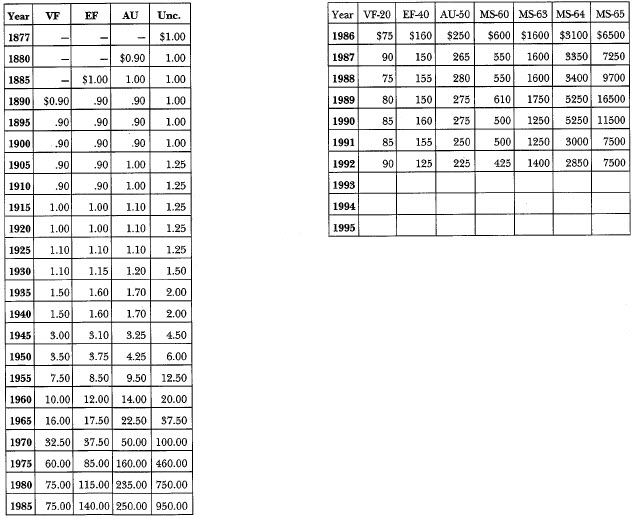
1877-S Trade Dollar: Market Values
1877-S: Summary of Characterstics
Business Strikes:
Enabling legislation: Act of February 12, 1873
Designer: William Barber
Weight: 420 grains
Composition: .900 silver, .100 copper
Melt-down (silver value) in year minted: $0.9457 Dies prepared: Obverse: 42; Reverse: 32. According to R.W.Julian, six obverses were ordered on November 24, 1876; six pairs were ordered on another date in November 1876; 18 obverses and 8 reverses were sent from Philadelphia on December 21, 1876 (apparently, all for 1877); 24 "dies of the best quality steel" were ordered on July 19, 1877.
Business strike mintage: 9,519,000. Delivery figures by month: January: 1,082,000; February: 863,000; March: 837,000; April: 876,000; May: 1,129,000; June: 312,000; July: 762,000; August: 1,329,000; September: 1,275,000; October: 481,000; November: none; December: 573,000. The die records may be incomplete; 42 obverses averages out to an extremely high 226,642 per die-pair.
Approximate population MS-65 or better: 50 to 100+ (URS-)
Approximate population MS-64: 170 to 325+ (URS-9)
Approximate population MS-63: 300 to 600+ (URS-10)
Approximate population MS-60 to 62: 1,750 to 3,500+ (URS-12)
Approximate population VF-20 to AU-58: 50,000+ (URS-17)
Characteristics of striking: Usually seen well struck. However, among large mintage issues such as this there are many variations in striking quality. Some have a prooflike surface, especially on the obverse.
Known hoards of Mint State coins: None
Rarity with original Chinese chopmark(s): Extremely plentiful. Most common of all chopmarked trade dollars.
Proofs:
None
Commentary
1877-S is the highest mintage trade dollar and is the most common in all circulated grades, including chopmarked coins.
Additional Information
"1877-S II/I" Trade Dollars
From time to time a report surfaces about an 1877-S trade dollar with Type II obverse and Type I reverse. A specimen furnished for study by Larry Hylton is described as follows: Broken upper left serifs to E(S), (O)F, ME I. Large open S on reverse. 426.6 grains (abnormally heavy); ring somewhat dull, not prolonged or sonorous, not a box dollar.
A Type II/I specimen owned by Col. Eugene P. Wilson was reported decades ago but not seen by John M. Willem or Walter H. Breen (cf. Willem, p. 175); die description unknown. John Lazirko (Lazirko, p. 36) reports that an 1877-S Type I observed was a struck counterfeit.
Any authentic 1877-S II/I trade dollar (should one ever be found) is an anomaly, struck using a reverse die left over from an earlier year; an authentic piece in AU or Mint State grade should weigh within close tolerance of the authorized 420 grains, as the mints were very particular about the quality of trade dollars (for they were being sent to China, where weight and fineness were all-important). A specimen in EF grade should weigh in the range of 117 to 118 or so grains.