Silver Dollars & Trade Dollars of the United States - A Complete Encyclopedia
Q. David Bowers
Varieties:
OBVERSE TYPE I: RIBBON ENDS POINT LEFT, 1873-1876
REVERSE TYPE I: BERRY BELOW CLAW, 1873-1876
Business Strikes:
1. Normal serifs: Breen-5778. Reverse with normal serifs. Most specimens known today are chopmarked.
2. Broken serifs: Breen-5779. Reverse with broken serifs at E (of STATES) and F (of OF) from hub damage. Others may exist with additional broken letters. Most specimens known today are chopmarked, This same hub was used to create Proof dies (see Proof No. 2 below).
Proofs:
1. Normal reverse: Breen-5778. Normal reverse (in contrast to No.2). One in the Katen Sale of June 1993, Lot 91, had flatness on the eagle's sinister claws; areas of unfinished surface at the junctions of the olive leaves, and between the olive leaves and the eagle's tail, also between the branch and the eagle's sinister leg; a whisper of a hairline crack extends from the right curve of R in TRADE horizontally to the adjacent A.
2. Patched letters reverse: Reverse from a die created from a damaged hub (also see Business Strike No.2 above) with the following characteristics: (A) Early state. Small raised fragment inside D of UNITED, attached to the right interior side just above the halfway point; tops of E in STATES and F in OF patched (visible only under high magnification, but very distinctive; the E's in UNITED and AMERICA are from different punches). Many raised die preparation lines in field, particularly at the bottom of the eagle and below it. Narrow area between eagle's tail and eagle's dexter leg not polished (compare this to 1875 Proof Reverse No.2, which has this polished). Most known 1873 Proofs are from this early state and are more deeply mirrored than Proofs from the later state. (B) Later state with die surfaces repolished. Letter characteristics as preceding, but die preparation lines polished off the die. New die lines, probably causedby the slip of an engraving tool, consist of two minute, closely parallel die scratches from the branch stem, through lowest arrow butt, through 00 (of 900), changing to just one scratch from that point to the rim between A and R of DOLLAR, and with shorter die scratches on the raised rim above ED (of UNITED) and the space to the right. This later state of the reverse was polished again (thus slightly diminishing the depth of the .die scratches) and was also used to coin Type I reverse trade dollar Proofsdated 1874 and 1875. Discovered by Jesse Patrick (see expanded commentary under Additional Information below). All impressions from this die show seen by the author show weak striking on the eagle's sinister leg and claws. 1873 obverse shows slight "chip" out of the outside of the left upper curve of 8 in 1878.
Note: So far as is known, Proofs of the varieties described above under nos. 1 and 2 are all from a common obverse die. There is a fairly deep die scratch extending straight from the bottom left segment of the bale, at an angle slightly upward through the folds of Miss Liberty's gown, terminating in the waves of the sea. Although this prominent feature has been ignored for many years, it was mentioned by Lyman H. Low in the description of an 1873 Proof trade dollar in the R.T. Rose Collection Sale, September 9-10, 1909: "A distinguishing feature of this specimen is a well defined line (in the die) through the outer skirt of Liberty, extending from the cotton bale to water."
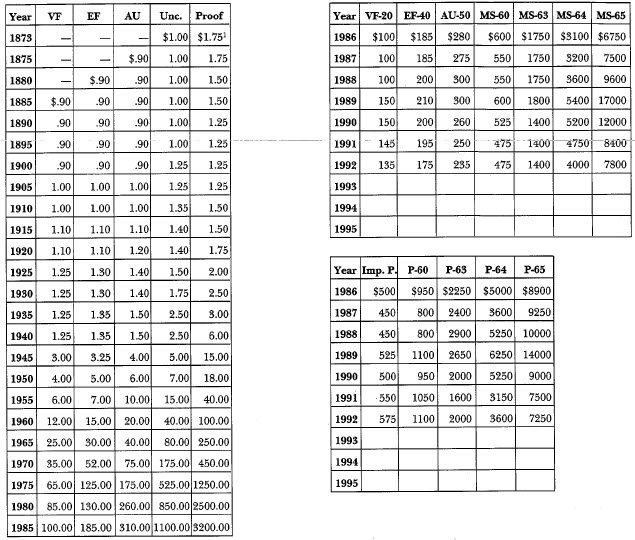
1873 Trade Dollar: Market Values