Silver Dollars & Trade Dollars of the United States - A Complete Encyclopedia
Q. David Bowers
1876-CC Trade Dollar
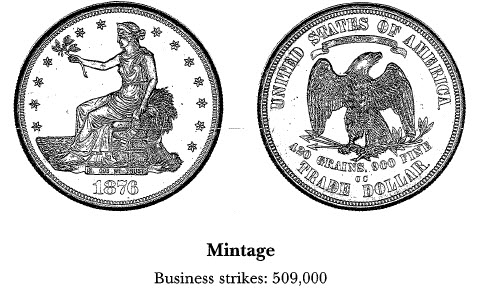
Coinage Context
Production halted early in year: The Carson City Mint started the year 1876 with 216,000 pieces struck in January, a generous figure. However, the amount declined to 80,000 in February, rose slightly to 85,000 in March, and continued to 128,000 in April, totaling 509;000 at which point coinage ceased for the year.
Numismatic Information
Circulated grades: In circulated grades from VF-20 to AU-58 the 1876-CC is somewhat scarce, though not rare. An estimated 1,500 to 2,500 coins exist, enough that anyone seeking a specimen can locate a satisfactory piece in relatively short order. A survey of eight coins (admittedly, a small sample) conducted by Mark Borckardt in 1992 found one of the I/I type and seven of the I/II.
Chopmarked pieces are somewhat scarce, with the Type I/II being the issue usually encountered.
Mint State grades: At the MS-65 level the 1876-CC may be unknown. In any Mint State grade it is a rarity. I estimate that just 2 to 4 MS-64 coins, only 5 to eight MS-63 pieces, and only 20 to 40 MS-60 to 62 specimens survive. These estimates are based upon conversations with specialists, printed population reports of certification services, and my own observations. As the rarity of the 1876-CC in Mint State is not widely known, certain professional numismatists and others have felt that it is not hard to find. For this reason, the population estimates I give in this book may err in being too liberal. Mint State coins may be even rarer than I say!
Considering all Mint State grades combined, the 1876-CC is the rarest of all trade dollars, and even outranks the famous 1878-CC. Any Mint State example of the 1876-CC is a rare prize. It is worth noting that the three coins in John M. Willem's personal reference collection were EF, EF, and AU.
In his 1980 study! Maurice Rosen stated that in years of looking he had seen only two 1876-CC trade dollars which he could truly describe as being in Mint State. Most pieces described as "Uncirculated" in dealers' offerings weren't. He noted that in a 1977 auction a "Brilliant Uncirculated" piece, so described, was graded by him as only EF-45, heavily bagmarked, and with scratches!
Bruce Amspacher reported this:" "I have asked many veteran dealers about this date, and almost without exception they state that they have 'never seen a nice one."
Varieties: The 1876-CC exists in types I/I and I/II, with Type I/I believed to be the scarcest.
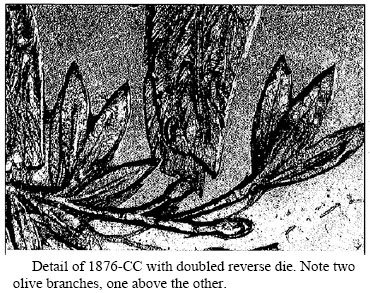
Doubled reverse die: Of all of the various die repunching, doublings, etc., in the trade dollar series, the 1876-CC I/I with doubled reverse die takes the cake as a mint gaffe. However, the 1876-5 II/II with doubled obverse die gives it a close run for the money.
Of the 1876-CC error, Bill Fivaz writes.(Letter to the author, November 30, 1991; another, January 29, 1992, contained additional data.)
This is probably the strongest and most widely spaced doubled die known in any series. The reverse die shows dra-matic doubling on the eagle's left wing (on the right side of the coin), the branches, berries, leaves, and much of the lettering. While not exceedingly rare, once you've found one, this scarce variety is very marketable due to the strength of the doubling. (This is not the doubled reverse die of 1875-CC.)
Known examples include the following:
1.Jack Beymer, discovery coin; VF-30. described by Dr. John W. McCloskey and illustrated in The Gobrecht Joumal; November 1984
2. Jeff Oxman.
3. Lloyd White.
4. Bill Fivaz, EF.
5. Bill Fivaz, AU; described in Coin World May 24, 1989, p.74.
6. Jack White, AU, with five chopmarks,
7. New England Collection, EF, chopmarked,
8. Leroy C. Van Allen Collection; sold into a New England collection 6/92, AU.
9. Bert A. Schlosser, EF cleaned, received on 6/4/92 from a Coin World, advertiser who listed it as a regular (not doubled die) coin.
10. Larry Comer Collection, EF-40.
11. Several others have been reported.
Some of the preceding listings may represent duplications. To date, all specimens reported to me have been in circulated grades.
Varieties:
OBVERSE TYPE I: RIBBON ENDS POINT LEFT, 1873-1876
REVERSE TYPE I: BERRY BELOW CLAW, 1873-1876
Business strikes:
1. Micro cc (a.k.a, Wide cc): Breen-5804. Mintmark .74 mm high; 1.2 mm spacing between C's. Quite scarce, An MS-63 coin is in the Dr. James
A. Stiles Collection.
2. Medium CC: Mintmark 1.1 mm high; .5 mm spacing between C's.
3. Tall CC: Breen-5805. Scarce. Minor varieties, apparently from leftover 1875-CC dies (Breen- 5796).
Note: One Mint State 1876-CC I/I trade dollar seen by the author, mintmark size not recorded, had a large patch of unfinished die area surrounding the eagle's sinister wing tip.
4. Tall CC. Doubled reverse die:(See: McCloskey, John W. "A Doubled Die 1876-CC Trade Dollar." The Gobrecht Joumal, November 1984.) Breen-5805A. Fivaz & Stanton $1014. Presently extremely rare. Spectacularly doubled in areas, a feature most no-ticeable on the olive branch (especially above IN of FINE) and on the motto E PLURIBUS UNUM. The VF-30 discovery coin was shown at the 1984 ANA Convention by Jack Beymer. Each C in the mintmark measures 1.2 mm high by 0.8 mm wide.
OBVERSE TYPE I: RIBBON ENDS POINT LEFT, 1873-1876
REVERSE TYPE II: NO BERRY BELOW CLAW, 1875-1885
Business strikes:
1. Medium CC: Mintmark 1.1 mm high; .7 mm spacing between C's.
2. Tall CC: Breen-5806. Mintmark 1.17 mm high; .5 mm spacing between C's. Minor varieties. Very common, but usually seen in low grades. Very few seen Uncirculated. Compare Norweb:1531.
More chop marked coins survive of Type I/II than of Type I/I.