Silver Dollars & Trade Dollars of the United States - A Complete Encyclopedia
Q. David Bowers
1874 Trade Dollar
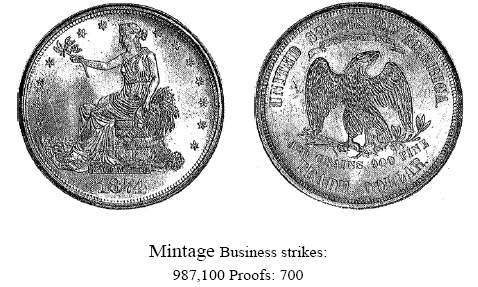
Coinage Context
Unusually high production of business strikes: With a production of 987,100 business strikes, the 1874 was struck in large quantities for a Philadelphia Mint trade dollar, considering that Philadelphia was the most distant of all mints from 'the Orient. In fact, this coinage figure remained the high-water mark for Philadelphia until the record coinage of 1877 (3 million+).
Most of the business strike mintage occurred early in the 1874 year and throughout the summer. None was coined from October through December. Nearly all of the 1874 mintage was shipped to the Orient.
Numismatic Information
Common with chop marks: As nearly all coins were shipped to China, most were melted there or elsewhere in the Orient or at the Calcutta Mint (to which location Chinese interests shipped many coins). However, enough remained in circulation in Chinese ports over the years that many coins were counterstamped. Today, the 1874 is the most common Philadelphia Mint counters tamped coin and is even more plentiful than the higher-mintage 1877.
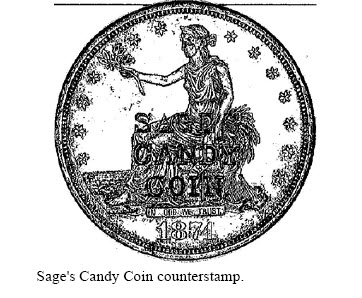
An unusual counterstamp: Many United States coins dated 1874, of the quarter dollar, half dollar, and trade dollar denomination, were counter-stamped on the obverse with the inscription in three lines, SAGE'S / CANDY / COIN. It is not known if these were premiums included in candy boxes, or whether they simply advertised a product known as Sage's Candy; nor are the identity and location of the issuer known. Inasmuch as this is the only American merchant's counterstamp known to have been issued in quantity on trade'dollars, I mention it here. About four to six specimens are known to exist.
Circulated grades: In circulated grades the 1874 is on the scarce side, especially in comparison to its San Francisco Mint contemporaries. I estimate that about 2,500 to 4,500 or so exist in grades from VF-20 to AU-58.
Mint State grades: As might be expected from the lack of extensive domestic circulation within the United States, the 1874 trade dollar is rare today in Mint State. The mintage was large enough that some survived by chance, including unchopmarked pieces in the Orient, but by and large, Mint State coins are hard to find. At the MS-65 level I estimate that perhaps six to 10 coins survive, while in each of the MS-64 and 63 categories, the population is more on the order of 50 or so to 100, with MS-64 coins being a bit scarcer than MS-63 examples.
In grades from MS-60 to 62 I believe that about 150 to 250 exist, which by any standard makes the issue a rarity. If this were a Morgan dollar, it would sell for tens of thousands of dollars in MS-60! Pssst! Don't tell anyone-trade dollars are bargains! (Which reminds me to quote the caption under Bruce Amspacher's photograph on p. 636 of John Highfill's Encyclopedia: "Well, tell me the truth, aren't trade dollars fascinating?"
Proofs: Proofs were struck to the extent of 700 coins, produced as follows: January: 100; February: 200; March: 100; April: 100; May: none; June: 100; July: none; August: none; September: 50; October: none; November: none; December: 50. It was customary in December to strike a few additional pieces to keep on hand until the end of the year.
Typically, on January 1st of the following year a small supply of Proofs was in inventory. Sometimes these were wholesaled to Philadelphia and New York dealers for face value. However, on January 9, 1875, 175 unsold Proofs were released for face value and, presumably, went to coin dealers. Some, possibly all, 1874 Proofs have bold, wide rims.
Apparently, most were sold as part of 1874 silver Proof sets, and deliveries by months match other silver Proof coins of the year. (Walter Breen's Encyclopedia of u.s. and Colonial Proof Coins, p. 150. 2 In his chapter in John Highfill's Encyclopedia, p. 635.)
Although 700 may have been distributed to numismatists, the rate of retaining them was not high, and today hundreds of pieces have been lost. These pieces were simply spent for face value, as was also the case for many 1873 Proofs-accounting for the impaired Proofs occasionally seen today. On the numismatic market the 1874 Proof is very undervalued. Bruce Amspacher commented as follows:" "The rarest of the non-clandestine [i.e., 1884 and 1885] issues in gem condition. Most known specimens are heavily impaired."
In my opinion, the two rarest Proofs of the 1873-1883 era are the 1873 and 1874, with the former being the slightly rarer of the two.
Varieties:
OBVERSE TYPE I: RIBBON ENDS POINT LEFT, 1873-1876
REVERSE TYPE I: BERRY BELOW CLAW, 1873-1876
Business Strikes:
1. With normal serifs: Breen-5782.
2.With broken serifs: Breen-5782. Some business strikes are from reverses showing broken serifs partly repaired by hand. It is unknown if these are rarer or more common than those with normal serifs or unrepaired broken serifs.
Proofs:
1. Normal issue: Breen-5782. Perfect reverse die.
Reported by Walter Breen. Rarer than the following.
2. Patched letters reverse: Some Proofs have the reverse No. 2 of 1873 (also used on some dated 1875); now, the arc scratch no longer extends all the way to border, and rust marks show between E and P in E PLURIBUS UNUM. Most seen are of this variety.
Note: In Henry Christensen's sale catalogue for the John M. Willem Collection, sold on September 5, 1980, Lot 700, a Proof has this notation: "Shows the diagnostic peripheral die crack."