Silver Dollars & Trade Dollars of the United States - A Complete Encyclopedia
Q. David Bowers
1876-S Trade Dollar: Market Values
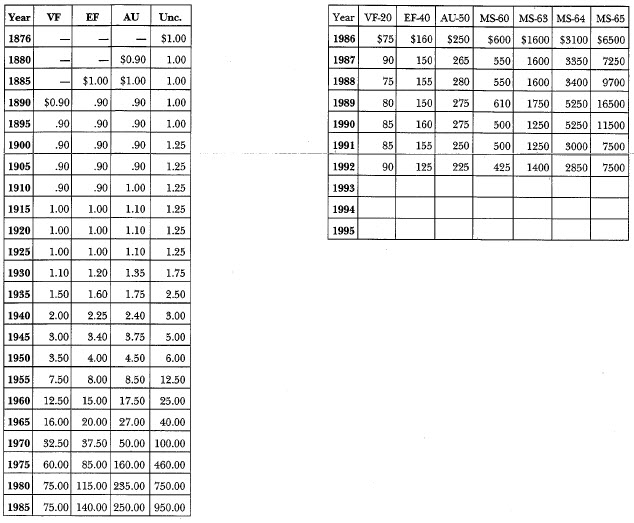
1876-S Trade Dollar: Summary of Characteristics
Business Strikes:
Enabling legislation: Act of February 12, 1873
Designer: William Barber
Weight: 420 grains
Composition: .900 silver, .100 copper
Melt-down (silver value) in year minted: $0.9101
Dies prepared: Obverse: Unknown; Reverse: Unknown:
Business strike mintage: 5,227,000. Delivery figures by month: January: 342,000; February: 410,000; March: 706,000; April: 385,000; May: 318,000;
June: 123,000; July: 127,000; August: 473,000; September: 450,000; October: 465,000; November: 545,000; December: 883,000.
Approximate population MS-65 or better: 20 to 40+ (URS-6)
Approximate population MS-64: 100 to 200+ (URS-8)
Approximate population MS-63: 175 to 300+ (URS-9)
Approximate population MS-60 to 62: 900 to 1,800+ (URS-11)
Approximate population VF-20 to AU-58: 25,000+ (URS-16)
Characteristics of striking: Usually well struck.
Some have evidence of light striking at the top of the obverse and at the eagle's sinister leg on the reverse. Among large mintage issues such as this there are many variations in striking quality.
Known hoards of Mint State coins: None
Rarity with original Chinese chopmark(s): Types II I and II/II are both common; I/II is rare.
Proofs:
None
Commentary
A common issue in all but the highest grades. More research needs to be done with minor die varieties.
Additional Information
A Glut of Trade Dollars
The American Journal of Numismatics, April 1876, reprinted the following newspaper commentary from the San Francisco Chronicle:
"The new trade dollar is fast becoming a drug in the market. Our banks and money-broker offices are becoming glutted with them. Their greater intrinsic value as well as their novelty threatened for awhile to crowd the familiar half dollar and the handy quarter out of sight.
"Chinamen remitting their hard-earned savings to their far-distant land would have nothing but trade dollars. (A reference to Chinese who had come to the United States to be laborers on railroads and other projects, and who sent part of their wages back home.) Oriental commerce was, and still is to a large extent, conducted on the solid basis of this bright, new and ringing silver representation of value.
"But the Orient, like San Francisco, is beginning to find that it is possible to be surfeited with even so much coveted a treasure as the trade dollar. The result is that reaction has set in against that coin in this market, and it no longer enjoys a preference over other silver. On the contrary, although a trade dollar is intrinsically worth eight cents more than two half dollars, the two halves will sell in the street from a half to three-quarters of a cent more than the dollar. The reason for this is primarily because of the super abundance of the latter. But there is another reason which is not generally understood. Halves and quarters of the United States are a legal tender forall payments up to a certain amount; the trade dollar is not a legal tender at all for any amount." It is merely a stamped ingot, having a certain value, like an ounce of gold, a diamond, or a bushel of wheat. It is a commodity, the value of which fluctuates according to the supply and demand."