Walter Breen's Encyclopedia of Early United States Cents
Walter Breen
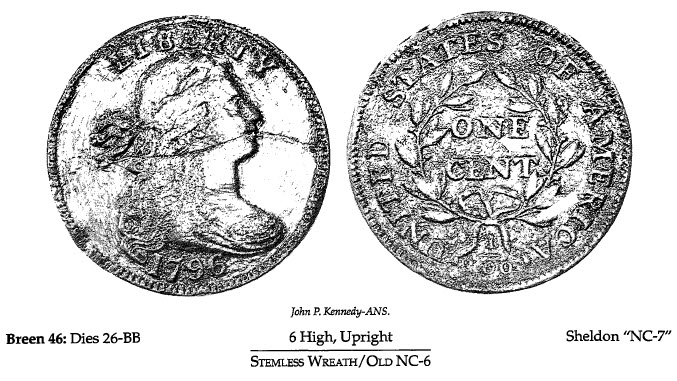
Obverse 26. In the date, 6 is high but is not leaning to the left, unlike other close curved date obverses.
Reverse BB. Stemless wreath. Die of 1797 numbers 26,31.
Die states. See Remarks.
Equivalents: Called ''NC-6'' in Early American Cents; delisted in Penny Whimsy. Clapp-Newcomb 34.
Rarity 8. Not quite three known.
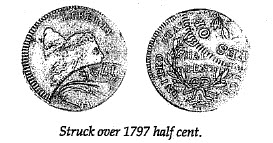
Remarks: Discovered by John P. Kennedy, 1928. (First mentioned in The Numismatist 6/1928, p. 351; first ill., Numismatist 8/1928, p. 462.) The second example was discovered in October 1994 by Mark Borckardt. This specimen was struck 65% off-center, then cut down and struck with dies for a 1797 half cent, Breen- 3a, including a lettered edge. (This second example initially generated considerable controversy over the sequence between the large cent and half cent strikes. Mark Borckardt incorrectly argued that the half cent was struck first. However, Chris Pilliod, a metallurgist by trade, offered a definitive explanation of why the large cent strike had to have come first. See Penny-Wise, no. 168, 5/15/1995, pp. 151-155. Recently, in early 1999, the Gallery Mint Museum made reproductions of this overstrike, clearly defining the original circumstances surrounding this emission.)
The discovery example has had its obverse so drastically retooled as to result in Sheldon's condemning it as an alleged alteration from 1797 number 31. In Penny Whimsy, Sheldon said he had listed this piece "as a gesture of deference to Mr. Clapp, who had included it in his own excellent monograph."
However, there was reason to reopen the question of the coin's genuineness. When I [Walter Breen] was studying the ANS cent collection during preparation of the present section, I found-to my surprise-that there is no way in which any such alteration could have been made from 1797 number 26 or 31: the spacing of LIBERTY, and the positions of date and BERT with respect to the device, differ greatly from their 1797 counterparts; and Sheldon's conclusion that an entirely new bust, LIBERTY, and date were imparted does not sustain critical examination: letters and numerals are of correct form. The piece is certainly die-struck, not made by cementing the obverse of one variety to the reverse of another. The layout of this obverse is nearest to obverses 17 and 25, less like 15, 22, and 24, though not identical to any. Even if the "die break" were a creation of Billy Sunday (William Sunday spent many years working on large cents, removing corrosion and defects. See Half Cent Encyclopedia, p. 80n.) (or whoever tooled the corrosion away), the combination still is a new variety.
In November 1994, Mark Borckardt met Denis Loring and Dr. John Kleeberg at the ANS with the second example, for side-by-side comparison. During this examination Denis noted that the date area of the discovery specimen was not tooled and its surface texture was an exact match to the reverse. This feature provides proof that the obverse was not ground down and re-engraved, per Sheldon's theory. The sub-standard weight is easily explained by the obverse tooling.
Condition Census:
F-15 Sharpness of VF-30 but porous. Struck 65% off-center,cut down, and overstruck by dies for a 1797 Lettered Edgehalf cent, Breen-3a. Discovered by Mark Borckardt when consigned unattributed to Bowers and Merena, 10/17/1994
• Bowers and Merena 3/1995: 2307 $30,800 • John Whitney.
G-6 Sharpness of VF-30 but rough surfaces and the obverse heavily tooled including a curved die crack from K3 to K9.
Discovered in March 1928 by George H. Clapp in the collection of John P. Kennedy (described by Clapp in The Numismatist, Vol. XLI, p. 351, 1928) • B. Max Mehl, privately • Col. E. H. R. Green • B. G. Johnson (St. Louis Stamp & Coin Co.), 4/17/1946 • George H. Clapp. ANS. Obverse illustrated in Clapp-Newcomb and in Early American Cents. This coin was believed by Sheldon, and others, to be a "fraudulent" coin, however, the existence of part of another specimen proves otherwise. AG-3 Purchased unattributed by Rod Burress early in 1999 and sold later the same year to Daniel W. Holmes, Jr.