Walter Breen's Encyclopedia of Early United States Cents
Walter Breen
1796 Liberty Cap Table of Equivalents
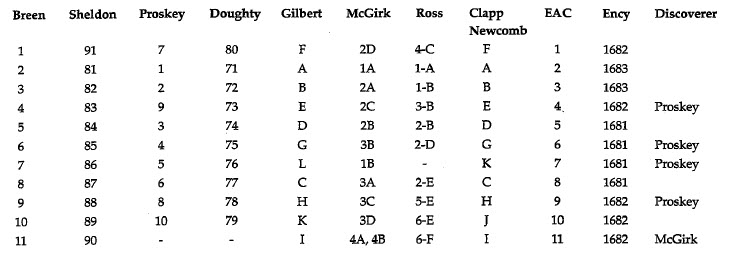
1796
Draped Bust Design
When Henry William DeSaussure replaced the ailing David Rittenhouse, one of his main goals as the new director of the Mint was to improve the designs of all silver and copper denominations, to replace Robert Scot's flowing hair concept. According to tradition, DeSaussure commissioned the illustrious portraitist Gilbert Stuart to furnish a sketch (now lost) representing Liberty for the silver coins. This was completed in Newport, Rhode Island, in August or early September 1795. Stuart's model was the socialite Mrs. William Bingham (Ann Willing). Silver and gold coins had top priority. Scot did not get to the new Draped Bust or "Fillet Head" device punch for cents until some time in spring or early summer of 1796. (Harry Salyards, 5/14/95 note to the editor: "This is legend upon legend upon legend. The scanty store of known facts is no better summarized than by R.W. Julian, p. 40 of Silver Dollars and Trade Dollars of the United States: A Complete Encyclopedia. Nor does Julian's conclusion that 'the Stuart descendant would thus have had little incentive to fabricate a story' ring true to me: he would have had every incentive, and few collectors to potentially contradict him." R.W. Julian, 11/1/95 note to the editor: "It is doubtful if the matter was kept secret; there was no interest in such matters until the rise of coin collecting. I personally doubt that DeSaussure, who knew few people in Philadelphia, had anything of substance to do with the design change except to carry out instructions from the President. The name of the 'model' is highly speculative." Further from R.W. Julian: "DeSaussure almost certainly did not inititate the change. Stuart probably suggested this to President Washington.) Mason's Coin and Stamp Collector's Magazine, December 1867, quoted a Mint official to the effect that the change occurred in July 1796; this information most likely originated with Adam Eckfeldt, and surely alludes to the time when Eckfeldt himself raised the new device punch from Scot's original die, and sank the first working dies from it. (Editor's note: I have reviewed the reference to Mason and note that he mentioned the appearance of the new design in July 1796, however, I cannot find a quote from any Mint official in this regard.)
The name "Fillet Head" alludes to the prominent ribbon behind the head, and was probably devised in Victorian times as a respectable avoidance of so suggestive an epithet as "Draped Bust." (Doughty, p. 38, names each as potential terms for the type, and adds that "Draped Bust is certainly to be preferred.") Webster's New International Dictionary, 1956, lists "fillet head" as a nickname for cents of 1796-1807, but does not label the phrase as a technical term of numismatics. The name "fillet head" recurs in coin auction catalogues as early as the 1860s. I do not recall an instance of the phrase "Draped Bust" earlier than Frossard's Monograph of 1879. Alexandre Vattemare (Collection de Monnaies et Midailles de L' Amerique du Nord de 1652 + 1858. Paris: Bibliotheque Nationale, 1861, p. 25.) repeated a preposterous old rumor that the model for the Draped Bust coins was Pocahontas.
Probably because the design, as translated into coin dies, had lost whatever subtlety it originally possessed, Stuart's family did not publicize the story for decades. Mint Director James Ross Snowden first published it as an aside in his A Description of the Medals of Washington:
The head of Liberty, on the dollar of 1795, was designed by Stuart, the celebrated portrait painter, at the request of the Director, as we learn from a relation of the family; Stuart facetiously remarking that 'Liberty on the other coins had run mad' -referring to the disheveled hair on the head of Liberty on the previous coins-'we will bind it up, and thus render her a steady matron. (Philadelphia, 1861, p. 177. Single quote marks added for clarity.)
"Engraved renderings of mad scenes in plays (e.g. Ophelia's in Hamlet) and operas by the hundreds, one and all, agreed on representing their madwomen as disheveled: a matron leaving her hair unbound was interpreted as having been driven to this departure from respectability by madness-nothing else would account for it, then even as in ancient Rome." (Half Cent Encyclopedia, p. 195n.) Note that the Carlisle Pollock diatribe of 1796 against Scot's coin designs referred to them as depicting "an Idiot with flowing hair."
According to Julian (R.W. Julian has been unable to locate a source for the information to follow.) Scot completed a batch of working dies for cents during the first week of October 1796. These were probably begun no later than early July. The eight "Type of 1795" reverses with single terminal leaves (see General Description, below) were most likely completed months earlier, as were the three "Type of 1794" reverses. Some of the "Type of 1797" reverses were made later, being first used with obverses dated 1797.
After the May 1796 deliveries exhausted the Mint's remaining stock of cent planchets, there were only five more purchases of copper through the end of the year: (Table after Julian, "The 1796 Copper Coinage," Numismatic Scrapbook Magazine, October 1965, p. 2720.)
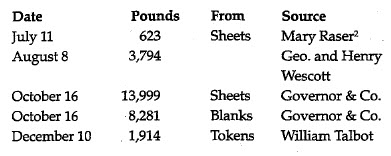
2. (Stewart, History of the First U.S. Mint, pp. 72-73, spells this name Roser.)