Walter Breen's Encyclopedia of Early United States Cents
Walter Breen
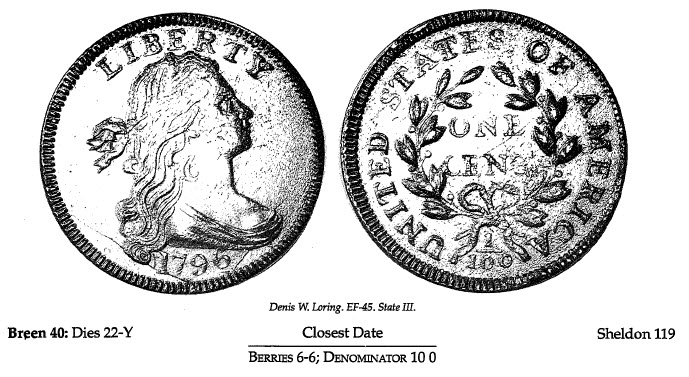
Obverse 22.
Reverse Y. Six berries on each branch, as on the preceding, but the layout is more typical for the type: a leaf is below D, not a berry. Fraction is skewed to the left, especially the numerator. Wide denominator spaced 10 0 with the final zero slightly high. Centers of leaves are not well brought up.
Die states: I. Obverse cracked from the left rim to, and along, lower curl, through the bases of 17 to the rim, at first faint, later heavy. Another crack from the rim below 6 crosses end of the drapery into the field. Reverse crack joins two dentils above TA; another down through F A; a third joins the right top of (O)N to left foot of the adjacent E, then down to the left top of (N)T.
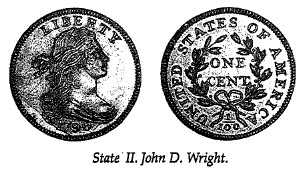
II. Plain double clash marks above and below the knot, before the face and at the throat.
III. Rim break above AT, eventually joining six dentils.
Equivalents: Proskey 18. Doughty 88? Gilbert 15.
McGirk 10A. Ross 14-K. Clapp-Newcomb 15. Sheldon 119.
EAC 40. Encyclopedia 1699.
Rarity 3.
Remarks: One of the three "Nichols Find" varieties. The others are 1797 numbers 5 and 12. Struck after 1797 number 12, on which variety this reverse appears in its earliest state.
Most of the high-grade survivors, possibly a few hundred in all, have long since vanished into date collections and type sets. Planchets are often partly or wholly prooflike though granular at their centers.
Condition Census:
The first of the varieties in the "Nichols Find" which, along with 1797 Sheldon 123 and 135, possibly numbered as many as a 1,000 Mint State 1796 and 1797 large cents according to Dr. Sheldon. These coins can supposedly be traced to a bag of cents bought in December 1797 directly from the United States Mint in Philadelphia by Benjamin Goodhue, a member of the Continental Congress, and later passed down to his daughters. The name "Nichols Find" was attributed to these coins in the 1860s when they were the property of the Nichols family and were disposed of by David Nichols of Gallows Hill, near Salem, Massachusetts.
Probably around 80 pieces of this variety now exist in or near Mint State, and grading one depends more on individual requirements than on technical ones. Most are M5-60, or slightly better, but it is doubtful that any exist which can be called better than M5-65, and possibly none meet the requirements of this grade. This variety is very rarely seen with original mint red color, unlike the two 1797 varieties.
Among the better examples seen are:
MS-61 Dr. William H. Sheldon, 10/1959 • A. C. "Hance" Jaquett, 1983 • Fred H, Borcherdt, MS-61 Dr. William H. Sheldon • ANS.
MS-61 Purchased over the counter by Morris Geiger, 1/1961 • Louis Helfenstein • Lester Merkin 8/1964: 9 $1,250 • Art Lovi • Stack's 9/1968: 9 $1,150 • unknown • 1971 ANA (Stack's): 8 $1,150 • unknown. Stack's 4/1983: 1037 $5,000 • John Whimey • Eric Streiner, 7/7/1992 • Dennis Mendelson, 4/23/1993 • Dr. Philip W. Ralls.
MS-61 Frederic W. Geiss • B. Max Mehl #109, 2/1947: 29 $167.50 • R. E. Naftzger, Jr. • A. Kosoff 10/1959: 33 $325 • Dr. J. Hewitt Judd • A. Kosoff ("An Illustrated History of United States Coins"), 1962: 32 not priced • Numismatic Enterprises 2/1966: 118 • R. E. Naftzger, Jr., 2/23/1992 • Eric Streiner, 5/1992. John Whimey. Obverse and reverse illustrated in Noyes.
MS-61 With minute planchet defects on both sides. Consignment "A" • Stack's 6/1968: 171 $800 • James c. Rawls • Stack's 6/1970: 819 $900 • Charles E. Harrison, 5/23/1996 • W. M. "Jack" Wadlington.