Walter Breen's Encyclopedia of Early United States Cents
Walter Breen
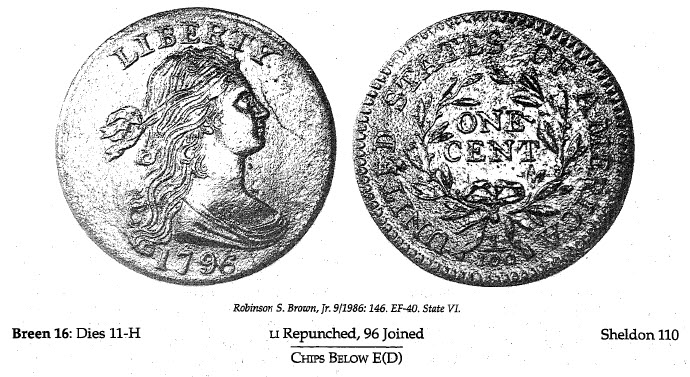
Obverse 11. Repunching on the left uprights of LI. R is repunched at the base, but this is hard to see on worn specimens. LIBERTY is closely spaced with IBE leaning a little to the right so that the base of each letter looks lower than its right hand neighbor. Tiny field chips before throat, the most obvious being close to the throat and nearer the chin than the bust. Apparently always has the crack joining 96.
Reverse R.
Die states: I. Crack joining 96. Reverse before grinding down. Reported although unseen and may not exist. (Penny Whimsy, pp. 171-72. Earlier, Clapp and Newcomb, pp. 29-30, stated they had never seen this die state.)
II. Reverse drastically reground, as in number 12, state V.
III. Cracked through the tops of RT, gradually extending through tops of adjacent letters.
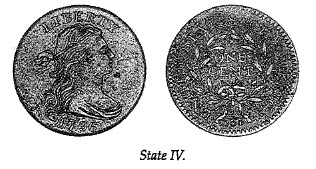
IV. Cracked through the tops of LIBERTY into the field at left. Cracked from the lower curl through lower part of the date.
V. Additional cracks from the rim across T to the forelock, and from the forelock past the face to rim, at first faint.
VI. New cracks from the rim to upper ribbon end and from the rim to throat.
VII. Rusted dies. The lump below E(O) becomes nearly half as large as the E. Break right of (ON)E. Triple reverse clash marks.
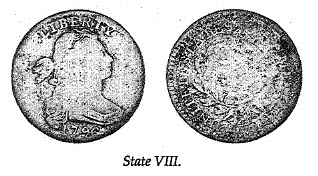
VIII. Rim break involving the tops of TY, extending 3 millimeters to the right. The lump at E is still larger.
IX. Additional cracks in the right obverse field and below the bust.
Equivalents: Proskey 19. Doughty 89. Gilbert 5. McGirk 12A. Ross 5-D. Clapp-Newcomb 5. Sheldon 110. EAC 16. Encyclopedia 1687.
High Rarity 2. The only nearly common variety of all 1796 Draped Bust varieties. Our number 34 is also relatively common.
Remarks: Often confused with the next, especially in low grades. These two obverses are very similar and were probably made on the same day. Positions of LIB are distinctive: on obverse 11 of numbers 16 and 19, bases of LI are about even, uprights are repunched, and IBE lean right; on obverse 12 of numbers 17 and 18, base of L is below I and I B E are much farther apart. Many are on concavo-convex blanks. For later use of this obverse, see number 19.
An example in the ANS (ex Wayte Raymond) has a clip at K-3:30. See "Oops!" chapter.