Walter Breen's Encyclopedia of Early United States Cents
Walter Breen
1796
Liberty Cap Design
(109,825)
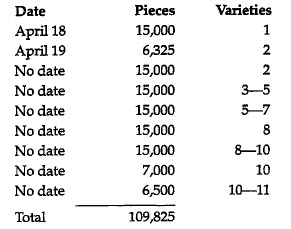
Scot's final Liberty Caps are confidently identifiable with the 109,825 coined in April and May 1796 and delivered between April 18 and about May 10. These exhausted the Mint's remaining blanks from scrap and clippings. No more copper arrived at the Mint until July 11. By then, Scot was already at work on the Draped Bust dies.
The following deliveries are recorded:
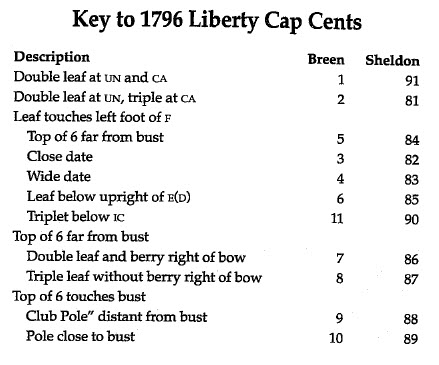
Scot made at least six obverse dies for the 1796 Caps. The exterior outlines of the device punch match the 1795 head, but the hair contours are different and the relief is higher. It is slightly more likely that Scot altered a 1795 matrix and had Adam Eckfeldt raise a new device punch from it, than that he merely reworked the hair and deepened the relief on each 1796 working die from the 1795 device punch. (Hair retouching is more obvious on these dies than on any 1795 obverse but less than on any 1794.) Whatever Scot's rationale, the net effect was that the heads are in too high relief, and central reverses are weak more often than not. Understandably, the 1796 Caps wore down quickly, far more quickly than the 1795s. Many pieces whose obverses grade Good or even VG have reverses so weak that attribution is guesswork. If the quantitative rarity ratings of the individual varieties are accurate, a total of approximately 2,400 to 2,500 survives lightly over 2.2% of the original 109,825 mintage: a condition recalling the 1793 Liberty Caps. This 2.2% survival proportion underlies both the ballpark mintage estimates
for each variety in the descriptions below and the tentative assignment of varieties to the deliveries in the table above.
Apparently to make his reverses look different from Gardner's 1795 dies, Scot gave them narrower leaves and dentils. The prototype sketch, greatly different from those of 1794 and 1795, served also for eight dies used with 1796 Draped Busts, all with those same narrow leaves and dentils. By comparing all 16 dies made from it, we can deduce something of the original appearance of the sketch. This must have shown the two branches nearly as mirror images: four pairs and a singleton outside, three pairs inside, and a single leaf at top. Extra leaves were added to make triplets on any or all of the three lower outside pairs and two lower inside pairs. There was no consistency about which pairs were made into triplets; some of the extra leaves are fragmentary. These 16 dies are the least standardized cent reverses after 1793. Thefirst one was used about March 1796 with a 1795-dated obverse, alias 1795 reverse D ("Type of 1796"), a month before any 1796-dated obverses went to press. Four of the initial eight reverses were reused with obverses dated 1797 and 1798 but not with the 1796 Draped Busts!
Only one reason comes to mind for Scot's replacing Gardner's 1795 head by his own higher relief one of1796: professional jealousy. Scot wanted nothing to remind him or anyone else in or out of the Mint that he ever had an assistant, lest he lose the engravership. For evidence that this view is no exaggeration, consider the following passage from John Lithgow's letter to Thomas Jefferson, December 24, 1804:
The coin of the United States has a wretched appearance after they have been a month in circulation, executed by Scot who has made an independent fortune [as a banknote plate engraver1 & who would [not] wish to employ Reisch [sic: John Reich] only from a fear that the excellence of his [Reich's] work would cause him [Scot1 to be supplanted. I have heard it said the other day, that it was a shame there was only one Republican [non-Federalist] officer in the Mint [Voigt] and that we should have such poor coin while we could command the talents of Reisch and do honour to the Jeffersonian Age. I wish that I had power I think I could provide a remedy for these evils without making the remedy equal to or worse than the disease, which is the only thing that ought to prevent a good man from following the bent of his benevolent intentions. I think Scot might be induced to give him a subordinate Situation-to give him part of the loaf with a view to securing the rest, as we poor people do with our Liberties.
For more about Reich, see the Classic Heads chapter. Physical specifications are officially as before.
Planchets are usually a little darker than on the plain edge 1795s. Diameter is normally 18/16" (28.6 millimeters); usual range 28 to 29 millimeters, though an example of number 2 in the American Numismatic Society measures 11/5" (30.5 millimeters). Not enough have been measured to ascertain if such extra broad specimens represent a sharply defined group. The variation in diameter may compensate for different thickness of strip and certainly represents a different diameter blank-cutter. Which blank-cutter? Most likely one intended for a medal; it was too large for the quarter dollar and too small for the half dollar or the $10 piece.