Walter Breen's Encyclopedia of Early United States Cents
Walter Breen
Mary Raser's copper may have served for the R stock half cents of 1797 while the Talbot, Allum & Lee tokens bought from William Talbot were rolled down and cut into half cent blanks (T stock). (R and T stock refer to Rolled copper and Tokens as source for half cent planchets. Half Cent Encyclopedia, pp. 140-141.)
Thomas Clifford (who had sold copper to the Mint in February 1796) recommended his father-in-law William Coltman's fum, The Governor & Company of Copper Miners, as a purveyor of wrought copper who could furnish ready-made planchets to the Mint's specifications. On March 1, Mint Director Boudinot ordered 10 tons of copper from this fum, part in plate or sheet form, part in planchets. The shipment arrived aboard the Rebecca on October 16. However, when the casks were opened, the blanks proved to be cupped (concavo-convex), almost as rough as cast iron, and discolored. On October 20, Boudinot complained to Coltman and refused to buy any more copper from the finn. The blanks had to be cleaned to render them usable at all and they went to press between about October 26 and November 20.
"Coltman" blanks are readily identifiable: the coins made from them have the border on one side rounded with missing dentils, clear dentils on the other side, and they normally come dark.
The following coinage delivery dates can be only seldom and approximately correlated with die varieties.
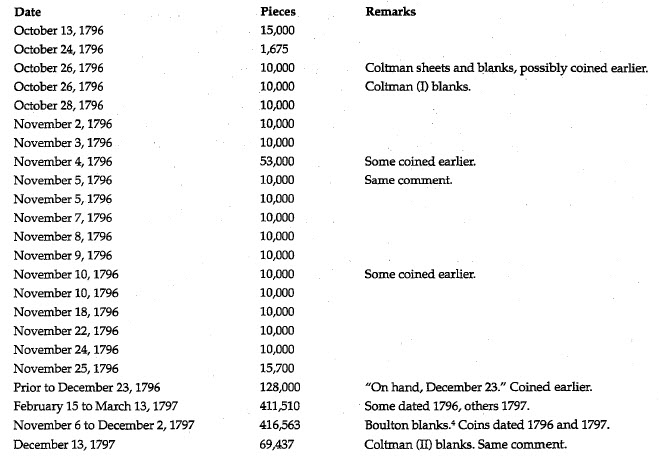
4. (The reference is to the Soho Mint (earlier known as Albion Mills), near Birmingham, England, under direction of Matthew Boulton and James Watt. Watt was the steam engine inventor while Boulton was, beyond doubt, the greatest innovator in coining technology since Leonardo da Vinci. For an appreciation of Boulton's work, see Breen's Encyclopedia of Proof Coins, pp. 12-18. Also, see H. W. Dickinson, Matthew Boulton, Cambridge: 1937.)
The "On hand, December 23" group, like that of February-March 1797, almost certainly included some from other copper sources. Archives records are grossly incomplete. For more detailed delivery data, see 1797.
Evidence that many Draped Bust cents dated 1796 were coined in 1797 (and possibly even 1798) includes both die states and planchet stock. Varieties dated 1796 come with broken reverses which are also encountered in earlier states with obverses dated 1797. Among these are numbers 40-43, all struck after 1797 numbers 12-13. There is evidence that many (not all) of 1796 numbers 37-45 and 1797 numbers 5-13 inclusive were struck on Boulton blanks, which date those to November 6-December 2, 1797. Evidence includes the Uncirculated survivors from the famed Nichols Find, now largely held by date and type collectors.
About 1863, David Nichols, of Gallows Hill (an area named for where the Salem Puritans hanged 19 people and crushed a 20th to death as alleged witches), sold at low prices a quantity of mint red cents (some partly prooflike in finish, many with central granularity), dated 1796 and 1797. These had come down in the family from the daughters of senator Benjamin Goodhue (1748-1814), evidently either directly from the Mint or from whichever local bank received them from the Mint. Date and type collectors prize them not only for the condition, but because the Nichols Find cents were better struck than most other 1796s, even to having full deep borders on both sides. The varieties in this group included 1796 number 40 and 1797 numbers 5 and 12. Sheldon unaccountably said of this group "they are all much alike, and rather uninteresting coins." (penny Whimsy, p.189.) Personal preference aside, the Nichols Find coins will always have historical interest as providing otherwise unavailable evidence for planchet stock. Without them we would have only guesswork about what Boulton's first shipment of planchets looked like.
Clapp and Newcomb first raised the question of whether the mint red specimens of 1796 number 40 and 1797 numbers 5 and 12 might have been made on Boulton blanks. (United States Cents of 1795, 1796, 1797, and 1800, p. 17.)
Archives documents, summarized by Julian, indicate that Thomas Pinckney had originally been in touch with Boulton as a possible source of ready-made copper cent planchets as early as 1795. Mint Director Boudinot attempted to place an order with Boulton in January 1796, only to learn that the Soho Mint was not yet in a position to fulfill it, owing to prior commitments, (These surely included expanding operations to fabricate copper blanks for the "Cartwheels:" some 722,000 twopence and 34,000,000 pence for the British government.) In the summer of 1796, after learning that Boulton would finally be able to furnish planchets, Boudinot ordered 10 tons. For over a full year the promised blanks did not materialize, and Boudinot wrote desperate complaints. Finally, four tons arrived aboard the packetboat Adriana, August 28, 1797, on the very day that the Mint closed for the duration of the yellow fever epidemic. Boudinot did not see the Boulton blanks until about November 1 or 2. They were worth waiting for: the Director pronounced them "perfect and beautifully polished," and for decades thereafter Boudinot and his successors regularly ordered cent planchets from Boulton, normally 15 tons each spring and fall, reverting to other sources only when Boulton shipments were delayed. The blanks from this initial shipment went to press November 2, 1797; between November 6 and December 2, the coiner delivered 416-563 cents, evidently including not only the three varieties named but those die-linked to them, and others on similar planchets. These comprised at least varieties 39-45 of 1796, and 5-13 of 1797.