Walter Breen's Encyclopedia of Early United States Cents
Walter Breen
Condition Census
MS-63 Double struck. Charles M. Williams • Numismatic Gallery#68, ll/1950: 121 $140 • R. E. Naftzger, Jr. • Auction '81 (Paramount Rare Coin Corp.): 1049 $4,200 • R. E. Naftzger, Jr., 2/23/1992 • Eric Streiner. State IV.
AU-55 J. Coolidge Hills • Lyman H. Low #211, 12/1923: 353 • George H. Clapp • ANS • Dr. William H. Sheldon • Dorothy Paschal • Joe Flynn, Jr. (Joe Flynn, Sr. Coin Co.) • Del Bland • Dr. Robert J. Shalowitz, 11/ 19/1974 • Jerry A. Bobbe,2/1975 • R. E. Naftzger, Jr., 2/23/1992 • Eric Streiner, who gave it as a gift on 5/29/1992 to ANS. Reverse illustrated in Clapp-Newcomb, in Early American Cents, and in Penny Whimsy. Obverse and reverse illustrated in Noyes.
AU-55 With a very small planchet clip. George M. Andrus • United States Coin Co. 1/1915: 153 • Henry C. Hines • Dr. William H. Sheldon • Dorothy Paschal. Dr. William H. Sheldon, 4/19/1972 • R. E. Naftzger, Jr. • New Netherlands Coin Co. 11/1973: 436 $1,600 • First Coinvestors • Pine Tree Auction Co. 2/1975: 683 $1,700 • First Coinvestors • Pine Tree Auction Galleries 10/ 1976:220 $1,680 • unknown. Harmer Rooke Numismatists, Ltd. 9/1980: 52 $1,250 • Mike Brownlee, 1/1981 at the NASC convention unattributed • Dr. Philip W. Ralls.
AU-50 Consignment A • Stack's 6/1968: 172 $220 • Robert Whitmore, 8/1977 • Chuck Furjanic • Samuel Kaeppel.
AU-50 Double struck. Consignment Derby • Coin Galleries 11/1981: 1358 $1,150 • C. Douglas Smith • Bertram Cohen, 3/1984 • G. Lee Kuntz • Superior Galleries 10/1991: 133 $5,500 • John R. Frankenfield.
AU-50 Consignment J. H. G. G. • Thomas L. Elder 2/1921: 298 $50 • unknown • Heritage Numismatic Auctions #1, 2/1990: 821 $2,970 • Thomas D. Reynolds.
EF-45 UBERTY and date "all double-cut" per the French catalogue. Dr. George P. French, 3/21/1929 • B. Max Mehl FPL, 1929: 152 $150 • Henry A. Sternberg, 8/1930 • T. James Clarke, 1944 • B. Max Mehl • B. Max Mehl #106, 6/1945: 1661 $42.50 • Sheraton Coin Co. • 1947 ANA (Numismatic Gallery #40): 830 $45 • David M. Bullowa.
EF-45 With a shallow low area below the ribbon. Consignment Wilkes-Barre • Coin Galleries 8/1987: 1499 $1,265 • J. J. Teaparly • Denis W. Loring, 4/23/1988 • Robinson S. Brown, Jr. • Superior Stamp & Coin Co. 1/1996: 170 $5,280 • Wes A. Rasmussen.
EF-45 With five long line-like obverse planchet defects. Stanley Dambrouckas (North American Coin Co.) • Steve Ivy Numismatic Auctions #3, 8/1983: 1164 $1,320 • Douglas F. Bird • Jack H. Robinson. Superior Galleries 1/1989: 226 $2,420 • Gary Ruttenberg • M & G Auctions 8/1996:128 $5,060." W. M. "Jack" Wadlington. State VI.
EF.45 Associated Coin Auction Co. 4/1956: 554 $80. EF-45 Howard R. Newcomb • J. C. Morgenthau & Co. #458, 2/1945: 134 $25.
EF-40 Oscar J. Pearl • Numismatic Gallery FPLB, B1944: 107 $135.
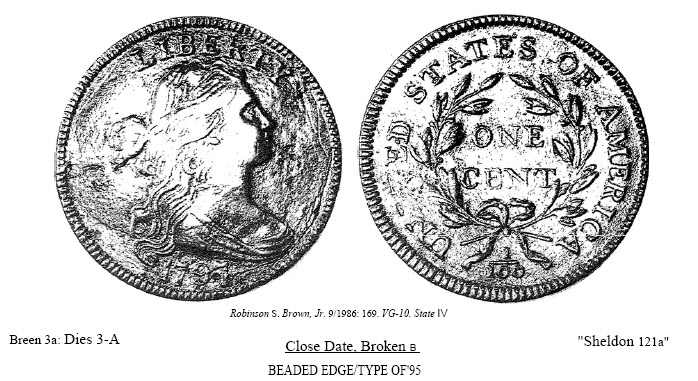
Obverse 3. Very closely spaced date; broken B, often weak. This obverse closely resembles obverse 7 of numbers 9-12, but the latter has a normal B and bases of 17 closer together.
Reverse A.
Edge: Beaded (II).
Die states: 1. Perfect obverse. Reverse as in number 2b, states V-VI.
II. Crack from the rim opposite chin to end of the drapery.
III. Obverse crack from the rim into left field, at first faint, later heavier and extending to the knot.
IV. Crack from the rim opposite ribbon to the lower curls. Reverse failing right of (N)E, where the multiple clash marks had been.
V. Multiple cracks in the left obverse field and through ERT, later extending through Y. A bulge develops behind the hair ribbon. Another crack through 97 to the drapery, at first faint.
Equivalents: "Sheldon 121a." EAC 3a. Encyclopedia 1703.
Rarity 6.
Remarks: This was long controversial. Sheldon said that two or three examples showed "clear evidence that their edges were turned down, probably on a lathe, to remove the grip marks." I have seen none answering this description)
He claimed that about 1940, George H. Clapp, Howard R. Newcomb, James G. MacAllister, Henry C. Hines, and Carl Wurtzbach "made a systematic examination of the available examples with alleged plain edges. Their opinion at the time was that there was no good evidence on which to postulate the existence of a true subvariety." Sheldon agreed with this so-called "Clapp committee" and added that any real ones would be "freaks like the dozen or so 1794s whose edges failed to get lettered,"! No contemporaneous written evidence survives of this joint study. However, even if these experts did say anything of the kind, their arguments, and Sheldon's, are obsolete. Beaded edges on even the lowest grade survivors match those on numbers 2a, 4, 5, 7, and 8; this rules out any possibility of tampering (the raised pellets on edge II differ in placement and shape from the less obvious ones on edge I). If any specimens do show up with plain edges, they will constitute another subvariety.