Walter Breen's Encyclopedia of Early United States Cents
Walter Breen
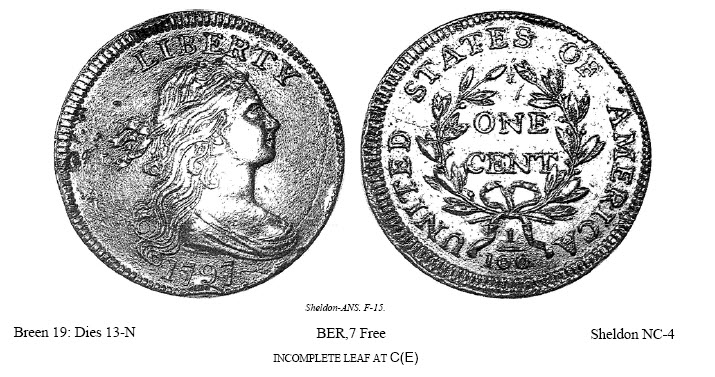
Obverse 13. LIBERTY farther above the hair than usual, about equidistant between the device and dentils. Top serif of B is very short and pointed, possibly broken and repaired by hand. With reverse N, these suffice to distinguish this from number 20.
Reverse N. Incomplete leaf at dE), its right edge bold, the rest mostly gone; broken outer leaf opposite IT. Berries are uneven, those at the right smaller. Fraction layout as in reverse M. Without the bulges of number 20.
Edge: Presently undetermined.
Die states: Obverse cracked from rim the opposite nose to end of the drapery. Reverse perfect with no bulges. This variety may exist with a perfect obverse die.
Equivalents: Clapp-Newcomb 19. Sheldon NC-4. EAC 19. Encyclopedia 1711.
Rarity 8. Three examples are currently known.
Remarks: Discovered by Dr. Sheldon in 1935.
Condition Census
F-15 Sharpness of VF-30 but several edge and surface dents. From a lot of 1797 cents purchased in 1934 from Henry Chapman by Dr. William H. Sheldon, 11/21/1946 • George H. Clapp • ANS. Obverse illustrated in Clapp-Newcomb and in Early American Cents. Obverse and reverse illustrated in Penny Whimsy and in Noyes. Discovered in 1934 by Dr. Sheldon to be a new variety.
AG-3 Sharpness of G-6 but rough. Discovered on 5/4/1989 in a junk box of coins by James E. Long, Jr. (J. E. L. Coins) • Early American Coppers 5/1990: 43 $9,000. Robinson S. Brown, Jr. • Superior Stamp & Coin Co. 1/1996: 195 $10,450 • Daniel W. Holmes, Jr.
FA-2 Sharpness of F-2 but corroded with flattened areas on both sides. Purchased unattributed by Tod Von Zuben.
No other examples have been reported.
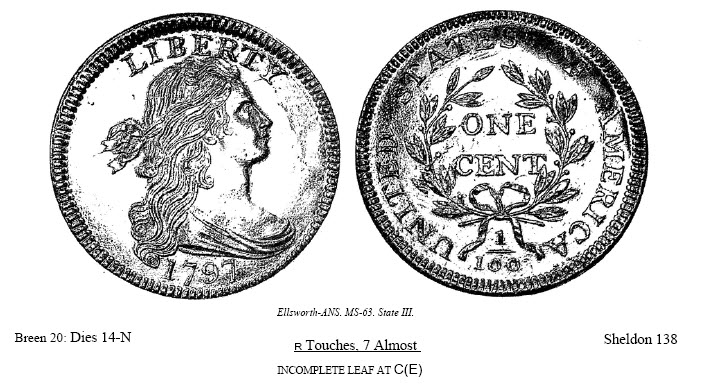
Obverse 14. Left foot of R touches the hair. B is broken and hand corrected, the top serif long, with a die scratch extending left above I. Corner of 7 almost or quite touches drapery. Guidelines (arcs of circles) in the field right of the top and base of y. Long spine from lower point of the upper ribbon end. Dentils are longer and heavier than on previous numbers.
Reverse N.
Edge: Plain. May exist with other edges.
Die states: I. Five sets of light clash marks. No bulge at ES O. Extremely rare.
II. Bulge at ES O, at first faint, later heavy.
III. Cracked from the base of y into the field opposite forehead, later extending into the field opposite chin. At least eight sets of clash marks. Reverse bulge advances.
IV. Reverse cracked from the rim to S(T), later extending to T; two more cracks from the tops of ES to the rim.
V. Crack faintly joins the leaves above ONE. Over 10 sets of clash marks. Faint bulge at UNITED S.
VI. Advanced bulge at S OF A. Bulge at TED becomes heavier. Many rust pits and chips throughout the reverse; many leaves weakened.
VII. Bulges at leaves, left of ON and below ST. The latter becomes heavy, later extending to ITED. Crack develops through STATE to the rim above (E)S.
VIII. Obverse cracks from the rim to lowest curl and from the rim toward mouth. Bulges behind the ribbon and above drapery near the rim. Reverse crack joining leaves above ONE extends down to the leaves left of C(E).