Walter Breen's Encyclopedia of Early United States Cents
Walter Breen
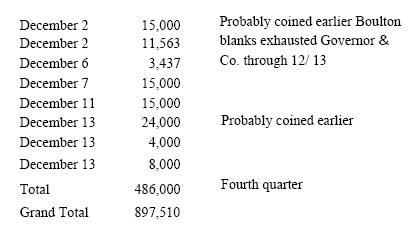
The above account, however, does not fully explain the diversity of types of planchets found on 1797-dated cents. There are two groups (1 and II below) which the Coiner's Department marked on edges, apparently in the same upsetting operation which made the blanks round and imparted raised rims; reason unknown, though 1 make an educated guess below. This information is as yet too new to allow census and determination of rarity. Many collectors have not bothered to look closely at the edges, except for the familiar "gripped edge" coins, varieties 2-3, and even these have handed us a surprise. One would expect that the varieties sharing the same kind of blanks were struck at approximately the same time. However, there is indisputable evidence that mixing occurred, as in the following tabulation.
I. Gripped Edge. Irregularly spaced incuse notches and raised pellets on edge. (Editor's note: Harry Salyards reports 21 notches and 11 pellets. Examination of seven coins in the ANS yields a range of 20 to 23 notches with an average of 21.5. These irregular notches and pellets seem to follow a consistent pattern among the coins examined. A future research project study all 1797-98 large cents with different edges to see if the edge features line up with obverse and reverse details, indicating some type of collar was used, or if the edge details are random, indicating the planchets had edge devices imparted prior to striking.) Varieties 2-3. Thought to be from the 1796 shipment of Coltman blanks.
II. Beaded Edge. Irregular pellets, some elongated, touching or almost touching. Varieties 2-5, 7, .8. Same origin and time of use as preceding. Possibly given this peculiar edge to identify them as the, lot from the Coltman 1796 shipment that required both scouring and remilling. These are often found with pitted surfaces. That numbers 2 and 3 come with both gripped and beaded edges (but not plain) suggests that the two batches of blanks were made successively and mixed before going to press. Possibly other Plain Edge varieties come also with beaded edge.
III. Plain Edge: Boulton blanks. (416,563 including varieties dated 1796. Coined November 6 to December 2, 1797.) Varieties 5-13. Uncirculated survivors show that these blanks were initially polished, though many have central granularity. The dark porous ones with similar edge finish may have been among the small quantity damaged by exposure to salt spray and bilgewater aboard the packet boat Adriana enroute from Boulton. Compare edge IV, below. That 5 and 7 come on both Beaded Edge and Boulton blanks indicates that mixing occurred in November and December 1797.
IV. Plain Edge: Collman blanks, two shipments, herein designated "early" and "late." (Early blanks were possibly among 411,510 delivered February 6-March 30, 1797. Late blanks include a1169, 437 delivered December 6-13, 1797, and others included among 336,000 delivered January 20- July 20, 1798, dated 1796, 1797 and 1798.) Often dark and sometimes porous. Some in 1797 and 1798 show a long diagonal bar on the edge. This is often obscured on worn coins, and may represent another batch requiring special treatment. Other Plain Edge coins have beveled edges, explanation unknown. On worn coins, edge IV cannot always be told from edge
III; nor have we yet learned to distinguish unambiguously the "early" Coltman blanks from the "late" blanks. The former match some late 1796 varieties; the latter match the early 1798 varieties. The distinctions so far observed are textural, slight, and on worn coins often obscured.
V. Partly Reeded Edge. Traces of diagonal and vertical reeding. Has one irregular raised area, which Denis Loring calls "welder's beads." Found on some few late 1797s struck in 1798 (varieties 14, 15, 16, 32),and on many early varieties of 1798. The enumeration of edges continues at 1798.
The Mint intermittently made cent planchets until June 3, 1800, the last batch being 5,670 from sheet copper bought from Jacob Eckfeldt. Thereafter, through 1814, all cents were struck on Boulton blanks with successive shipments not yet distinguishable.
The theoretical goal for 1794-1814 cents is to identify unambiguously each type of planchet used on any variety; if possible naming its source, inclusive dates of manufacture, and sometimes even the aggregate mintage of varieties from distinguishable planchet shipments. The partial figures already obtained enroute to that goal are included herein. Doubtless as more collectors examine edges (the third side of a coin), they will make more discoveries, clarifying the picture.
Sheldon mentioned the beaded edge on S-134 (our number 4) as "semi-gripped" but ignored it on other varieties as not important enough to number as subvarieties. (Early American Cents, p. 184. Sheldon did notice the beaded edge on "plain-edge" examples of his number 121 (our number 3a) and considered these to be fraudulently altered. See Penny Whimsy, pp. 186-187.) Because these edges were unquestionably imparted in the Mint, and because some demonstrably represent different planchet sources, they deserve study for the same reasons as the edge changes of 1793-94. The first step is to look at the edges of your own coins. Discovering that all "plain edge" impressions of 2a and 3a checked to date have the same beaded edge as 4a led me to check edges on other varieties.
Discovering a beaded edge (5a) on a Nichols Find coin, previously believed to come only on Boulton blanks, openedthe floodgates. We are not under any illusion that we have yet seen all the distinguishable edge variations.
The Gripped Edge and Beaded Edge varieties, numbers 2 and 3, are enumerated as 2a, 2b, 3a, and 3b. The balance of varieties should also be given sub-varieties, however, due to the very preliminary nature of edge study, along with incomplete census and rarity determination, these are not so divided in this work. The plain edges III, IV early, IV late, and V are not always distinguishable on worn examples. With further study and more refined comparison methods this limitation may become unnecessary.
The emission sequence for 1797 is still uncertain, despite abundant new die state information, detailed study of punches and layouts, and recognition of the various types of planchets. Partly this is because dies were not used in the order of their manufacture and partly because of planchet mixing. Most of all this is because the varieties are organized in separate die-linked groups whose order is not completely decidable. Though Sheldon's emission sequence was an improvement over all previous attempts, it was nevertheless an uneasy compromise, like those for 1794 and 1796. Some years ago Denis Loring and I worked out a sequence for 1796 through 1798, which became the "EAC" numbers. This order required revision and still requires further study; the conclusions here presented remain tentative, and the present emission sequence is subject to revision. as new edge evidence comes in.