Walter Breen's Encyclopedia of Early United States Cents
Walter Breen
1797
(Mint report, 897,510)
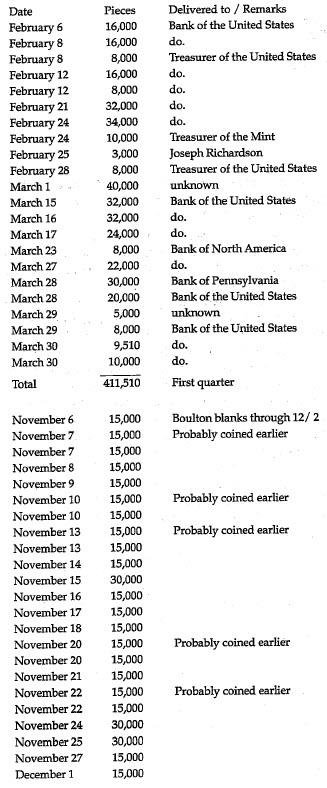
Cent coinage began about February 5-6, 1797, using the poor quality Governor & Company (Coltman) blanks prepared before the end of 1796. Coining from this lot continued through March 13, when the supply of planchets ran out, although deliveries of those already struck continued through March 30. On March 13, Director Boudinot issued Warrant Number 5, directing the coiner to deliver (i.e, to record as delivered) the cents struck during the first three months of the year; as Julian says, "this was merely a bookkeeping device." The Mint had ample quantities of scrap copper on hand, but Boudinot wished to minimize use of this copper because of risk of further damage to the rollers. (R. W. Julian, "Cent Coinage of 1797," Numismatic Scrapbook, April 1975, p. 85.)
The Mint obtained only two shipments of copper during the year, both being British imports. The first comprised four tons of blanks from Matthew Boulton, in 28 casks (about 14,000 planchets each) at $2,678.46. After intolerable delays (they had been ordered in 1796), these arrived August 28, the very day the Mint closed for the yellow fever epidemic. Their stated weight should have made 415,042 cents: their average weight was a little light, making the calculated total 418,363, (Julian, "Cent Coinage of 1797," p. 88; states "slightly more than 418,000.") costing 64.5 cents per 100 blanks, Collector of Customs Delany (Clement Biddle, The Philadelphia Directary, Philadelphia: James & Johnson, 1791, lists "Sharp Delany, Esq." of 40 Walnut St. as a Collector for the Port of Philadelphia.) vainly attempted to collect duty on them and they remained in a warehouse until after the Mint reopened following the end of the epidemic. Some were discolored and otherwise damaged by exposure to salt spray and bilgewater aboard the packetboat Adriana.
These blanks went to press November 6 through December 2, 1797, making in all 416,563 cents fit for issue, dated 1796 and 1797. The 1,800-odd spoiled ones were later rolled down for use as half cent blanks. Boudinot was most pleased with the quality of the Boulton planchets, pronouncing them "perfect and beautifully polished." These yielded the "Nichols Find" cents, discussed under 1796 Draped Busts.
The other purchase, a most reluctant one, was from William Coltman's firm, the Governor & Company of Copper Miners. This shipment left England on August 12, 1797, arriving in Philadelphia October 31, while the Mint was still closed during the epidemic. At standard weight these 3-3/4 tons would have comprised 388,333 planchets. The calculated number was 388,612 (Julian, "Cent Coinage of 1797," p. 89; gives the figure 388,333.) at $2,700.85, or 69.5 cents per 100 blanks. They were just as unsatisfactory as the Coltman firm's previous shipment. Because the Mint had run out of Boulton planchets, the coiners had to use the Coltman blanks. As with the first Coltman shipment, workmen had to scour many and run them through the upsetting machine, to impart the necessary raised rims. On December 4, 1797. Director Boudinot wrote to his nephew Samuel Bayard (American Claims Commissioner in London, and Boudinot's sometime purchasing agent and liaison with Boulton.) to the effect that the Boulton shipment had been "perfection itself," whereas the Coltman shipment "cost £11 per ton more than those of Boulton and were £11 per ton worse executed. (Julian, "Cent Coinage of 1797" p. 92.)
Between December 6 and 13, 1797, the Coiner delivered 69,437 cents from this shipment. Julian has conjectured that this odd number represented the best of the Coltman planchets, because the worse ones would have required more time for scouring and upsetting.
The following are all the recorded deliveries of cents during calendar 1797. Those coined in February and March were from the Coltman (Governor & Co.) sheet copper and blanks, many dated 1796. Delivery dates shown for this group are those of release from the Mint; actual coinage was earlier, but records are missing. Delivery dates for the November-December group are those from Chief Coiner Voigt to the Treasurer of the Mint; their later destinations are unknown.