Walter Breen's Encyclopedia of Early United States Cents
Walter Breen
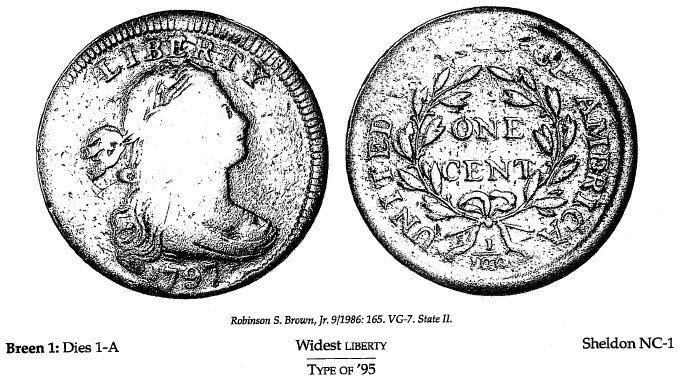
Obverse 1. Widest spaced LIBERTY. Perfect B. Medium evenly spaced date.
Reverse A. Type of 1795 with single terminal leaves. Same as 1796 reverse G of Liberty Caps.
Edge: Plain. Apparently on Collman blanks of 1796. Die states: 1. Obverse crack from tops of BE down through the middle of RT.
II. Small pieces are broken away at BER; the crack is heavy and extends through IBERT.
Equivalents: Clapp-Newcomb 1. Sheldon NC-1. EAC 1. Encyclopedia 1703.
Rarity 7.
Remarks: Discovered by Charles E. Clapp, Sr. in 1924.
Condition Census
VF-25 Discovered in 1958 by some workmen in the wall of an old house in Wilmington, DE. that was being demolished and sold unattributed to A. C. "Hance" Jaquett and traded by him in 10/1959 for a date set of large cents, 1793-1820, grading VF-Uncirculated including the three types of 1793, via Kenneth W. Rendell acting as agent, to Dr. William H. Sheldon, 4/19/1972 • R. E. Naftzger, Jr., 2/23/1992. Eric Streiner, 4/23/1992 Fred H., Borcherdt. State II. Obverse and reverse illustrated in Noyes.
VG-8 Sharpness of EF-40 but corroded, the date almost obliterated while TATES OF is obliterated. Purchased unattributed on 4/8/1988 by Chris Victor-McCawley (CVM), 4/11/1988 • Robinson S. Brown, Jr. • Superior Stamp & Coin Co. 1/1996: 168 $3,520 • John R. Frankenfield. State I.
VG-7 Purchased unattributed on 2/15/1975 from a dealer at the Early American Coppers convention bourse by Gordon J. Wrubel, 3/1975 • Denis W. Loring, 4/1/ 1975 • C. Douglas Smith, 8/1977 • Denis W. Loring, 8/ 1977 • Robinson S. Brown, Jr.• Superior Galleries 9/1986: 165 $6,875 • Frank H. Stillinger. State II. Plain edge. Struck from mis-aligned dies.
G-6 Sharpness of F-12 but porous. Purchased unattributed on 1/13/1990 by Rob Retz, 5/11/1990 • Daniel W. Holmes, Jr.
G-5 Sharpness of VF-25 but porous. Purchased unattributed by Peter Boisvert at a flea market in 5/1991 and sold to Larry Briggs Rare Coins.
AG-3 Charles E. Clapp, Sr., 7/1924 • George H. Clapp • ANS. State I. Obverse illustrated in Clapp-Newcomb, in Early American Cents, and in Penny Whimsy. The discovery coin for the variety.
No other examples have been reported.
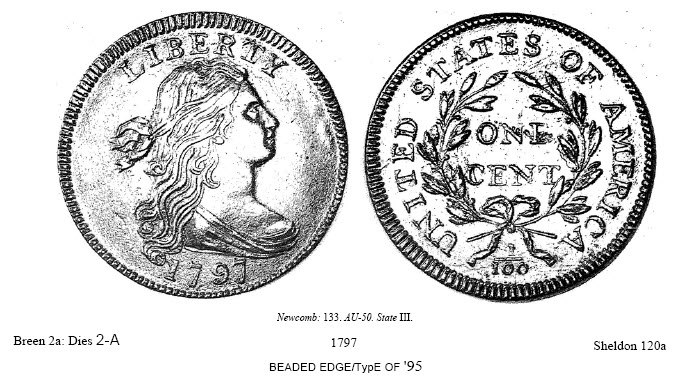
Obverse 2. Date spaced 1 7 97, diagnostic with this reverse. T above R-Y. Very similar to obverse 6 of numbers 7-8, but the final 7 almost touches the drapery, whereas in the other obverse with this date spacing, the final 7 almost touches a dentil instead.
Reverse A.
Edge: Beaded (II). This variety may exist with a plain edge as variety 1.
Die states: I. Perfect obverse. Reverse as in 1796.
II. Obverse roughness, possibly from die rust, before the face and near the knot. Reverse has at least 12 sets of clash marks. A bulge develops at UNI.P (The obverse clash marks were mostly polished off the die; an unseen earlier state may have had them.) See variety 2b.
III. Faint crack through tops of u; crumbling begins at the nose, mouth, jaw, and ribbon. See number 2b. The crack extends through LIBERTY, at first faint, later becoming heavier (on 2b).
IV. Obverse crumbling also at the top of I, becoming heavier.
V. Reverse crack from the rim past the left side of u. Later with advanced crumbling on the profile. See 2b.