Walter Breen's Encyclopedia of Early United States Cents
Walter Breen
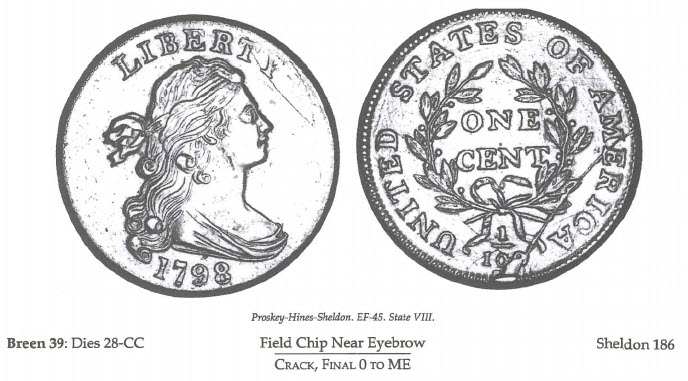
Obverse 28. Bald area below the lower round back curl. Top of 7 is recut (minutely, not visible on worn coins). LI are close and IBE are increasingly farther apart (as are ERTY), R is high, and TY are distant. Die chip in the field right of the eyebrow. Die scratch on the neck. Usually identified by the crack of state II.
Reverse CC. Type of 1799. E(D) is wide and perfect. E(S) is narrower with its left base gone. Small single center dot. Die scratch from the wreath stem extends through the leaf pair below ME. Left bow is broken at its base and the right bow is broken at right. Leaf pairs above (N)E and below ME are stemless. Outer leaf pair below (N)T overlaps the wreath stem. Instantly identifiable by the die crack from rim to rim through the final 0, wreath, and ME: see Die States, Remarks. Edge: Beaded edge (BE) in early states, plain edge (PE), and single-flange edge (SFE).
Die states: I. No obverse cracks. Reverse is always cracked from the rim below denominator through final 0, ribbon, two lowest outer pairs of leaves, base of (M)E, right top of adjacent E, and back to rim.
II. Cracked from the rim above T through TY to rim opposite the chin. Die scratch on the neck gradually fades or is ground off. Rim is beginning to crumble below the middle 0, not close to it. Clapp 34b-GGc.
III. Heavy sliver out of the die from lower reverse rim toward the crack, affecting right side of the final O. Crack from rim through middle of final 0 joining the main crack above it.
IV. The sliver out of the die now touches both digits with the final 0 distorted. Cracked through IC to the first crack.
V. Small rim break below first 0, not touching it.
VI. Rim break now touches first 0 and covers about half of the second. The crack of state I becomes heavy, developing a lump between the leaves below IC, Clapp 34b-GGd.
VII. Crack from first 0 to left end of the fraction bar and stem. Clash marks from drapery below TES. Clapp 34b-GGe.
VIII. Branch crack from the crack of state VII diagonally to below the left ribbon. Clapp 34b-GGf.
IX. "Retained cud" from rim to the right top of N, through bases of ITED, to rim.
x. The state IX "retained cud" is now a huge rim break, taking out the right top of N and all of ITE (not D). Crack of state VI is heavy.
Equivalents: Doughty 121. Proskey 13A. McGirk4F7 (illustrated). Clapp 46. Sheldon 186. EAC 39. Encyclopedia 1732.
Rarity 2.
Remarks: Struck after both 1799 overdates. This reverse comes perfect with the 1799/8 obverse, cracked with the broken 1799/8 obverse (1799 number 2, state IV), and more heavily cracked with the 1798 obverse. The break was a by-product of the accident (clashing of axially misaligned dies) which had forced early discard of the 1799/8 obverse.
Clapp attributed the obverse crack at TY to the same cause. This implies axial die misalignment in both 1799/ 8 number 2 and the present number, bringing the upper right of both obverses and the lower right reverse closer together than other die areas. The lower left obverse (both dies) and upper left reverse would be more weakly struck. As the best specimens of this 1798 variety do not show these weaknesses, either the condition was corrected immediately after the die cracked, or else another explanation is necessary.
Doughty knew of the different reverse breaks of this and the next but could not explain why they were different. He did not see that they were separate reverse dies from a single complete hub. Ten years later, George W. Rice was using similar die failure evidence to prove that the 1799 Overdate and Normal Date cents were from different working reverses. ("The Cent of 1799" Numismatist, March 1900, pp. 71-72.) Clapp had the correct explanation in 1931, (see above, at number 20.) but a generation later Dr. Sheldon still insisted that "there is really only one 1800 reverse."? Perhaps excusable in 1890, but not in 1958.
The French, Robinson S. Brown, Jr. coin has a double profile on the jaw.
Condition Census:
MS-63 From England • New Netherlands Coin Co., privately 4/9/1949 • C. Douglas Smith, 1/1957 • Dr. William H. Sheldon, 4/19/1972 • R. E. Naftzger, Jr., 2/ 23/1992 • Eric Streiner • Jay Parrino (The Mint), 3/1997 • Thomas D. Reynolds. Obverse and reverse illustrated in Penny Whimsy and in Noyes.'
EF-45 David Proskey • Henry C. Hines • Dr. William H.Sheldon. Dorothy Paschal, 5/1/1972 • C. Douglas Smith. State VIII.
EF-45 Michael's Coins, 11/5/1965 • Jackson c. Storm, 8/1/1984 • Robert E. Matthews • Superior Galleries 51 1989: 352 $6,600 • John R. Frankenfield.
EF-40 Christian M. Petersen, 10/4/1954 • Willard C. Blaisdell, 8/1977 • Denis W. Loring, 12/1977 • Myles Z. Gerson. Denis W. Loring, 10/1980 • Fred H. Borcherdt.
VF-35 B. G. Johnson (St. Louis Stamp & Coin Co.), 10/1923 • George H. Clapp • ANS. Reverse illustrated in Clapp.
VF-35 Richard Picker, 10/19/1964 • C. Douglas Smith. VF-35 Sharpness of EF-45 but two obverse edge dents. Charles Stehlin •Thomas L. Elder 4/1917: 441 $6.50 • Elmer S. Sears • Hillyer Ryder, S /1945 • Wayte Raymond • New Netherlands Coin Co. #41, 9/1953: 265 $62.50 • Dorothy Paschal • C. Douglas Smith • Gordon J. Wrubel • Ellen Enzler • Numismatic and Antiquarian Service Corporation of America 12/1978: 2620 not sold • Ellen Enzler, 4/1983 • Dr. Philip W. Ralls. Reverse illustrated in Early American Cents as Bvd for 1799.
VF-35 Howard R. Newcomb • J. C. Morgenthau & Co. #458, 2/1945: 267 $35 • George H; Clapp • ANS. Obverse and reverse illustrated in Clapp.
VF-35 Seen in Baltimore in 11/1998.
VF-35 Charles F. Heinig • Stack's 10/1978: 855 $360.
VF-30 Dr. George P. French, 3/21/1929 • B. Max Mehl FPL, 1929: 194 $40 • Henry A. Sternberg • T. James Clarke. B. Max Mehl #113, 5/1950: 2335 $20 • unknown • Thomas E. Werner • C. Douglas Smith • Dorothy Paschal, 1977 • Robinson S. Brown, Jr. • Superior Galleries 9/1986: 261 $1,155 • C. Douglas Smith • Herman Halpern. Stack's 3/1988: 168 $1,155 • Dr. Michael Eisenberg. State VII.
VF-30 Charles E. Clapp, Sr., 7/1924 • George H. Clapp • ANS.
VF-30 Kagin's Numismatic Auctions #315, 4/1979: 66 $750.
VF-30 Maurice A. Storck • Kagin's Numismatic Auctions #340, 1/1986: 4198 $1,045. C. Douglas Smith.
VF-30 Sharpness of EF-45 but some fine porosity. Dr. Peter A. Ward • Bowers and Merena 11/1995: 3169 $770.