Walter Breen's Encyclopedia of Early United States Cents
Walter Breen
Toward A Rational Oassification
The variables for 1798 dies are at least as diverse as those for 1796 Draped Busts; we owe to George H. Clapp {1931} their definitive classification.
The first 18 obverses of 1798 have the same device punch as those of 1797: "Style I hair" or "Head of 1797." Four of these (dies 1, 2, 3, and 8) show "Style I" letters, with long straight tail to R: evidently made in 1796 or 1797, but not given the final digit of the date until hardening, because of uncertainty about when they would go into use. The two 1798 overdate obverses show "Style II" letters, with curved tail to R, and must have been made for late 1797 use. We do not know when Scot ordered the new letter punches. According to Stewart, on February 1, 1798, Boudinot authorized payment to Thomas Bingham for a figure 8 for dollars, and "2 letters for cents" at 50 cents each; these are not identified, (Stewart, History of the First U.S. Mint, p. 183.)"Style II" differs from "Style I" in more than two letters: besides the R above mentioned, the D is larger, the E has stronger serifs and a shorter but heavier crossbar, the L has longer top serifs and a heavier, taller, sharper toe. This change evidently preceded introduction of the small 8 punch. The large 8 was probably intended for eagles while both 8s occur also on half eagles.
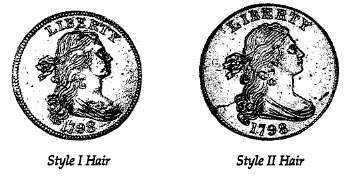
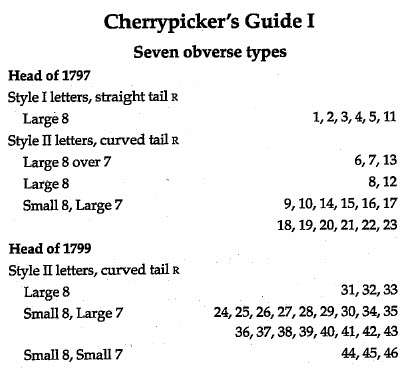
Later 1798 obverses show a modified portrait, with a conspicuous extra curl: "Style II hair" or "Head of 1799." What Clapp believed was the first die in this group comes with a large 8 while all others have a small 8. Only the last two obverses made for 1798 show the small 7 used in later years, though for various reasons Clapp did not put them at the end of his sequence. This 7 punch appears also on the 1799 overdate (but, oddly, not the perfect date 1799) and on all 1800 overdates except the first. It has a shorter shaft but much taller serif than the large 7. These variables combine into seven types, as illustrated below.
The four types of reverses differ more dramatically than the obverses. Three reverses were resurrected from the 1796 Liberty Caps: Scot's copy of Gardner's "Type of 1795" with single terminal leaves. The second and third types were unused leftovers from 1797, respectively with "Style I" and "Style II" letters: "Type of 1797." One die of the latter group (C, of number 4) has closely spaced 100 crowded to the right, almost touching the ribbon, recalling 1797 number 9; another (L, of number 15) has C in AMERICA corrected from a T; a third (FF, of number 42) has its large fraction punched over a small fraction, and 11 berries rather than the normal 10. The fourth type ("Type of 1799") represents a failed Mint experiment in uniformity and labor-saving, a replay of Scot's similar attempt with the 1794 half cent reverses.
At some unknown time in 1798 or 1799, Scot and Eckfeldt attempted to sink cent reverses from a complete hub; this served for the last 16 dies of 1798 and that of 1799, continued through 1800, and reappeared on three dies of 1801 and one of 1802. (Doughty could not tell the 1798 dies apart and called them all ''Reverse H" ; Clapp called them the "0" group; Sheldon was unaware that the four 1801-2 reverses were from the same hub.) Though the hubbing press was the largest of the Mint's five, normally used for silver dollars and medals, it was not strong enough to enter the complete hub into a die blank with enough force to impart full detail, especially to make a die large enough to require basining," Therefore, every "Type of 1799" die shows hand strengthening: berries vary in size and minutely in position; leaf stems and berry stems vary in thickness, length, and direction, and are sometimes missing. The fraction bar varies in length, thickness, and direction of slant, while the fraction varies in heaviness and serifs. Letters show variable traces of repunching and are occasionally blundered by being given one blow rotated 180P degrees. from normal; C(ENT) sometimes shows a sharp chipped serif. What remains constant is the position of letters relative to each other and to leaves. It can not be determined which working die, if any, served also as the original matrix from which the complete hub was made.