Walter Breen's Encyclopedia of Early United States Cents
Walter Breen
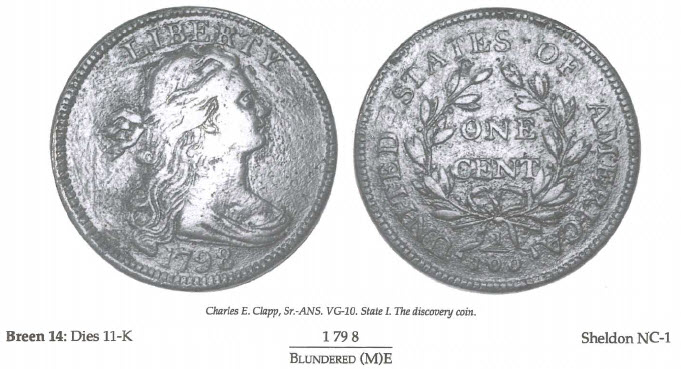
Obverse 11. Date spaced 1 79 8. IB lean slightly to the right with E slightly high.
Reverse K.
Edge: Reeded edge (RE).
Die states: I. Perfect obverse. Reverse rusted at RICA as preceding.
II. Cracked from the rim through left top of v, right foot of T, and to forelock.
Equivalents: Clapp 15. Sheldon NC-1. EAC 15. Encyclopedia 1723.
High Rarity 7. Just six examples are known. Remarks: Discovered by Charles E. Clapp, Sr. The crack must have advanced rapidly to require immediate discard of this obverse die.
Condition Census:
VF-20 Sharpness of EF-40 but a long and very heavy obverse scratch with the reverse lightly rough. Purchased unattributed at Worthy Coin Co. Bid Board Sale 3/1990: 936 by Ronald E. Adam. Obverse and reverse illustrated in Noyes.
VG-10 Charles E. Clapp, Sr., 3/1921 • George H. Clapp • ANS. State I. Obverse illustrated in Clapp, in Early. American Cents, and in Penny Whimsy.
VG-10 Purchased unattributed by an eastern dealer in 1962 and sold by Richard Picker to Dr. William H. Sheldon, 4/19/1972 • R. E. Naftzger, Jr., 2/23/1992 • Eric Streiner • Dr. Philip W. Ralls. State II.
VG-7 Purchased unattributed on 6/3/78 from Karl Wildfing by Thomas D. Reynolds.
VG-7 Howard R. Newcomb • J. C. Morgenthau & Co. #458, 2/1945: 203 $2 • withdrawn when the high bid reached only $2.00 and sold by James G. Macallister to David O. Hughes and by him on 10/22/1946 for $12.50 to R. E. Naftzger, Jr., 6/1972 • Denis W. Loring, 5/1974 • Dr. Robert J. Shalowitz, 6/1974 • John W. Adams, 6/ 1974 • Denis W. Loring, 3/1975 • Richard H. Wright. Del Bland, 11/11/1975 • C. Douglas Smith, 2/1/1977 • Philip Van Cleave • Kagin's Numismatic Auctions #340, 1/1986: 5169 $5,225 • C. Douglas Smith.
AG-3 Sharpness of G-6 but porous. Purchased unattributed in 7/1982 from Donald Folsom by Donald H. Petersen • Jack H. Robinson, 4/1986 • Dr. Philip W. Ralls, 3/24/1992 • Robinson S. Brown, Jr. • Superior Stamp & Coin Co. 1/1996: 220 $6,600 • Daniel W. Holmes, Jr.
No other examples have been reported.
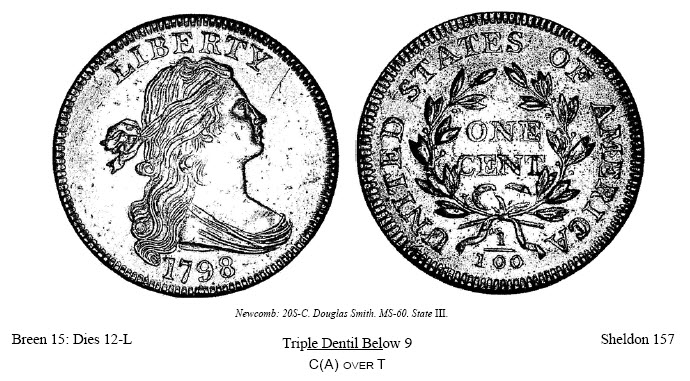
Obverse 12. Triple dentil below 9. Date compactly spaced with 17 close and 9 8 farther apart, somewhat like obverse 7 of number 10.
Reverse L. Wide fraction spaced 1 00. u is low, ED are high, and A is high, this letter nearer the second T. C(A) corrected from a T. (N)E repunched, as is the left ribbon.
Edge: This variety is known with reeded edge (RE), plain edge (PE), beaded edge (BE), and double-flange edge (DFE).
Die states: I. Perfect dies. RE.
II. Rust pit like a spur from the throat, rust develops in the central reverse. Faint clash marks on both sides, on some, as many as five sets. Clapp 14-L.
III. Crumbling along the profile. Rough crack or line of rust from the rim to throat. Rust right of the date with a crack through 798. Reverse has a faint crack through the tops of NITED to the rim and another crack from bases of TE(S) to 0, later extending to the top of (A)T. Clapp 14b-Lb.
IV. Extensive rust in the right obverse field, face, LIB-ERTY, and back of head to the ribbon. The reverse is severely rusted and scratched in the center. Faint crack between S 0 to the wreath, nearly to rim. The first reverse crack of state II is heavier, reaching the rim above N, with a branch from E(D) to the rim. The second crack extends to F. The ribbon bow is nearly gone. Clapp 14c-Lc. See Remarks.
Equivalents: Doughty 122. Proskey 14. McGirk 11A, 26A. Clapp 16. Sheldon 157. EAC 16. Encyclopedia 1723.
Rarity 2.
Remarks: One ANS example labeled "14c-Ld," with alleged heavy cracks through the legend, proved to have resinous foreign matter like glue simulating cracks.