Walter Breen's Encyclopedia of Early United States Cents
Walter Breen
1801
(Mint record: 1,362,837)
At the beginning of the year, the Mint was out of cents and out of copper to make any more. On December 3, 1800, Mint Director Boudinot had written Boulton & Watt ordering another shipment of blanks and expressing apprehension about further supplies. Similar letters followed throughout the winter of 1800-1801 and into the summer of 1801-in vain. By June 12, 1801, Boudinot was desperate enough to write Boulton that if another shipment were not forthcoming very soon, the United States would have to order its blanks elsewhere. R. W. Julian points out that this was an idle threat: the Governor & Co. of Copper Miners was the other possible supplier, and that finn had already shown that it could not match Boulton's quality or Boulton's prices. (Julian, "The Cent Coinage of 1801," Coin World, December 1, 1976, p. 32.)
Unknown to Boudinot, Boulton had shipped 20 tons of cent planchets on March 21 although their arrival aboard the Swanwick (under Captain Kirkbride) was delayed until July 11. Part of the delay was a byproduct of the Napoleonic wars. Any British transatlantic ship had to assemble an armed convoy for protection against French privateers-at great cost in money and time.
For unknown reasons, the cent planchets did not go to press until August 16 or 17. Julian theorizes that somehow the demand for cents had briefly lessened, due to business setbacks. A reasonable alternative guess is that not enough dies were ready until then. In the meantime, the Mint had been filling orders for eagles, silver dollars, half dollars (8,160 delivered August 14), dimes (from 9,260 delivered March 16), and half dimes. (Harry Salyards notes "it deserves emphasis that this makes a 'clean break' from the coinages of 1797-1800, with their overlapping figures for planchets supplied and coined cents delivered; from 1801 on, 'what you see is what you get,' in terms of cent mintages." Letter to the editor, September 30, 1996.)
Boulton's covering letter of March 21 complained that he would not be able to send a second shipment that spring: on the one hand, over £10,000 of his funds were tied up in Denmark and Norway, and might be seized by those governments under Napoleon's influence; on the other, the price of raw cake copper had risen to £151 per ton, supplies were scarcer, and competition fiercer. His next shipment of planchets (25 tons) departed England on August 26 on board the New Jersey, arriving October 27. All cents struck between August 17, 1801 and January 25, 1802 inclusive are from the first of these two shipments of planchets. Blanks from the second shipment lasted through October 4, 1802. Edge differences are therefore unlikely in early 1801 cents, but may exist on the last few varieties and on those of 1802. To date, collectors have not studied cent edges for these years.
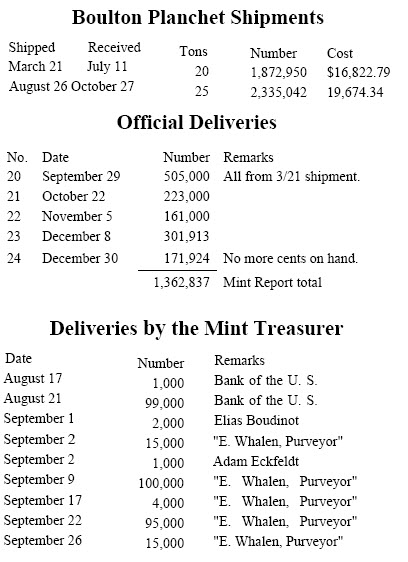
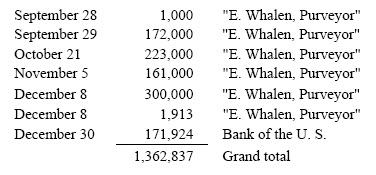
As we saw under 1800, "E. Whalen, Purveyor" was the Mint's spelling of Israel Whalon, the Philadelphia deputy of Thomas Tucker, Treasurer of the United States, legal distributor of cents.
Julian says that in the 1801 shipments each cask cost 65 cents in Birmingham, and weighed 12 pounds unloaded, about 433 pounds loaded, containing about 17,500 blanks. The Mint reused them for shipping coined cents.
Some of the earliest cents coined in 1801 may have been dated 1800: die steel was still in short supply, and (as in 1798-99) any usable obverses would not have been discarded. (Against this conjecture is based on the difference in copper: most 1800s are on dark blanks wholly unlike those of 1801 or later years.) There are no overdates, but the obverses with pointed first 1 in the date (as throughout 1800) were evidently made in 1800 with the last digit omitted, for 1800, 1801, or possible later use. (They did not, however, go to press in order of manufacture.) Some of these have a broken left base to Y, like 1800 number 29; on some other dies this y looks normal, usually (or always) because it was corrected by hand, and the broken y punch occurs on some 1802 dies. Obverse 3 has the peculiar crowded spacing of 180 found on many 1800 dies, originally intended to leave plenty of room for a second o. Before any 1801 cent dies could be completed, the 1 punch broke at the upper left serif (blunt 1). The four obverses with both Is blunt were probably the last ones made. Some cents dated 1801 were struck in 1802: at least numbers 16-17 and possibly also 14-15.