Walter Breen's Encyclopedia of Early United States Cents
Walter Breen
1800
(Mint report, 2,822,175)
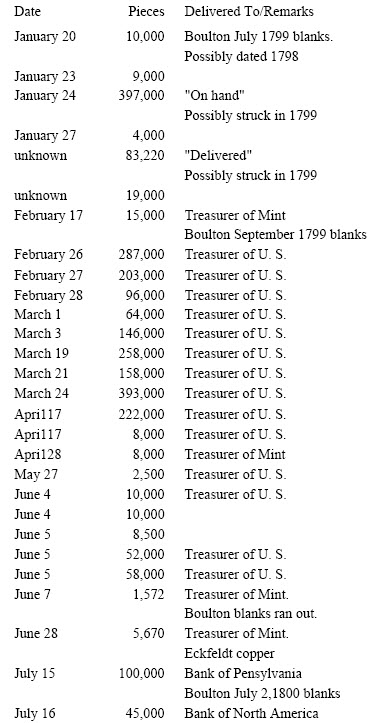
At the beginning of 1800, the Mint had on hand nearly 300,000 planchets from the Boulton shipment of July 1799, and over 900,000 from the Boulton shipment of September 1799. Owing to unprecedented demands for cents, the blanks from the July 1799 shipment were exhausted by the end of January 1800; those from the September shipment, by June 7. Many of these were probably dated 1798. Mint Director Boudinot was awaiting another shipment from Boulton, but with neither coined cents nor additional blanks on hand, and a heavy demand for cents, he had to fill the gap somehow. He bought 300 pounds of sheet copper from Jacob R. Eckfeldt (father of assistant coiner Adam Eckfeldt) and sent them to the blank cutter. On June 17, the Coiner delivered 5,670 cents from this source: the last cent blanks to be made within the Mint for generations. On July 2, the long-awaited Boulton shipment arrived (58 casks, in all ll tons), and thereafter through 1814 all cents were struck on Boulton blanks.
Planchets in the July 1800 shipment ran a little light-weight: the specified weight would have contained 934,283 blanks of standard weight (168 grains), but actually contained 948,433; the average weight is therefore 165.49 grains (10.72 grams). The cent blanks in this shipment wereexhausted by September 30. Rather than hunt for more sheet copper that fall, Boudinot ordered the coiner to make half cents from the 190,000 blanks on hand.
Between February and November 1800, copper prices had risen in England from £132 to £151 per long ton of raw (cake) copper. Boulton, in a letter to Boudinot, November 24,1800, said that owing to these drastic price fluctuations he might not be able to ship any more planchets until spring; and in fact no more arrived until late July 1801.
One would expect to find edge differences distinguishing the three Boulton shipments and the Eckfeldt planchets. The evidence is not nearly complete enough for certainty, but to date the varieties believed to be earliest (including some overdates) have the same single flange edge (SFE) found on some of the latest 1798-dated varieties, while some of them and all later varieties have one or another version of plain edge (PE). The SFE coins therefore probably represent Boulton blanks of July 1799. If so, many were struck in January 1800, before the blanks from this shipment were officially exhausted (no more on hand in the vault); the rest shortly after, while the last of these blanks were mingled with those from Boulton's September 1799 shipment. There is as yet no clue enabling one to identify the varieties struck from Eckfeldt copper. Out of a total mintage of 5,670, one would expect only a few dozen survivors. Not enough specimens have been weighed to enable absolute identification of the July 1800 Boulton shipment. Pursuing these lines of research may eventually lead to absolute identification of planchet sources and renumbering varieties to reflect delivery dates.
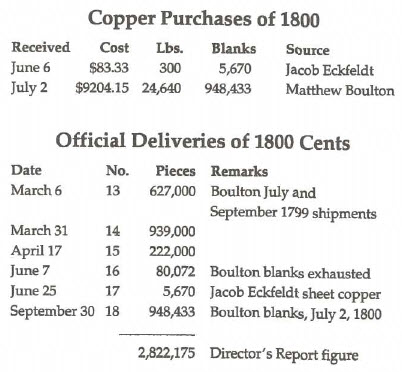
The following list of cent deliveries to and from the Mint Treasurer (after Julian, like the foregoing tabulation) is confused and, especially in the first half year, not completely reconcilable with other accounts due to sloppy bookkeeping.