Walter Breen's Encyclopedia of Early United States Cents
Walter Breen
As in 1802, the Mint distributed cents to local banks, while its purveyor Israel Whalon (or Whalen, or Whelon: spellings vary) shipped other cents to cities elsewhere in the United States. In December 1803, Tench Coxe took over Whalon's duties.
The emission sequence contains uncertainties similar to those of 1802. We can be sure that the group 1-3 came first because two of its three reverse dies also appear in 1802 numbers 19-20. We can be sure that the Large Date obverse was made last, though it may not have been used last; the three pairs of dies with Large Fraction reverses, numbers 16-20, either immediately preceded the latter or may even have followed it.
Almost certainly these nine varieties 16-24 constitute most of the 1804 mintage; confirmation must await discovery of the date of manufacture of the new letter punches, or in matching the edges of 1804 cents to the Large Fraction varieties of 1803 but not those of Small Fraction varieties. But in what order were the intervening groups made?
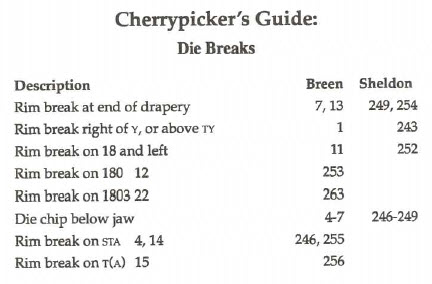
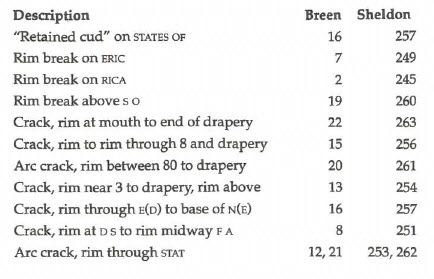
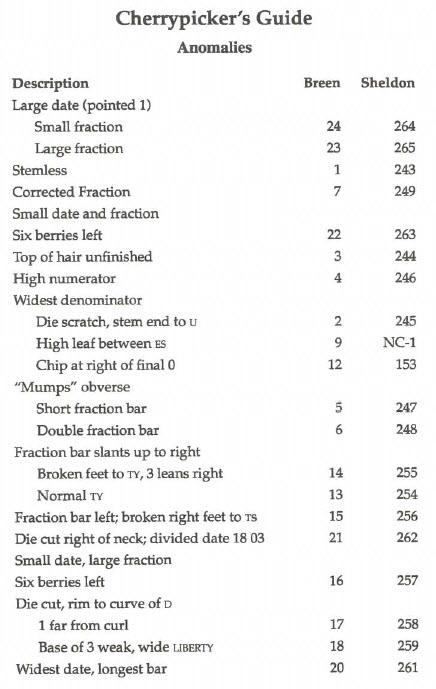
Among the remaining Small Fraction coins, the reverse of number 7 is an 18011/000 die with its blunder corrected. This variety shares a normal 1 in the fraction with reverses of numbers 13, 14, and 22, a normal D with number 22, and a broken x with numbers 12 and 22. The broken TS found on most of the later 1802 reverse dies reappear on 1803 numbers 3-6, 8, and 13-15. Other evidence which might help solve the problem is obscured because some broken letters were hand repaired. The extra wide fraction of number 2 (die of 1802 number 19) reappears in numbers 9 and 12. The high numerator of 1802 reverse K recurs in number 4. Most likely all these dies were left over from 1802, possibly some even from 1801; and Scot, here as in former years, did not use reverses in order of manufacture. The order here presented is therefore subject to revision.