Walter Breen's Encyclopedia of Early United States Cents
Walter Breen
1803
(Mint report: 2,471,353)
With over two million cent blanks on hand at the beginning of the year, and promises of regular shipments from Boulton, Mint Director Boudinot doubtless felt that one of his major problems was solved. The start of the Mint's second decade seemed auspicious: the Mint had survived personnel shortages, materiel shortages, thefts, epidemics, and even Congressional attacks. (More of all these were to come, however.) One of Boudinot's major remaining problems was die steel of proper size, affecting half cent coinages 1803-08 and cent coinages 1800-05. To this shortage we attribute continued use of clashed, rusted, and broken dies long after they would normally have been condemned as unfit. However, though we do not know the date, the Mint must have received a new shipment of die steel of superior quality. After 1804, though cent coinages were smaller in amount, they required far fewer dies; the average number of cents coined per die more than doubled, and variations are less marked.
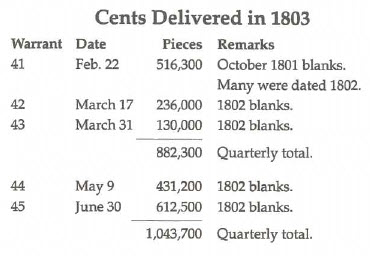
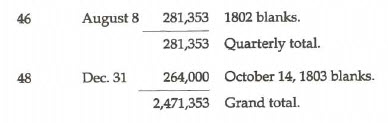
The 516,300 cents delivered February 22, 1803 included many dated 1802; all were struck on planchets from Boulton's October 1802 shipment.
On February 23, 1803, the remaining Boulton blanks (Theoretically 1,713,250 actually about 1,694,000.) were officially charged to the coiner and cent deliveries through August 8 came from these.
The 2,770 spoiled cents of the February 22 group and the 3,325 rejects from the August 8 group were rolled down to make 5,900 usable half cent blanks. This was the last time the Mint would make its own blanks for circulating half cents.
Boulton delayed further copper shipments pending thefinal Congressional attempts to abolish the Mint. His July shipment (62 casks of cent planchets and 33 casks of half cent blanks) arrived in Philadelphia, on board the Bristol Packet under Capt. John Phillips, while the Mint was closed for the yellow fever epidemic (September 20-November 1). The cent blanks went to press November 7, sufficing for all struck through November 12, 1804 (most dated 1803). Boulton's second shipment arrived aboard the Newton under Capt. John Riley; it contained again 62 casks of blanks for cents, 31 for half cents, but did not go to press until the end of 1804. ( R.W Julian, "The Cent Coinage of 1803," Coin World, May 4, 1977, p. 52.)
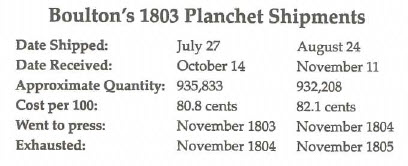
Blanks from the 1802 and 1803 shipments may be distinguishable, however, nobody has studied edges of cents in this period. All cents struck in 1803 and 1804, from the 67,470 pounds purchased in 1803 and the 45,410 pounds of 1804, were overweight, averaging 7 dwt 3-1/ 3 grains each (11.10 grams). (According to G. Duvall, "Report of the Comptroller of the. Treasury," February 16, 1805.) The discrepancy or "underplus" went into the Mint's "Profit and Loss" account. (American State Papers-Finance, Vol. II, pp. 136-7.) Julian points out that the same complaint applied continually from 1802 through 1814, though the Comptroller's reports do not always mention it.