Walter Breen's Encyclopedia of Early United States Cents
Walter Breen
1802
(Mint report: 3,435,100)
This year began as a dramatic contrast to 1801: Mint Director Boudinot had nearly 3 million cent blanks on hand, and every reason to believe more would be forthcoming when needed. As if in an act of faith that the Mint had solved its planchet supply problems for good, Boudinot sold 9,591 pounds of "rough copper," apparently clippings. (G. Duvall, "Report of the Comptroller of the Treasury," American State Paper5--'-Finance, Vol. II, 3/2/1803, #198, p. 31.)
Early in February 1802, the blanks from Boulton's July 1801 shipment ran out, and those from the October 1801 shipment went to press. Some cents struck during this period of change must have been dated 180l.
On April 7, 1802, Boulton shipped 39 more casks of cent planchets on board the Amiable (under Capt. D. C. Tillinghast): approximately 650,000 blanks, weighing over seven tons-all he had on hand. The consignment did not depart for another week, arriving June 15. Boulton's covering letter, dated April 14, promised further shipments and suggested that thereafter he ship 25 tons of cent blanks (about 2.3 million) regularly each spring and fall. Boudinot, on July 23, replied that he could not commit himself to any such schedule. The unstated reason was, as R. W. Julian points out, almost certainlypolitica1: Congress had not finished its attempts to abolish the Mint. (Cent Coinage of 1802:' Coin World, April 6, 1977, p. 1.)
On June 14, Boulton shipped another 26 casks of cent blanks (over 444,000, weighing nearly five tons) on board the Tom (under Capt. Peter Turner); these arrived August 27.
Two more shiploads of blanks were to follow: 77 casks (14 tons, 1.3 million) July 31, aboard the Roebuck (under Capt. Edward Kelley), arriving October 8; and 22 casks (four tons, approximately 375,000) August 18 on the India (under Capt. Caleb Hathaway), arriving October 28. No more would arrive until October 1803, but these shipments proved ample. Their cost had dropped from the high water mark of £150 per ton down to £131 in mid-1802, a welcome by product of temporary peace between Britain and Napoleon's France. (Julian, "Cent Coinage of 1802," p. 38.)
Julian conjectures that the high demand for cents in 1802 may mirror an economic upsurge, and refers to the odd coincidence that in the years of economic improvement there were fewer mis-made dies and fewer misstruck coins. (Cent Coinage of 1802," p. 28.)
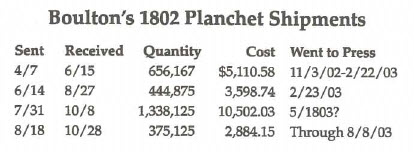
The quantity is reported as a theoretical figure based on weight. These planchets may be distinguishable by edges, as in 1797-1800. However, nobody to date has studied edges on 1801-03 cents.
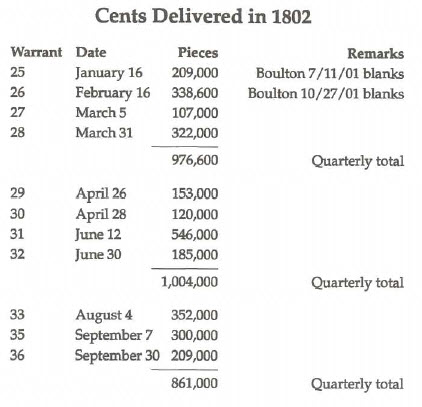
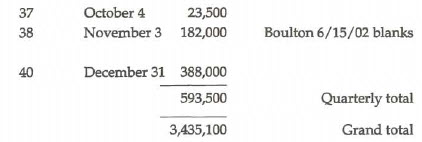
The missing warrant numbers, 34 and 39, cover the two deliveries of half cents, 8,200 on August 14 and 6,166 on November 17. The quarterly total figures are identical to those given in the Director's Report for 1802.
Little can be deduced from these delivery dates. Many delivered in the first quarter of 1802 were dated 1801; and the first delivery of 1803 (February 22, 1803) contained coins dated 1802: number 20 followed 1803 number 1.
Clues to the order of manufacture of dies dated 1802 and 1803 occur in the progressive chipping of punches, specifically N, T, and D, and in 1803 also the numerator.
They are partly obscured by Scot's hand repairs to individual letters. Perfectly formed NS occur only on numbers 13 and 17-20 (replacing the previous broken IV). The right foot of T is broken away on 1801 reverse G and most 1802 reverse dies beginning with number 9. Upper serif of D is short (partly chipped off) on numbers 12, 14- 16, and 19-20. For further details see 1803 below.