Walter Breen's Encyclopedia of Early United States Cents
Walter Breen
1795
During the first ten months of 1795, the Mint was pre-occupied with survival and silver coins, not necessarily in that order. Coinage included 86,416 half dimes from March to July (about 10% dated 1794), 317,844 half dollars from February to June (18,164 dated 1794 and 299,680 dated1795), and 160,295 silver dollars from May through October (dated 1795). These coins were more important as public relations items than as a supplement to Spanish coinage (dollars and fractional coins) then forming the bulk of circulating precious metal. Despite large mintages, few federal silver coins got into the hands of the general public and most stayed in banks for years, while the Mint's expenses still came to a large percent of the value of the coins it manufactured. Meanwhile, Congress had begun an investigation of the Mint to determine whether to abolish the"costly failure." The institution had many political enemies in and out of Congress, including some who eagerly awaited abolition as their cue to negotiate coinage contracts with Birmingham token factories.
The stress further affected Rittenhouse's already failing health, and early in 1795 he began talking of resignation. On April 9, Tench Coxe, Commissioner of the Revenue, offered the directorship to Dr. Benjamin Rush. Rush declined, however, in the fall of 1797 Washington appointed him its Treasurer.
When Rittenhouse resigned in June 1795, his successor, Henry William DeSaussure, named two primary goals: to place gold coins in circulation and to improve the designs of all denominations. (R.W. Julian, in a note to the editor dated 11/1/1995, stated: "1 know that Snowden said that DeSaussure was responsible for the change but I seriously doubt this; it almost certainly was a decision by the president. The gold coinage preparations were well under way before Rittenhouse left office at the end of June 1795.") During DeSaussure's four months in office, he took steps to fulfill this promise to the public. This meant even more time pressure for Robert Scot and John Smith Gardner. Scot had to sink six new matrices and raise from them six new device punches: two each for eagles, half eagles, and silver dollars. Gardner(with Adam Eckfeldt's help) had to sink these into working dies: four pairs for eagles, 10 pairs for half eagles, and two pairs for silver dollars. Half eagles were delivered between July 31 and September 16, eagles beginning September 22, and the redesigned dollars (Draped Bust with Small Eagle reverse, from models by John Eckstein after drawings by Gilbert Stuart) in late October. Even success was not enough:
DeSaussure resigned that same month due to health concerns.
Washington offered the directorship to Representative Elias Boudinot. Boudinot (1740-1821) was reluctant to accept it for lack of thorough grounding in chemistry-not realizing that as director his real task would be administration. Acting Secretary of State Timothy Pickering nevertheless preferred Boudinot over the other candidate, Isaac Smith, and on September 23, Washington concurred, (Taxay, U. S. Mint and Coinage, p. 101.) Boudinot ordered Scot to prepare dies for quarter eagles, quarter dollars, and dimes, and to redesign the lower denominations to conform to the Draped Bust dollars.
These developments left little time that year for copper coins. Nevertheless, the Mint continued purchasing copper. (Table after Julian, "The Copper Coinage of 1795," p. 3297, and "Cent Coinage of 1794-95," p. 14; Stewart, History of the First United States Mint, 1924, pp. 72-3, misdated the Prince purchase as June 13: in many handwritings Jan. is easily confused with Jun.)
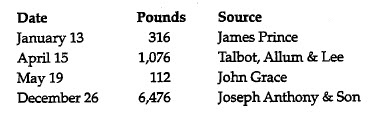
The shipment from the New York merchants Talbot, Allum & Lee probably consisted of about 52,000 of that firm's cent tokens, at 18 cents per pound. As some were coined at 46 to the pound and others at 50 to the pound, the Mint evidently valued the tokens at less than half face value. Most of these were cut down during spring 1796 to make half cent planchets. Why the firm was willing to sell its remaining tokens to the Mint so cheaply is uncertain. I have seen no Archives correspondence which could clarify the circumstances. Possible reasons include political pressure or financial reverses. One of the partners (Lee) retired the following year and the firm dissolved in 1798. (See discussion in Half Cent Encyclopedia, pp. 135-37.)
There is no way to distinguish planchets made from the Prince and Grace purchases. The Joseph Anthony shipment formed part of the mintage of plain edge coins in early 1796 from 1795 dies.
Deluged with escalated demand for dies to strike gold and silver coins, Scot necessarily delegated the task of making dies for copper coins to John Smith Gardner. The second Gardner head, made in December 1794 ("Head of 1795"), served for all six federal cent obverses dated 1795. Their reverses were all done by hand using individual punches for leaves, berries, letters, and numerals. Five of these dies were from a sketch (possibly by Gardner) differing greatly from the one Scot had used for most cent reverses of 1794. The other two dies are attributed to Scot. See General Description below.
Steel available for these dies was of poor quality, scaling and chipping at hardening. This problem was not completely solved until after Boudinot had arranged with Boulton & Watt for shipments of die steel. (See Sholley, "Inexperience, Not Die Steel, Caused Problems At Early U.S. Mint," Penny-Wise, March 1996, regarding current knowledge about sources of supply and quality of die steel.)
More than once, as I have been informed, the operations have been suspended, for want of dies, which the industry of the engraver could not supply fast enough for the presses. A happier selection of steel, aided by more skill in hardening the dies, has remedied this evil, and the engraver is now enabled to supply the mint with dies of every kind, in advance. (Report of the outgoing Director, Henry William DeSaussure, Oct. 27, 1795, in American State Papers: Finance, Vol. I, pp. 356-7.)