Walter Breen's Encyclopedia of Early United States Cents
Walter Breen
The same simple Mode of coining is now practiced at the Mint of the United States with great Advantage. [This probably means that Boudinot ordered Voigt and Eckfeldt to install hardware corresponding to Harper's.] - The present Director [Boudinot] on coming into office, found the Dies used by the said Memorialist, still in his Possession, and conceiving this to be very improper, took them into the Mint, with Design of paying the Memorialist for them. The Director finding that he could not legally reimburse him for his Services, offered him (Harper) the second appointment in the coining Department, which was refused, he being engaged in a more lucrative Employment-
The Director therefore on the whole of the Memorialist's Case (altho he does not think he suffered much by making the Presses, it being in the Way of his Business) yet considered him in Equity entitled to a reasonable recompense for the candid and carefull Information given to the Committee, the dies taken into the Mint, and the loss of Time in attending for that purpose.(Letters Sent by the Director of the United States Mint at Philadelphia, vol. 1, Nov. 2, 1795-Dec. 29, 1817. Record Group 104, Treasury Section, National Archives. From microfilm furnished by Alan Meghrig.)
This document proves that the Harper sample cents were in fact the first cents of 1795, being made for the Congressional committee no later than March 1795, seven months before any federal cents of this date.
After the price of copper had soared enough, in the fall of 1795, to make federal cents a losing proposition, John Harper made another move, in a letter addressed to Boudinot about a week after the latter became Director:
Sir:
I propose to engage with you, or any other gentlemen, on the following terms-that is to say-to receive sheet copper of the wright size and coin the same into Cents complete for circulation at the rate of eighty dollars per ton and to return the same in Cents and shruf [clippings] deducting twenty-five pounds in each ton for wastrel. I will also forge and harden all the dies, beds, and punches for the same.
Philadelphia, November 4, 1795.
"John Harper."
Boudinot's action was not to Harper's liking: as we saw above, he seized Harper's dies and offered him the post of Assistant Coiner. Unfortunately, the available salary was less than what Harper was already making. Boudinot may have encouraged Harper to petition Congress for compensation for expenses of his experiment; the text of this petition, dated February 3, 1796, is unknown, as the original document is lost. (Julian surmised that it was among many documents which perished when the British burned Washington in 1814.) However, Congress asked Boudinot to comment on the petition, and his reply was the above quoted Report of February 8, 1796.
The sobriquet "Jefferson Heads" is evidently from a slight (and probably unintentional) resemblance of the profile to that of Thomas Jefferson. This nickname first appeared in Mason's Coin Collector's Magazine. (Vol. 1, no. 9, p. 79 (12/1867). Editor's note: In vol. ill, no. 8, p. 85, Mason noted "its name derived from a sale of coins in New York, in 1864." W. E. Woodward, in his sale of October 18-22, 1864, described lot 617 as "1795 Sometimes called the Jefferson Head.") Mason had the Fewsmith specimen of number 11b, and made electrotype copies of it; as late as 1881 he was still selling these at 50 cents each. (Mason's Coin Collectors Herald, November 188l.) At that time, electrotype copies were collectors' only way of ascertaining what rarities looked like as coin photographs were rarer than the coins. In the 1950s some of these electrotypes were offered as genuine specimens.
This so called "Jefferson head cent" was probably named for the same reason as Guinea pigs (because they did not come from Guinea, and they are not pigs). The portrait on the piece does not resemble that of Jefferson, nor did he have aught to do with the issue, and last, but not least, it is not a cent; but is undoubtedly a counterfeit of the cent of 1795, and was struck somewhere about 1803. (David Proskey; Coin Collectors Journal, March 1880, p. 35.)
Evidently Proskey thought the large fraction was copied from that of the 1803 cents. He did not know the Harper story, of course.
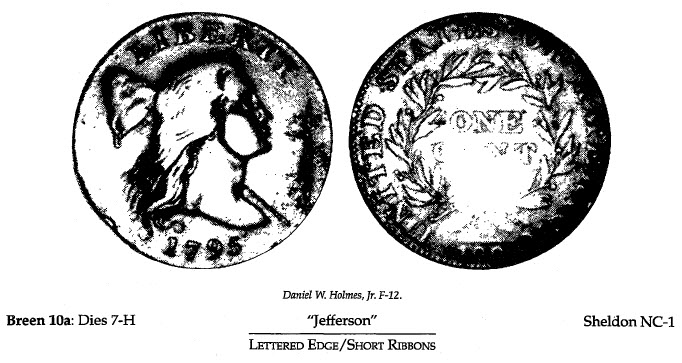
Obverse 7. Hair nearly straight and brushed into almost parallel thin strands, the lowest of which forms a long "lazy S" curl. No hair ribbon. Chin small and pointed with lips pouting. Small date. No attempt to imitate federal style.
Reverse H. As on reverse I of number 11, but no other die in the series, this has long lanceolate leaves, mostly in triplets or spread pairs. Each branch terminates in double leaves. The bow has three loops, though die failure obscures this detail. Anyone of the following points will enable the collector to distinguish this die from its sister reverse I: 1) Short ribbon ends not extending below the very long fraction bar. 2) Two outer berries on a very long single stem below the space between IT. 3) Outerleaf of triplet at ED ends well to right of center of base of E. 4) Triple leaf below STA. 5) Triple leaf below MER. 6) Right stem end opposite center of base of final A.
Edge: Lettered (see illustration). FOR is large and the leaf after DOLLAR points down. Thick planchet.
Die state: Bulge at bow, ribbons, and adjacent parts of wreath. The illustration in Penny- Wise does not show the reverse die cracks found on number 10b.
Equivalents: Included in EAC 9, Encyclopedia 1678.
Rarity 8. Only one reported.
Remarks: Discovered by Tony Terranova and Joseph H. Rose, at Harmer Rooke Numismatists Ltd., June 1974. Offered at the 1974 ANA convention at $30,000, unsold; at Harmer Rooke's September 22, 1976 auction, lot 311, it sold to William R. T. Smith, who consigned it to Bowers and Ruddy Galleries in 1978. After Bowers and Ruddy returned it as unsold, Smith sold it to Daniel W. Holmes, Jr. An enlarged illustration was published in Penny-Wise. (Penny-Wise, no. 44, 9/15/1974, p. 205.) W. R. T. Smith pointed out the difference in edge device from other specimens in his article, "Cents and Nonsense."(Penny-Wise, no. 57, 11/15/1976, p. 294-5.)