Walter Breen's Encyclopedia of Early United States Cents
Walter Breen
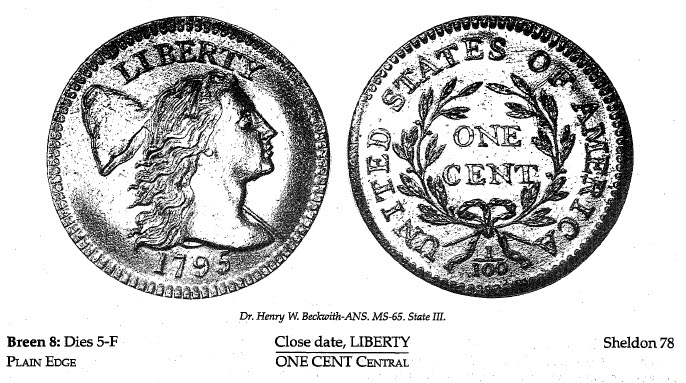
Obverse 5. Date closely spaced with 17 a little closer than the other digits. Top of 5 barely touches the bust. Poleis long and touches a dentil, LIBERTY is closely spaced. Junction of forelock and brow is below the left uptight of Y; Two center dots one in the hair left of the earlobe arid another on the neck ar edge: of hair just below the ear.
Reverse F. ONE CENT central; actually CENT is below center on this die, and the tiny center dot is a little less than halfway between the two NS. Triple leaf at D with other leaves in pairs, similar in layout to reverse C. Three berries left and four right. Right stem practically touches the right foot of final A. ES are high, AME touch, R is high, and (N)T is low.
Edge: Plain.
Die states: 1. Perfect dies, no clash marks. But compare with state V.
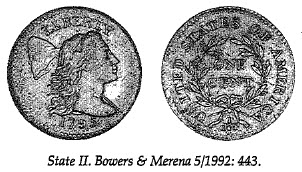
II. Faint fivefold clash marks at neck. Reverse has at least five sets of clash marks below TES 0 with complex clash marks from hair in the wreath.
III. Small break or die Chip under the jaw near neck.
IV. Traces of 11 sets of dash marks, in and below the cap, and on the reverse below TESO.
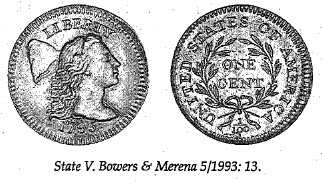
V. Both dies heavily polished with clash marks gone. Many specimens have somewhat prooflike surfaces.
VI. Crumbling joins top of 5 to the bust. Equivalents: Proskey 7. Doughty 70. McGirk SA, 5B, 5C. Clapp-Newcomb 6. Sheldon 78. EAC 7. Encyclopedia 1676.
Rarity 1.
Remarks: Often weak at N, opposite top of the cap. Often on blanks showing numerous minute defects.
Reverse F is a Gardner die copying reverse C. It may have been made as early as December 1795.
An example has been reported at 187.0 grains (11.3% overweight). (Kagin's Numismatic Auctions, 1/1986: 4139.)