Walter Breen's Encyclopedia of Early United States Cents
Walter Breen
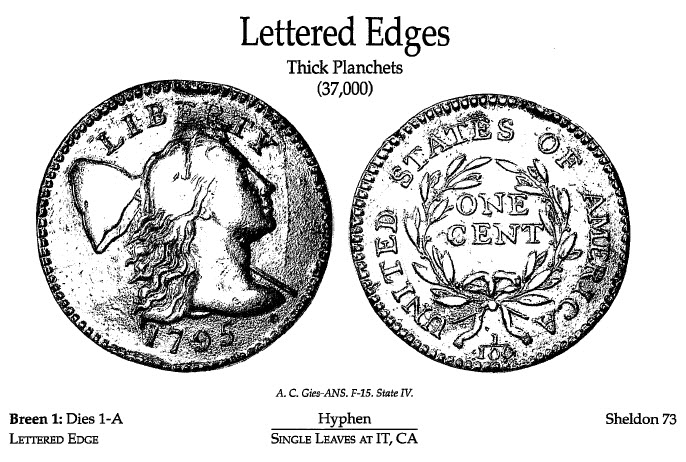
Obverse 1. Wide date with 1 close to the point of lowest lock and 5 free of the bust. b and r are high with Y low and leaning to the right. Hyphen-shaped die chip between rt, extending under the tail of the r. Bulged below er.
Reverse A. Single leaves at IT and CA. A leaf points to E(R). Five berries on each branch with none at the right bow. Low close fraction, its bar touching all digits except the first zero. D is low. E is below ON and c is below ENT.
Die states: I. The "hyphen" chip between RT is constant while the bulge at E becomes larger. Two fine cracks join RT, one from the chip, the other at their bases.
II. Advanced bulge at ER. Cracked from the left top of u through N, to the base of I, below TE to D, and beyond.
III. Double clash marks from the cap. Delicate crack from the center of F down through AME, up through RI, and to the rim above c. Rare. Struck after the first specimens of number 2.
IV. Cracked from the rim above y into the field before the face, eventually to pole. This begins as elongated dots and later becomes very heavy. A light crack develops through UNITED. Very rare.
Equivalents: McGirk 2B, 3B, 3C. Clapp-Newcomb 1. Sheldon 73. EAC 1. Encyclopedia 1672.
Low Rarity 5.
Remarks: Discovered by Sylvester S. Crosby before 1883; rediscovered by McGirk (who did not recognize that it was a different obverse die from any in Doughty) and by George R. Ross. (Numismatist, December 1922, p. 591.)
The discovery coin was in the Crosby collection, lot 1498 $4, described by Haseltine in hisatalogue of June 27-29, 1883.
Probably about 2,000 were coined. The 40-odd survivors represent 2% of the mintage. This low survival proportion reflects melting of cents in late 1795 and in 1796 as they were worth more than face value: recall DeSaussure's letter above.
The Norweb coin has the edge blundered ONE HUNDREDR A DOLLAR. (Dan Trollan, Penny-Wise, no. 184, 1/15/1998, p. 11.) Dan Trollan reported an example with an unlettered edge in the Kristian Wang collection and an example with the edge lettered ONE HUNDRED A DOLLAR in the collection of Red Henry.
Condition Census:
EF-45 Foster Lardner • The United States Coin Co. 11/1914: 26 $135 • Henry C. Hines, 1945 • Dr. William H. Sheldon, 4/19/1972 • R. E. Naftzger, Jr., 2/23/1992 • Eric Streiner, 12/1993 • Wes A. Rasmussen. Obverse illustrated in Early American Cents and in Penny Whimsy. Obverse and reverse illustrated in Noyes. Hines refused a $500 offer from George H. Clapp in 1938 for this famous rarity.
VF-20Dr. George P. French, 3/21/1929 • B.Max Mehl FPL, 1929: 95 $75 • T. James Clarke, 1944 • B. Max Mehl, 1944 $125 • Henry C. Hines • Homer K. Downing • 1952 ANA (New Netherlands Coin Co. #38): 1705 $77.50 • Dr. William H. Sheldon • Dorothy Paschal, 5/1977 • Denis W. Loring, 2/1979 • Charles E. Harrison, 12/1991 • Denis W. Loring, 12/2/1991 • Robinson S. Brown, Jr. • Superior Stamp & Coin Co. 1/1996: 103 $3,960 • Walter Husak. State I.
F-15 Sharpness of VF-25 but edge dents. A. C. Gies, 5/ 1936 • George H. Clapp • ANS. State IV. Obverse illustrated in Clapp-Newcomb and in Noyes.
F-15 Charles M. Williams • Numismatic Gallery #68, 11/1950: 86 $34 • M. L. Kaplan • C. Douglas Smith • Dr. Charles L. Ruby, 12/1972 • Superior Stamp & Coin Co. • Superior Galleries 2/1974: 406 $625 • Fred S. Werner • Superior Galleries 11/1976: 49 $525 • William R. T. Smith, 9/1977 • Denis W. Loring, 11/1977 • Charles Gifford • Frank H. Stillinger.