Walter Breen's Encyclopedia of Early United States Cents
Walter Breen
Reeded Edge
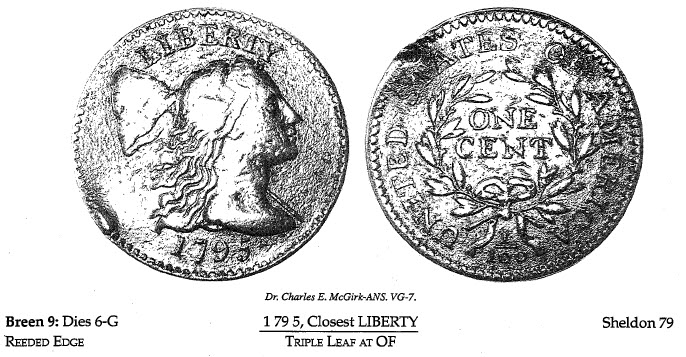
Obverse 6. Date spaced 1 79 5 with 1 and 5 very close to the hair and bust but neither touching. LIBERTY is crowded together with all letters touching neighbors except B. Forelock nearly touches Y. Junction of forelock and brow is below the right upright of Y.
Reverse G. Style of 1794. Fourteen leaves left and 18 right. Single leaves at C(E) and above ONE, double atop right branch, triple at OF. Seven berries on each branch, three below M, the innermost berry vestigial. This die reappears as 1796 reverse H, with the first six Draped Bust obverses.
Edge: Vertically reeded. Weights close to Plain Edge standard, 168 grains (10.89 grams).
Die states: Two minute die chips between E(O) and the wreath. On the Downing coin, roughness obscures them.
Equivalents: McGirk 6A. Clapp-Newcomb 7. Sheldon 79. Judd 20. EAC 8. Encyclopedia 1677. Pollock 29.
High Rarity 7. Six known, a seventh reported.
Remarks: Apparently discovered by W. A. Lilliendahl in 1862. "1795 Thick die, milled edge, in excellent preservation, and excessively rare." (Lilliendahl collection, Bangs, Merwin, 5/26-28/1862: 538.) It brought $2.50, which would then have been very high for a lettered or plain edge 1795 in any grade below Mint State. Lilliendahl's discovery coin is untraced and probably resides somewhere in a date set marked "Plain edge, ONE CENT central." The term "thick die" then normally applied to lettered edge coins, most often number 3, and probably connoted "double leaves atop right branch."
Publicized by McGirk (Numismatist, April 1913, p. 198-9.) as a Plain Edge variety. Others claimed it was discovered by David Proskey.
In Early American Cents, Sheldon illustrated the wrong reverse (that of 1796 number 25); this error was corrected in Penny Whimsy.
The reeded edge was an experiment which proved to be a needless frill, adding to the cost of manufacture without compensatory advantage. Unlike precious metals, copper, especially at the new weight standard, was unlikely to attract specialists in clipping and shaving coins. Most likely the reeded edge was an attempted measure to combat counterfeiting. (A query from Harry Salyards in a letter to the editor, dated 9/22/1996: "The edge reeding is unusually crude and irregular, at least as viewed on the Jack H. Robinson coin. Has anyone ever held two examples together and compared the edge reeds to see if they match?") Accordingly, listed as "experimental" by Dr. J. Hewitt Judd (number 20) and also listed by Andrew Pollock ill (number 29). (U.S. Pattern, Experimental and Trial Pieces, Racine, WI: Whitman Publishing Co., 1959, p. 15; United States Patterns and Related Issues, Wolfeboro, NH: Bowers and Merena, 1994, p. 23.)
Obverse is similar to obverse 4 of number 5. The two dies were probably made the same day or on successive days. If the present variety was only made for experi-mental purposes, there is no way of deciding if it preceded or followed number 8.
This reverse is attributed to Scot. It was reused with 1796 Draped Bust obverses.
This is by far the most coveted of all regularly num-bered Sheldon varieties (those he did not give NC numbers), easily outdistancing his numbers 15, 37, 96, 210, and 217, and at least six of his NCs. By bidding successfully on the G. Lee Kuntz coin, John R. Frankenfield became the ninth person ever to complete a set of the numbered Sheldon varieties. More recently, Daniel W. Holmes, Jr. became the 10th when he completed his set in December 1996 and W. M. ''Jack'' Wadlington became the 11th to complete a numbered set in November 1997. The others: George Clapp, Dr. William H. Sheldon, Dor-othy I. Paschal, R. E. Naftzger, Jr., Denis W. Loring, Robinson S. Brown, Jr. (twice!), Jack H. Robinson, and G. Lee Kuntz. When "the bug bites" (Sheldon's phrase), it can bite hard. Alan J. Brotman, Sheldon, and Loring have owned three different specimens each; Clapp, Newcomb, and Downing owned two each; and Robinson S. Brown, Jr. has owned the same coin on two different occasions.
Condition Census:
MS-60 Rumored to exist in a provincial European museum.
VG-8 Discovered by Dr. S. T. Millard • B. Max Mehl #34, 3/1915: 75 $15.50 • G. Kraft • Robert D. Book, 5/ 1930 • George H. Clapp, traded for "a famous 1794 cent" • Howard R. Newcomb • J. C. Morgenthau &: Co. #458, 2/1945: 76 $165 • James Kelly FPL #21, Fall 1945 $350 to #23, Spring 1947 $175 • Celina Coin Co. #21, 3/1947: 2037 • James Kelly • James Kelly 11/1947: 927 $150 • James Kelly. James Kelly 4/1948: 1327 $150 • Christian M. Petersen • Hollinbeck Coin Co. • Hollinbeck Coin Co. #166,10/1953: 278 $660 • Dr. William H. Sheldon, 4/19 / 1972 • R. E. Naftzger, Jr., 2/23/1992 • Eric Streiner • Anthony Terranova, 12/20/1993 • Daniel W. Holmes, Jr. Obverse illustrated in Early American Cents. Obverse and reverse illustrated in Penny Whimsy and in Noyes.
VG-7 Sharpness of F-12 but a very heavy edge dent has been repaired, minutely porous, and bent. W. Elliot Woodward #108, 4/1890: 866 $0.95 • Chas. Steigerwalt • Hon. George W. Lewis • Henry Chapman 6/1916: 633 $25 • Dr. Charles E. McGirk • Walter F. Webb, 2/19/1937 • George H. Clapps ANS. Obverse and reverse illustrated in Clapp-Newcomb.