Walter Breen's Encyclopedia of Early United States Cents
Walter Breen
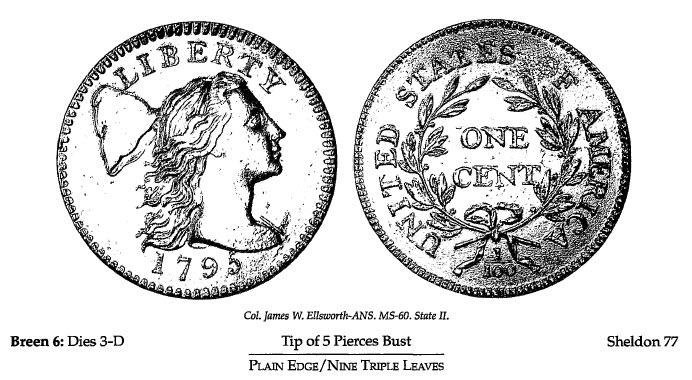
Obverse 3.
Reverse D. Style of 1796 with narrow dentils and leaves. Five triplets on the left branch and four on the right. Dot in the triangle of A(M). ED are high, AMER touch, NE are very close, c is below EN, and EN touch. Four berries left and six right. Die chips near ribbon ends and the fraction.
Edge: Plain.
Die states: 1. Obverse as state V of number 4b. Reverse without cracks.
II. Obverse reground to remove clash marks (two remain below LI). The pole is a disconnected fragment and hollow places appear in the hair. Faint triple clash marks on the reverse. Usually weak at NI (opposite cap), CENT, top right leaves, and O(F).
III. Bulges develop right of Y, at border opposite the chin, above the pole, and right of the date, later also left of the date. Precedes number 4b, state VI. Faint reverse cracks from the rim above AT through ES, from the rim above S to top of O(F), from rim through E(R) (this becomes heavy), from right base of final A through the ribbons touching lower edge of the knot.later extending to C(A), and through NI to the rim.
IV. Cracked from the rim right of final A to the berry and from the leaf below (N)T.
V. Cracked from the rim through right side of N(I) to the left termina1leaf. Additional delicate cracks. Obverse swellings advanced. See Remarks.
VI. Bulge on the obverse advanced from 6:00 to 9:00, affecting 17. A reverse bulge affects ED STAT and AMERI.
Equivalents: Proskey 6. Doughty 69. McGirk 4A, 4B, 4C. Clapp-Newcomb 5. Sheldon 77. EAC 6. Encyclopedia 1675.
High Rarity 3.
Remarks: Unlike earlier 1795 reverses, this die is attributed to Scot. The narrow dentils and leaves continue through the 1796 Liberty Caps. This die is similar to re-verse B of 1796; its most probable time of manufacture was March 1796. Gardner left the Mint on or shortly after March 31.
Intermediate die states probably exist. The coin with a crescent shaped die chip below and left of the lowest lock has not been available for rechecking; nor has the one reported to have a crack from the shoulder to the cap and border (Proskey 6 "Sub Variety").
Harry Salyards commented: ''To illustrate the transitional nature of this year's cent coinage, I own an example of this variety, somewhat overweight at 10.92 grams, on a planchet whose thickness is halfway between the old Lettered Edge cent thickness and the new Plain Edge cent thickness. Since this coin is only G- VG, the weight discrepency was obviously greater when it was new. (Letter to the editor, 9/22/1996.)
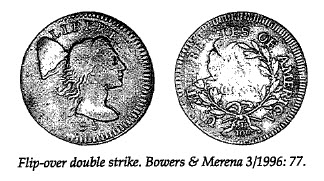
In his fixed price lists since February 1986, Thomas D. Reynolds has listed at least three different examples with incomplete (clipped) planchets. Pete C. Smith has reported others including at least six with double clips. A flipover double struck example (illustrated above) appeared in an Auctions by Bowers and Merena sale, 3/1996, lot 77. Others are known double struck, such as lot 662 in the Ruby sale (2/1974). See "Oops!" chapter.
Condition Census:
MS-60 Col. James W. Ellsworth, 3/1923 • Wayte Raymond • Charles E. Clapp, Sr., 8/1924 • George H. Clapp • ANS. State II. Reverse illustrated in Clapp-Newcomb and in Penny Whimsy. Obverse illustrated in Early American Cents.
AU-55 Charles E. Clapp, Sr., 3/1921 • George H. Clapp • ANS.
AU-55 Peter Mougey • William H. Woodin • Thomas L. Elder #43, 9/1910: 19 $23.50 • Dr. George P. French, 3/21/1929 • B. Max Mehl FPL, 1929: 91 as "an even olive Proof' $150 • Henry A. Sternberg • T. James Clarke, 1944 • B. Max Mehl, privately. Lotus Sullivan • French's #31, 4/1947: 375 $76 • R. E. Naftzger, Jr., 2/23/1992 • Eric Streiner • Dennis Mendelson • Thomas D. Reynolds. Obverse and reverse illustrated in Noyes.
AU-50 Henry C. Miller • The United States Coin Co. 12/1917: 420 $29 • Dr. George P. French, privately • un-known. Charles J. Dupont • Stack's 9/1954: 106 $325 • Mrs. R. Henry Norweb • Bowers and Merena 11/1988: 2738 $6,600. State II. Reverse illustrated in Early American Cents.