Walter Breen's Encyclopedia of Early United States Cents
Walter Breen
On October 27, the Coiner delivered 37,000 cents representing one week's work. The Bank of the United States received 26,000 of these while the Bank of Pennsylvania received 11,000, both on the same day, exhausting the Prince and Grace purchases and the Mint's supply of usable copper.
There is no copper in the mint fit for coinage. There are, indeed, considerable quantities of clippings of the copper, which are reducible into ingots, and would, when rolled, be fit for use; but the mint is so illy prepared for these operations on that metal, whilst occupied in the coinage of the precious metals, that it would be advisable for the Government to apply these clippings, and some other masses of copper in possession of the mint (the copper nails?), to some other purposes, and to exchange therefor, some of the sheet copper it (the government) possesses, or to purchase sheet copper for the coinage. The price of copper having risen considerably, from causes which, it is said, will be operative for some time, if not permanently, it has been suggested that it would be useful to diminish the weight of the cent, as the copper would, thereby, be brought nearer to its proportionate value to silver, and might prevent its being worked up by the copper smiths. The law seems to have contemplated the possibility of such an arrangement being proper, by giving you (President Washington) the power to make the alteration.
Accordingly, on October 27, the incoming Director, Elias Boudinot, stopped further copper coinage until something could be done about bullion costs. Temporay failure of the Anglesey mines had sent copper prices high enough that each cent cost mote than face value to produce; approximately $1.22 per 100. Brokers were quoting 36 cents per pound for plate or sheet copper, while the Mint's break-even figure was 31 cents. The Act of March 3, 1795 had authorized the President to reduce official weights for cents and half cents. (Legal minimum would have been 160 grains for cents and 80 grains for half cents; Boudinot proposed 168 and 84 grains.) Late in December, President Washington reduced the weight standard: the end of an era. (See discussion in Half Cent Encyclopedia, pp. 123-26.)
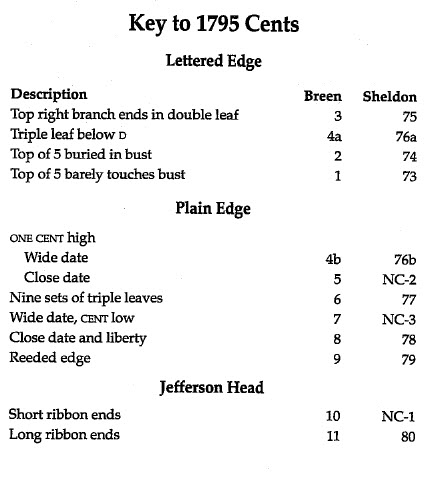
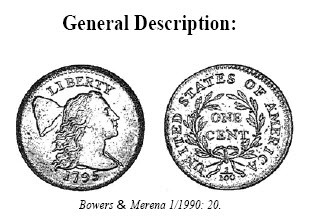
Obverse: Simplified copy of the 1794 design with five locks, the lowest bent down without forming a curl. The device punch contains the cap but not the pole. LIBERTY, 1795, and border dentils were punched in by hand while the pole was engraved by hand. On the three obverse dies prepared in October 1795 for the Lettered Edge coins, dates are widely spaced and begin far to the left. On the three later dies (possibly made in December), dates are less wide and begin more to the right as. on most obverse dies of 1794. .
Reverse: Layout approximately copies the 1794 prototype, but wreaths differ markedly. Unlike the half cents, there is no standard design. Gardner's sketch must have been vague. We can deduce that it specified on each branch three inside pairs of leaves, four outside pairs and one singleton, and another single leaf at the top. However, each die copying it either added or omitted at least one leaf, not always in the same pair. Two reverses are attributed to Scot: D with fine dentils and narrow leaves mostly in triplets, as in the 1796 Liberty Caps, and G with layout of 1794, leaves 14 left and 18 right, double leaf at top of right branch, triplet at OF.
Edge: Lettered, the same as in 1794. See the following sections for plain and reeded edges.
Weight: Standard 208 grains (13.48 grams). This was reduced in December: see the following section. Observed weight range for the lettered edge coins is 187.37-225.5 grains (12.14-14.61 grams), except for the piece in the Smithsonian overstruck on a token.
Diameter and thickness: As in.1794.