Walter Breen's Encyclopedia of Early United States Cents
Walter Breen
Plain Edge
Thin Planchet
Issues of December 1795-March 1796 (501,500)
After Boudinot interrupted cent coinage, he wrote to President Washington, December 3, recommending that the official weight of the cent be reduced. Accordingly, Washington gave verbal orders that, beginning December 27, 1795, cents should thereafter weigh 7 pennyweight (168 grains or 10.89 grams). Boudinot promptly directed workmen to cut cent planchets at the new weight. Copper prices later went down, and cent coinage thereafter began to yield a profit to the Mint.
Some of the earliest cents struck at the new weight (numbers 4b, early state, and 5) were apparently made on blanks from John Anthony's shipment of 6,476 pounds, recorded as received December 26. Either Boudinot jumped the gun, or work must have gone on all night long: the first 20,000 pieces were coined on December 27, the next 25,000 on December 31. Other sheet copper purchases followed in February 1796, mostly for 1795 Plain Edge coins:
| Date | Pounds | Source |
|---|---|---|
| February 8 | 2,418 | George & Henry Wescott |
| February 9 | 7,490 | Alexander Bilsland & Co. |
| February 13 | 1,657 | Thomas & John Clifford |
| February 27 | 2,494 | George & Henry Wescott |
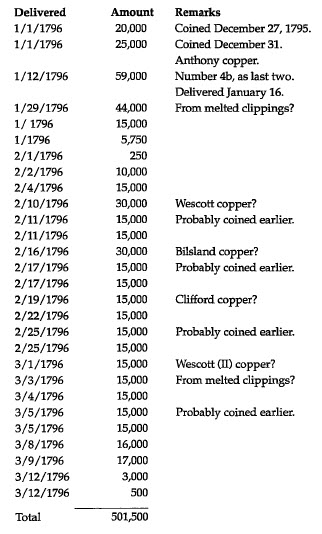
Some of these were also used for 1796 Liberty Caps. According to Julian, about half the 501,500 Plain Edge1795s were made from these sheet copper purchases, the other half on blanks made from remelted clippings. There is no way to distinguish among these copper sources, except that the coins struck from remelted clippings are more likely to show planchet defects. Director Boudinot insisted that subsequent copper purchases be in sheet form as scrap copper had to be melted, cast into ingots, and rolled into strip before cutting into blanks. Between the extra expense for additional processing and the risk of breakdown of the Mint's primitive rolling mills, any per-pound savings on scrap copper would be false economy.
The table which follows represents all deliveries believed to include 1795 Plain Edge cents. Often, the Coiner recorded the deliveries a day or two after the actual coinage. This explains deliveries too large to have been coined in a single day, and extra deliveries on a single day.
More freaks or mint errors survive among 1795 Plain Edge and 1797 cents than of any other years from 1793 through 1857. Many others were cut down to make half cent planchets. These episodes of abandonment of quality control may reflect a combination of high coinage quotas and low morale. (see "Oops!" chapter.)