Walter Breen's Encyclopedia of Early United States Cents
Walter Breen
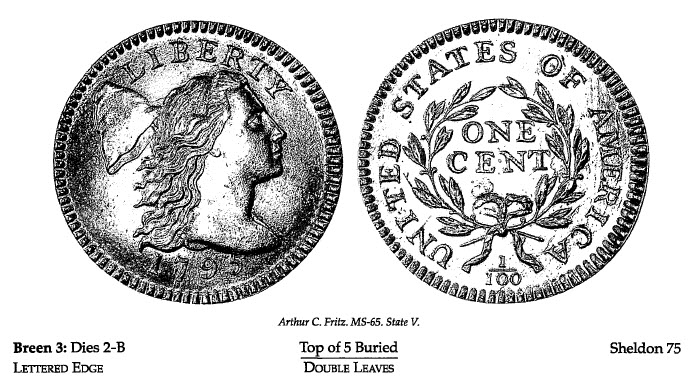
Obverse 2. Cracked from the rim between 95 to top of 9 and the bust.
Reverse B. Double leaf at top of the right branch. All leaves are in pairs except the three singles at TE(S) and OF. Five berries left and four right with a berry below the right bow. Three center dots. U and ST are low. C E N is widely spaced. Long die scratch from the outer leaf point below IT pointing to E, another down from the right upright of N(r), others in the field, most prominently at OF AMERICA and both ribbons.
Edge: Normally lettered as before; but see Remarks. Die states: 1. Crack from right of 9 and scattered traces of die rust (mostly near the date) as in number 2, state V.
II. Double clash marks below S O.
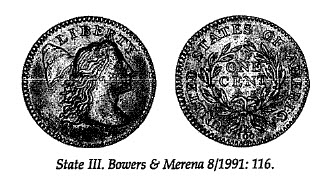
III. Reverse cracked from the rim above A through the tops of ME.
IV. Crack from the rim opposite the mouth to tops of RTY. Rust advances in the right obverse field. Triple reverse clash marks below S o.
V. Obverse buckling, most prominent at the date and left. Rust advanced. Delicate crack from the rim slanting up to the cap. The crack through RTY extends through tops of IBEto the rim above L. Reverse beginning to buckle.
VI. Buckling obliterates A(M), evidently related to the crack of state III. (Walter Breen, "The Cent Collectors' Forum," The Numismatist, March 1957, p. 280.)
Equivalents: Proskey 2. Doughty 67. McGirk 2A.
Clapp-Newcomb 3. Sheldon 75. EAC 3. Encyclopedia 1671.
Rarity 3. This variety constitutes the majority of 1795 Lettered Edge cents.
Remarks: Often on defective planchets; even Mint State survivors show granularity or minute pit marks. Sometimes found with foreign matter having adhered to the reverse die, so that areas around ONE CENT look as though flakes had come off the planchet.
Probably about 24,000 were coined, representing three days' work.
In the Smithsonian Institution is a Mint State specimen overstruck on a 1794 Talbot, Allum & Lee token (Fuld 3 or 4) weighing 146.7 grains (9.50 grams). No edge lettering of its own although OF shows from that of the token. (Editor's note: John D. Wright has examined this coin and states that their is no visible evidence of edge lettering from the token. Refer to his article II A Fascinating 1795 Cent," Penny-Wise, no. 158, 9/15/1993, pp. 322-329.) This may have been a set-up trial or some other kind of experimental striking. Its light weight rules out any intention to overstrike tokens for circulation. This piece was in the Mint Cabinet Collection inventory in 1859, and almost certainly formed part of Adam Eckfeldt's original archival collection (1792-1839), which became the nucleus of the National Collection.
Donald Botteronreported a specimen with. plain edge, 187.4 grains (12.14 grams).(Penny-Wise, no. 29, 3/15/1972, p. 61.) All such specimens (like similar coins dated 1793 and 1794) represent not an intentional sub-variety but mint errors. The blank missed the edge marking process before going to press. Beware of cast and electrotype copies which may also have a plain edge (check ring, weight and edge). Weight standard, 208 grains (13.48 grams).
Robinson S. Brown, Jr. (Superior, 9-10/1986: 99.) had one with the edge blundered ONE HUNDRED A DOLLAR. This may be the coin called Proskey 3.3 On October 4, 1985, James Livingston showed me one struck on a "straight clip" (end of strip), with part of A DOLLAR on the straight segment.' Dan Trollan reported an example owned by Jim Long with doubled edge lettering," At the 1989 ANA convention, Dorothy Gershenson showed me a high-grade double struck specimen with one striking about half off-center and both dates clear. See "Oops!" chapter, below.
Donald Botteron reported a specimen with. plain edge, 187.4 grains (12.14 grams).
(Penny-Wise, no. 29, 3/15/1972, p. 61. All such specimens (like similar coins dated 1793 and 1794) represent not an intentional sub-variety but mint errors. The blank missed the edge marking process before going to press. Beware of cast and electrotype copies which may also have a plain edge (check ring, weight and edge). Weight standard, 208 grains (13.48 grams).
Robinson S. Brown, Jr. (Superior, 9-10/1986: 99.) had one with the edge blundered ONE HUNDRED A DOLLAR. This may be the coin called Proskey 3.3 On October 4, 1985, James Livingston showed me one struck on a "straight clip" (end of strip), with part of A DOLLAR on the straight segment. (Coin Collectors Journal, March 1880, p. 34.) Dan Trollan reported an example owned by Jim Long with doubled edge lettering, (Letter to Mark Borckardt, April 28, 1997.) At the 1989 ANA convention, Dorothy Gershenson showed me a high-grade double struck specimen with one striking about half off-center and both dates clear. See "Oops!" chapter, below.