Walter Breen's Encyclopedia of Early United States Cents
Walter Breen
Unlike the Downing coin, the Whitson example is not overstruck on a previously struck coin. (John D. Wright, in a note to the editor, considers the Dawning coin to be an example of this variety. He states his belief that this is a flip-over double strike with the undertype showing the same hair style found on the Jefferson Heads and no other Liberty Cap cents. The edge has H and D in HUNDRED colored in yellow, Downing's trademark for his coins. This would indicate Downing recognized this as a lettered edge Jefferson Head prior to the sale of his collection in 1952. At the sale of the Robinson S. Brown, Jr. collection in 1996 the editor had a chance to examine both coins together. It is my opinion that the edge lettering on these two coins is identical. See additional comments at our number llb.) The planchet is very irregular, not round, and broader than normal (30.1 millimeters), allowing more border dentils to show than on llb. The reverse is about 10% off center (Penny- Wise, no. 147, 11/15/1991, p. 321. In examination of this coin, Breen stated that it is about 15% off-center, the editor feels 10% is accurate, and John Wright states 3% off-center.) while the obverse is normally centered.
Reported to the numismatic fraternity in Coin World and in Penny- Wise. (Coin World, October 9, 1991, pp. 86, 93. Penny-Wise, no. 147, 11/15/1991, pp. 321,385.)
Condition Census:
G-5 Sharpness of F-12 but porous, with edge dents; cleaned and recolored. Purchased unattributed in Fresno, California in 8/1991 by Curtis R. Whitson • Superior Galleries 10/1992: 75 $25,300 • Robinson S. Brown, Jr.• Superior Stamp & Coin Co. 1/1996: 114 $23,100 • Daniel W. Holmes, Jr. 151.8 grains.
"X" Sharpness of AG-3 but holed. Homer K. Downing. 1952 ANA (New Netherlands Coin Co. #38): 1716 $21.50 • Harold Bareford, 9/12/1985 • Herman Halpern • Denis W. Loring • Daniel W. Holmes, Jr.
No other examples have been reported.
(Coin World, October 9, 1991, pp. 86, 93. Penny-Wise, no. 147, 11/15/1991, pp. 321,385.)
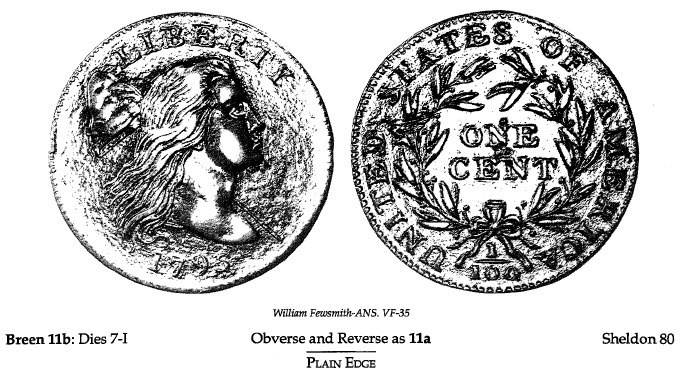
Obverse 7. Usually shows no border dentils. Reverse I.
Edge: Plain.
Die state: Obverse die lapped with curls and serifs thinner.
Equivalents: Proskey 8. Clapp-Newcomb X2. Sheldon 80. EAC 10. Encyclopedia 1679.
High Rarity 5.
Remarks: First described by Ebenezer Locke Mason in 1869, from a specimen in the J. Colvin Randall collection.
Usually well worn, these circulated side by side with federal cents. This remark applies both to the pieces struck on blanks cut from strip (Encyclopedia 1679), and to those variously identified as on cast blanks and as old casts (Encyclopedia 1680). The former are somewhat rarer and show edge marks from the blank-cutter.
All the struck "Jeffersons" apparently date to January or February 1795, before the Boudinot committee wrote its report, and many months before federal Lettered Edge 1795s. When the old casts were made is, of course, unknown.
The weight range of struck pieces is about 200 to 206.5 grains (13.0 to 13.38 grams); casts are slightly lighter. Clapp & Newcomb (United States Cents of the Years 1795, 1796, 1797, and 1800, New York: American Numismatic Society, 1947, p. 11.) mention a cast example at 193 grains (12.5 grams).
A single specimen is known overstruck on a Liberty Cap cent with lettered edge, probably a 1794. This is the Homer K. Downing specimen, 1952 ANA lot 1716, $21.50, currently in the collection of Dan Holmes. Part of the upper edge of the cap and head show below ONE CENT, while dentils and STATE are faintly visible on the obverse. Fair, pierced above head. This may have been a trial piece for Harper's second reverse die, (Del Bland, in an August 3, 1992 letter to Walter Breen, stated his belief that this was struck on an example of number l0a or l0b as the dentils are different than any other Lettered Edge cent. John Wright, in a note to the editor, believes this to be a flip-over double strike and actually a second specimen of our number lla. Side-by-side comparison of this coin and the Robinson S. Brown, Jr. specimen of lla yielded many similarities.) The Downing specimen has a diameter of 29.8 millimeters and weighs 190.9 grains.
Condition Census:
VF-35 Sharpness of EF-45 but obverse lightly burnished, with a reverse scratch and gouge. Purchased in 1868 for $1.50 by Ebenezer Locke Mason, Jr. (Mason & Co.) • J. Colvin Randall • Mason & Co. #6, 10/1869: 287 $141 • John W. Haseltine • Mason & Co. #7, 11/1869: 538 $145 • J. Colvin Randall • Wm. Fewsmith • Mason & Co. • Mason & Co. 6/1870: 56 limited at $90 and passed • Mason & Co., $90 •Alfred S. Robinson, 1872 • Mason & Co. • J. Coolidge Hills • Lyman H. Low #211, 12/1923: 348 $39 • Charles E. Clapp, Sr., 8/1924 • George H. Clapp • ANS. Obverse and reverse illustrated in Clapp-Newcomb and in Penny Whimsy. Reverse illustrated in Early American Cents.
VF-25 Sharpness of VF-35 but some old heavy scratches in obverse fields. Dr. G. F. E. Wilharm • B. Max Mehl #59, 2/1921: 1343 $26 • Robert D. Book, 5/1930 • George H. Clapp, 3/31/1949 • Carnegie Institute • Ray Byrne (Pittsburgh) $6,500 • Del Bland $7,500 • Jack H. Beymer, 8/13/1974 • Denis W. Loring, 3/1976 • Dr. William E. Rubin • Auction '80 (Paramount International Sales Corp.): 556 $10,500 • Ed Hipps-Ed Hipps Gallery) • Carnegie Institute. When informed by Del Bland that this coin had been illegally removed from the Carnegie Institute, Hipps turned it over to the authorities who returned it to the Carnegie Institute.