Commemorative Coins of the United States
Q. David Bowers
1904-1905 Lewis and Clark Gold Dollars
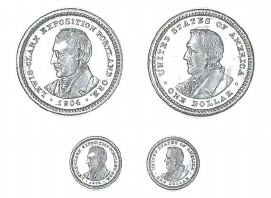
Coins for an Exposition
On April 13, 1904, a congressional act provided the following: "The secretary of the Treasury shall, upon the request of the Lewis and Clark Centennial and American Pacific Exposition and Oriental Fair Company [a name setting a record in length among coin issuers up to that time], cause to be coined at the mints of the United States not to exceed 250,000 gold dollars, of legal weight and fineness, to be known as the Lewis and Clark Exposition gold dollar, struck in commemoration of said exposition."
Farran Zerbe, the entrepreneur who facilitated the issuance of the 1903 Louisiana Purchase Exposition gold dollars, was the moving force behind this legislation as well, although his name did not officially appear in connection with it. The authorized quantity of a quarter million pieces was identical to that approved earlier for the Louisiana Purchase Exposition and reflected Zerbe's hopes and aspirations for widespread sales.
The 1804-1806 Lewis and Clark Expedition
Under the sponsorship of the government Captain Meriwether Lewis and William Clark sought to explore the upper reaches of the Missouri River to report on the land acquired in 1803 by the Louisiana Purchase. Lewis, a young man, grew up in Virginia and participated in several campaigns against the Indians in districts to the west. Lewis was known to Jefferson, who appointed him as his personal secretary when he became president, even though Lewis had difficulty spelling even simple words. It is believed that Jefferson hired him with the intention of using him in Western exploration. Later Lewis was allowed to form his own party to explore the northwestern area of the Louisiana Purchase. He selected William Clark, youngest brother of George Rogers Clark, to accompany him as a leader.
Departing from River Dubois, near St. Louis, on May 14, 1804, the Lewis and Clark party of several dozen men carried goods (including peace medals) for trade and presentation to Indians. Supplies and provisions were carried in three large canoes and on packhorses. By winter the group reached the district of the Mandan Indians (where Bismarck, North Dakota would be situated later) and remained there until the spring thaw. Departing from the Mandans on April 7, 1805, the expedition continued westward, crossed the Rocky Mountains, and followed the Columbia River to the Pacific Ocean, reaching there in November, laying the foundation for the United States later to claim the territory comprising Oregon.
Sacagawea, a Shoshone Indian, assisted Lewis and Clark as an interpreter and made part of the journey with them. The explorers wintered in the Columbia River area. On March 23, 1806, they began their return trip, arriving in St. Louis on September 23rd, having traversed approximately 8,500 miles. Captain Meriwether Lewis and William Clark were honored by Congress and given government offices in the West and tracts of land.
The 1905 Lewis and Clark Exposition
Held in 1905 in Portland, Oregon, the Lewis and Clark Exposition followed on the heels of the 1904 Louisiana Purchase Exposition and as a result did not draw much national attention, particularly as both expositions emphasized the same historical exploration. (The city of Portland, Oregon was founded in 1845 by two New Englanders, one of whom sought to name it Boston and the other, Portland. A one-cent piece was flipped for heads or tails, and Portland was chosen; otherwise, the Exposition would have been held in a place called Boston, Oregon.) The event, held on a 406-acre site, attracted an estimated 2,500,000 visitors from opening day on June 1, 1905, until closing on October 14th. Unlike the St. Louis fair of the preceding year, the Lewis and Clark Exposition was not designated by Congress as an international event, and no official government invitations were extended to foreign nations to exhibit. Notwithstanding this, 16 countries accepted offers from the Exposition itself.
Seven large buildings, many smaller ones, and the usual concessions and midway attractions entertained visitors. Exposition exhibits emphasized natural resources including fishing, mining, and forestry, but arts and manufacture were not neglected. The Forestry Building, measuring over 200 feet in length and constructed of native Oregon fir including some logs of six or more feet in diameter, was a focal point of interest. After the Exposition closed, the structure was maintained as a museum of the lumber industry. In the annals of fairs in the United States, the Lewis and Clark Exposition is not one of the more memorable. Numismatically, however, it is very important.
Design, Production, and Distribution of the Coins
Charles E. Barber, chief engraver of the Mint, was named to prepare designs for the Lewis and Clark commemorative gold dollars, creating motifs which consisted of a portrait on the obverse of Captain Meriwether Lewis and on the reverse his explorer companion, William Clark, both apparently taken from portraits in oil done years earlier by Charles Willson Peale (later on view in Independence Hall, Philadelphia).
Art historian Cornelius Vermeule was no admirer of Barber's work (or George T. Morgan's either), as noted in this 1971 commentary. "The lack of spark in these coins, as in so many designs by Barber or Morgan, stems from the fact that the faces, hair, and drapery are flat and the lettering is small, crowded, and even."
David M. Bullowa in The Commemorative Coinage of the United States told the story of production: "Although the Mint records state that 60,069 pieces were struck, 25,028 dated 1904 and 35,041 dated 1905, these figures do not tell the true story. Of the 25,028 struck in September 1904 at the Philadelphia Mint, 10,025 were sold, and 15,003 were melted down at the San Francisco Mint. The fair management ordered from the Philadelphia Mint 10,000 , pieces dated 1905. This mint, prior to its summer closing, struck an additional 25,000 during March and June, to meet possible orders; and as none of these were needed subsequently, the entire 25,000 were melted. In other words, about 10,000 of each date were distributed, and 40,000 of the 60,000 pieces struck were returned to the melting pot."