Commemorative Coins of the United States
Q. David Bowers
1916-1917 McKinley Gold Dollars
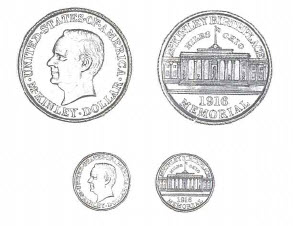
Two Issues of Gold Dollars
The next commemorative gold coins in chronological order are the 1916 and 1917 McKinley gold dollars ostensibly issued for an altruistic purpose. (Biographical information concerning McKinley can be found in the present book under the entry for 1903-dated Louisiana Purchase gold dollars.) On February 23, 1916, congressional legislation was passed that provided for the production of not more than 100,000 gold dollars, to be known as McKinley souvenir dollars, "for the purpose of aiding in defraying the cost of completing in a suitable manner the work of erecting a memorial in the city of Niles, Ohio to William McKinley, late president of the United States." The National McKinley Birthplace Memorial Association, located in Youngstown, Ohio, was to be the recipient of the coins and anticipated profits.
Originally it was intended that a commemorative silver dollar be issued in connection with the deceased president's memorial, but Colonel Joseph G. Butler, Jr., president of the Memorial Association, pointed out that McKinley had been elected in 1896 mainly on his support of the gold question, and that silver coins (reminiscent of the "free silver" campaign of his opponent, William Jennings Bryan) would be inappropriate.
Design and Production
Possibly licking its wounds from the Panama-Pacific commemorative coins, for which the Mint Engraving Department designed only the quarter eagle (and that by default), the Treasury did not call for outside help with the McKinley gold dollar motifs. The project was assigned to Chief Engraver Charles E. Barber and his associates. On March 31, 1916, Mint Director Robert W. Wooley submitted the Mint's own designs to the Commission of Fine Arts, which made suggestions for revision, but the Commission's ideas were ignored.
Charles E. Barber created the obverse design, which consisted of a portrait of McKinley quite unlike that used on his 1903-dated Louisiana Purchase Exposition coins of the same denomination, an image so different that the uninformed observer would not know that the same man was being depicted. Perhaps Barber deliberately sought to create a distinctively new version. The reverse design by George T. Morgan, called "inaccurate and incompetently done" by historians Anthony Swiatek and Walter Breen, (The Encyclopedia of United States Silver & Gold Commemorative Coins, p.157.) was intended to represent a front view of the McKinley Birthplace Memorial in Niles, Ohio.
Cornelius Vermeule commented as follows in 1971: (Numismatic Art in America, p. 105.) "When Barber and Morgan collaborated-one doing the obverse and the other doing the reverse of the coin-the results were almost always oppressive. The McKinley Memorial dollars of 1916 and 1917 bear witness to these stylistic judgments, the unclothed bust on the obverse looking tastelessly Roman and the classical, colonnaded Memorial Building placed across a reverse further constricted by too much, too large lettering."
In August and October 1916, 20,026 McKinley commemorative gold dollars were struck at the Philadelphia Mint. In February 1917 a further 10,014 McKinley gold dollars of the same design, these dated 1917, were struck at the same facility.
Distribution
Of the 30,000 1916- and 1917-dated McKinley gold dollars produced for distri-bution, about 20,000 were sold. About 10,000 were returned to the Mint for remelting. Most of the melted coins are believed to have been dated 1917.
B. Max Mehl in his 1937 monograph, The Commemorative Coins of the United States, told how he purchased thousands of unsold coins: "This issue of these gold dollars was prompted by some personal friends of the president. The original plan was to strike 100,000 of the gold dollars to sell them at $3 each and use the proceeds to erect a memorial building at the birthplace of McKinley at Niles, Ohio. However, like all similar plans promulgated by those who are inexperienced in numismatics, the sale of the coins met with meager success. In 1916, 20,026 of the coins were struck, of which approximately 15,000 were sold.
"In 1917 another issue of 10,000 were minted of which only about 5,000 were sold. By that time the Committee in charge apparently realized that the number of collectors in the country could not and would not absorb an issue of 100,000 coins at $3 each. The Committee had 20,000 coins left on hand. About 10,000 of these were disposed of at a greatly reduced price to the 'Texas dealer' [Mehl himself], who in turn distributed them extensively among collectors of the country at a reduced price from the original issue price of $3 each."
Mehl's estimates of sales of 15,000 1916-dated coins and just 5,000 dated 1917 are probably correct, even though they differ from the figures of about 10,000 for each of the 1916 and 1917 issues given by most reference books. Mehl was on the scene and had dealings with the issuing commission and was in a position to know the facts.
I estimate that original sales were approximately as follows:
1916: Sold by the Commission to the public and numismatists at the time of original distribution, 8,000 or so coins.
Later sold to B. Max Mehl, 7,000 or so coins.
1917: Sold by the Commission to the public and numismatists at the time of original distribution, 2,000 or so coins. Later sold to B. Max Mehl, 3,000 or so coins.
These estimates are backed up by these observations: When slightly worn pieces are seen today, they are almost always the 1916-dated issues. Very few worn 1917 coins are known. This indicates that the general public received very few 1917 pieces. Among Mint State coins 1916-dated McKinley gold dollars are seen about twice as often as are those dated 1917.