Commemorative Coins of the United States
Q. David Bowers
1984 Olympic $10 Gold Coins
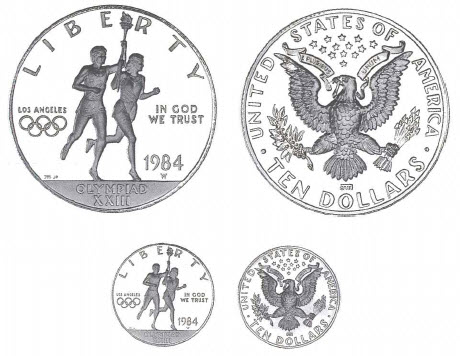
New Commemorative Gold Coins In connection with the Los Angeles Olympic Games (see historical and legislative commentary under 1983 Olympic silver dollars), gold coins bearing a legal face value of $10 were issued at four mints using the same alloy and specifications as employed for United States $10 issues circa 1838-1933, the first commemorative gold coins to be struck since the 1926 Sesquicentennial $2.50 gold pieces.
The obverse design was modeled at the Philadelphia Mint by staff engraver John Mercanti after a sketch by James M. (Jim) Peed of the Bureau of the Mint's Washing-ton office. Depicted were male and female runners ("Dick and Jane," according to the facetious remarks of some observers including Rep. Frank Annunzio (Comment by Cornelius Vermeule in a letter to the author, March 25, 1991: "Jack and Jill indeed, not Dick and Jane as was suggested. There's no Dalmatian 'Spot' running after them.")) holding a torch.
Both JM and JP initials appear at the lower left, an unusual double signature, which resulted from a conversation which Mint Director Donna Pope had with the present writer. At the time I was president of the American Numismatic Association (for the 1983-1985 term), and Mrs. Pope maintained an excellent relationship and continuing dialogue not only with the ANA but with numismatic publications and the entire collecting fraternity. She inquired whether it was accepted practice to include the initials of the designer as well as the engraver, and I cited several examples from history, after which she decided to employ it on the 1984 Olympic gold coins. (Examples among earlier commemoratives include the JE-LGF combined monogram for lames Earle Fraser and Laura Gardin Fraser on the reverse of the Oregon Trail half dollar, the combined monogram for William Marks Simpson and Marjorie Emory Simpson on the reverse of the 1936 Norfolk half dollar, and EJ and MP for Elizabeth Jones and Matthew Peloso on the reverse of the 1982 Washington half dollar (the latter being unauthorized by the Mint director and unknown to her until after coins were struck). Elsewhere in American-related Coinage the "1783"-dated Washington pieces with military bust were signed T.W.I. and E.S. for the engraver and for the creator of the portrait.) Mrs. Pope feared criticism if she were to defy convention by using a double set of initials, for certain individuals in the government stood ready to find fault with just about anything the Mint tried to do.
The reverse of the 1984 $10 gold coin by John Mercanti illustrated a heraldic eagle adapted from the Great Seal of the United States, a motif similar to that used on numerous regular issue coins from the 1790s onward (most recently on the Kennedy half dollar from 1964 to date).
Director Pope Discusses the Design
In an interview with the author. (February 11, 1991.) Mint Director Donna Pope told of the origin of the Olympic $10 design concept: "[U.S. Treasurer] Bay Buchanan and I came up with the idea of the two runners, one male and one female, carrying the torch. I asked Jim Peed to do the first drawing of it, to take our idea and put it on paper. There was considerable controversy at the Mint. Some wanted the people shown on the coin to look generic-rather than looking like a definite woman or man. We could not get what we wanted from the engraving staff. Bay finally talked to John Mercanti, rather than the chief engraver, and asked for a sketch because we couldn't get one that was right [from others on the engraving staff]."
When Jim Peed's sketch was found to be satisfactory, Bay Buchanan telephoned the artist to say, "Jim, you've won the gold" (Recollection of Jim Peed in a letter to the author, March 19, 1991.)
The Commission Reviews the Designs
After seeing preliminary designs in October 1982, the Commission of Fine Arts forwarded this commentary to the Mint: (Letter from J. Carter Brown to Francis B. (Barry) Frere, October 27, 1982.) "Obverse: Design with two figures super-imposed on Olympic symbol is too complicated, and the feet of the figures seem to be tripping on the numbers of the date. The possibility of using the handsome Olympic symbol alone could be considered. Reverse: Approved."
The minutes of the Commission meeting held on November 10, 1982, reveal that changes had been made: "Mr. Frere [Francis B. Frere, representing the Mint] showed drawings of the 1984 ten-dollar coin. The figures on the obverse remained but had been turned slightly to avoid confusion with the numbers of the date. The members still thought the design too complicated, especially when reduced to coin size; they also thought the use of figures would inevitably invite criticism based on race or ethnic origin. The design was not approved, and the recommendation was to use the Olympic rings with the torch superimposed on them. The reverse, showing the Great Seal, was approved previously, although a slight change in the arrangement of the inscription was approved at this time."
In congressional testimony J. Carter Brown, chairman of the Commission of Fine Arts, commented concerning the preliminary design. (Oversight on 1984 Olympic Commemorative Designs, Hearing Before the Subcommittee on Consumer Affairs and Coinage .... December 1, 1982, Serial No. 97-98, p.19.) [Of all of the Olympic coin designs] the gold one, in many ways, it being the most expensive, should be the best, and I think the general consensus is that it is the least good. There are problems there with those two running figures who seem to be tripping over the lettering and tortuously dealing with several hula hoops at once. Again, [like the 1984 Olympic dollar] it is a question of cramming too much visual information into too small a format.