Commemorative Coins of the United States
Q. David Bowers
1987-W Constitution Bicentennial $5 Gold Coin
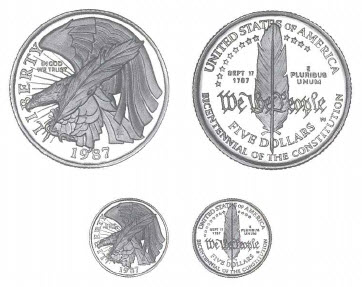
The Constitution Commemorated
In connection with the 200th anniversary of the U.S. Constitution, observed in 1987, the Act of October 29, 1986 (public Law 99-582) authorized the production of up to one million commemorative gold $ 5 coins as well as a suitable quantity of silver dollars. (Details can be found in the present text under the description of the 1987 Constitution Bicentennial dollars.)
Following a competition involving 11 outside and six Mint artists and sculptors, each of whom received $1,000 for participating, an announcement was made on March 31, 1987, that the designs of private artist Marcel Jovine had been chosen by Secretary of the Treasury James A. Baker III for the 1987 $5 coin.
The obverse depicted "a linear, highly stylized flying eagle with a quill pen in his talons," per the official Mint description. The reverse showed a quill pen oriented vertically, with the calligraphic inscription from the Constitution, We The People, across the lower part.
Upon reviewing the design, the Commission of Fine Arts suggested "that the five-dollar gold coin by Marcel Jovine ought to spell out the month, 'September,' and use a consistent size '0' in the word of at the top and bottom of the coin. (Minutes of the meeting of the Commission, April 16, 1987, p. 2.)
Elizabeth Jones recalled Jovine's work. (Letter to the author, March 15, 1991.) "He modeled both sides himself. The Mint supplied the first plain plaster basins (as with all 'outside' artists) with their proper measurements (the dish effect is to help in the eventual coining process). Marcel made his own plaster positives and negatives. However, a couple of times the models had to be reviewed (for relief heights and potential Proof polishing of difficult areas) by a technology staff member at the Mint.
Sometimes Marcel came to the Mint, sometimes the Mint person visited Marcel's studio (in his home in Closter, New Jersey) and took measurements with depth gauges." The same procedures were later followed with his designs for the 1988 Olympic and 1991 Mount Rushmore coins.
"There was an argument in my office, in my presence, over the size of Marcel Jovine's logo, between him and Dr. Cosgarea [operations officer from Head-quarters]. We laugh about it now. It was quite a scene!"
Marcel Jovine Discusses His Designs
In an article in Coin World the designer of the 1987-W $5 gold coin discussed the motifs: "Marcel Jovine envisioned a simple and striking design for his submission to the Bicentennial of the Constitution design contest. That decision probably aided Jovine's selection as one of two sculptors to design the coins.
'''It was definitely confining to have to graphically define an abstract concept, to incorporate the philosophy and political ideas,' Jovine said, commenting about the congressionally mandated requirement that designs be emblematic of the Bicentennial of the Constitution....
"Jovine said he was pleased the Treasury seemed to follow his philosophy that 'the obverse and reverse should be from the same artist' although the design selected was not the one Jovine submitted for the $5 coin. 'I had a profile of Washington looking to the right, but they wanted the reverse I did for the dollar coin,' Jovine said. 'My first impression was, 'My God, we'll have two quills on the same coin,' but after I thought about it they really reinforce each other.' ...
"Jovine said he was pleased to be selected to submit designs and especially pleased to have his designs selected. And his pleasure continued as he created the design and made his final sketches, although working in the much lower relief of a coin provided more technical challenges than working on medals, he said. 'In medals you can work in high relief, but not coins,' he said. 'You have to be concerned about the areas that will [have a] Proof [finish], too.'"
Production and Distribution
Constitution Bicentennial 1987-W $5 gold coins were struck in .900 fine gold at the West Point Mint. The initial specimen was made at a special ceremony at West Point on July 1, 1987, when Secretary of the Treasury James A. Baker III caused the first coin to be struck via electronic hookup from the Philadelphia Mint (where Secretary Baker was striking the first silver dollar; see entry under the 1987 Constitution Bicentennial silver dollar for details of the ceremony).
Sales of 1987-W Constitution Bicentennial $5 gold coins were accomplished through several purchase options including Nos. 4, 5, and 6 described in the present text under the 1987 Constitution Bicentennial silver dollars, and repeated here, as well as additional Options 7 and 8 (using the same numbering system):
(4) Two-coin Proof sets consisted of a Proof 1987-S dollar and a Proof 1987-W $5 and were first offered at $ 217, later raised to $250. Through this option 443,757 sets were marketed. Coins in plastic capsules were housed in a navy blue velvet presentation case with a hinged lid and a plaque of the Great Seal on the lid. The case and a descriptive certificate were enclosed in a navy blue cardboard box imprinted on the lid with the Great Seal and "United States Constitution Coins." The box was placed within a navy blue slipcover similarly imprinted.
(5) Two-coin Uncirculated sets comprised an Uncirculated 1987-P dollar and a 1987-W $5. These were first offered at $217, a price later raised to $240. Sets sold amounted to 79,688. Sets were packaged Similarly to the two-coin Proof sets.