Commemorative Coins of the United States
Q. David Bowers
1989-W Congress Bicentennial $5 Gold Coin
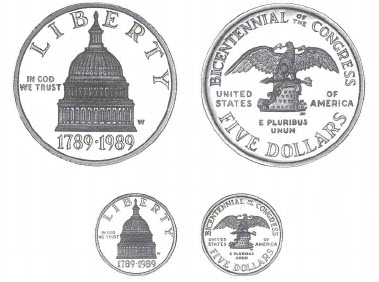
A $5 to Commemorate Congress The 200th anniversary of the operation of Congress under the U.S. Constitution furnished the opportunity in 1989 for the issuance of commemorative coins including a clad half dollar, silver dollar, and $5 gold half eagle, under Public Law 100-673 signed by President Ronald Reagan on November 17, 1988. The legislation provided that the new coins were to be dated 1989 and were allowed to be minted through June 30, 1990. The $5 gold coins "may be issued in Uncirculated and Proof qualities and shall be struck at the United States Mint at West Point, New York," according to the wording of the act.
The Design Process
Eleven outside artists as well as Mint Engraving Department employees were invited to submit designs. The work of John Mercanti of the Mint was selected for the $5 gold coin, but not without dissension within the ranks at the Mint Engraving Department, for it was alleged that his sketches were accepted before the designs of all of the other employees were reviewed. (Per Elizabeth Jones in a conversation with the author, February 15, 1991.)
The obverse design depicted "a spectacular rendition of the Capitol dome" with the dates 1789-1989 below, while the reverse "centers around a dramatic portrait of the majestic eagle atop the canopy overlooking the Old Senate Chamber," according to an enthusiastic description printed in the Annual Report of the Director of the Mint, 1989.
The motif from the Old Senate Chamber of the Capitol was selected to balance the mace from the House of Representatives shown on the related Congress Bicentennial silver dollar coin. The Commission of Fine Arts agreed with the choices but suggested that the reverse design could be improved by "texturing the shield to give the appearance of stars." (Letter from Commission Chairman J. Carter Brown to Mint Director Donna Pope, March 6, 1989. Subsequent comment by Eugene Essner from minutes of the Commission meeting, April 20, 1989, p. 2.) Subsequently Eugene Essner of the Mint told the Commission that the coin was too small for the stars to show up.
The Designs Reviewed
Coin designers achieve immortality by having their initials on commemoratives for future generations to see, but while still on earth the same artists have had to endure a lot of criticism. The Congress Bicentennial $5 was the subject of many adverse comments by observers, the price paid by John Mercanti for numismatic posterity. Since day one in the American commemorative series, this practice has been a fact of life.
Ed Reiter felt the depiction of the Capitol on the obverse of the $5 gold coin was unimaginative, and that concerning the reverse of the coin: "This bird looks more like a fricasseed chicken limping out of the chamber after an especially grueling filibuster. It's puzzling why the powers that be would have chosen these two designs easily the worst of the lot-for the coin that, being gold, is the centerpiece of the set." ("Change the Contest, the Designs Will Follow." COINage, May 1989, p. 8. Subsequent quotes are from "New Congress Coins Under Fire," by the same author, COINage, June 1989, pp. 42 ff.)
Robert A. Weinman, past president of the National Sculpture Society, called the designs "stodgy and safe," noting, "I've seen worse, but this stuff is right off the shelf. There's nothing inspired about it. That dome design is the ultimate in platitudinous dopiness. That's where Congress meets, of course, but I think it could have been rendered far more interestingly, either by showing more of the building or something symbolic of the building. I think it's pretty lacklustre." medalists, commented as follows: "The way these competitions appear to berun, they are a waste of time-a huge waste of time. It's unbelievable."
Part of the problem, in Kaufman's view, is that selections are made by viewing sketches, not models, and sketches do not necessarily indicate how a finished coin will look. "It appears that everything hinges on the drawing. And so the winner will always be the best illustrator, rather than the best coin designer .... The Mint tries to please the politicians, and the politicians want to have their say and reward those who are looking after them. Before you know it, you are no longer talking about numismatic art or something you can be proud of; you're talking about politics as usual." With regard to the Congress Bicentennial designs, Kaufman dismissed them all by saying that "if they were works of art, you'd be hiding them in the cellar."
Joseph Veach Noble, executive director of the Society of Medalists, agreed that there were problems with the competitions but felt that the main challenge was insufficient time for the Mint to select designs and prepare dies. He noted that typically the artists had less than a month to prepare their designs.
Cornelius Vermeule imaginatively compared the new Congress Bicentennial coins to a hamburger: "I have a few reservations about these Congress coins. For instance, I'd rather see that dome being used on the gold coin's reverse, rather than on the obverse; a person or personification would be much more appropriate on the obverse.
And that eagle on the reverse is sort of dessicated, isn't it? But, really, I'm so happy to see us producing regular commemorative coinage again, after such a long time, that I'm not going to nitpick.
"Certainly these new coins are well above the standard of that Jack and Jill Olympic ($10 of 1984) or that one with the body parts on top of the Los Angeles Coliseum (1984 Olympic $1). Surely these coins are better-much, much better-than nothing at all. And it's great to see them. It's as if you've been starving on a desert island and suddenly somebody takes you to a Burger King. You don't kvetch about the quality of Burger King's food; you're just so glad to see some food. But after your appetite is sated, you want better."