Commemorative Coins of the United States
Q. David Bowers
1915-S Panama-Pacific Quarter Eagle
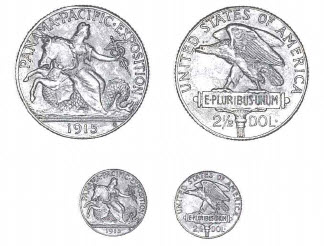
Design of the Quarter Eagle
The 1915-S Panama-Pacific quarter eagle was the first of two 20th-century issues of this denomination to be produced in the commemorative series, the other coming more than a decade later in connection with the 1926 Sesquicentennial Exposition.
Evelyn Beatrice Longman, a New York City sculptress, was selected to prepare the design following the recommendation of the Commission of Fine Arts. (Evelyn Beatrice Longman (Mary Evelyn Beatrice Longman) was born in Winchester, Ohio on November 21, 1874. She studied art at Olivet College and later was a pupil of Daniel Chester French and Lorado Taft. Her sculptures in marble and bronze were exhibited and earned medals at various expositions including St. Louis in 1904 and San Francisco in 1915. The National Academy of Design awarded her prizes in 1918, 1923, and 1926 (in 1919 she was the first woman sculptor to achieve full membership in the Academy). Monuments and architectural sculptures by her appear in many widely scattered locations in the United States. In 1920 she married Nathaniel Horton Batchelder a teacher and moved to his town of Windsor, Connecticut. Miss Longman, own late; by her married name, maintained studios in New York City (11 East 14th Street; 1915 address) and at the Loomis School, Windsor, Connecticut (1947 address). The artist died in Osterville, Massachusetts in 1954.) In correspondence with the Treasury Department Miss Longman described her design as having only the head of an eagle on one side, with the denomination being expressed with a dollar sign rather than the letter D. On the reverse was shown "a cluster of fruit symbolic of California, the greatest fruit-growing state in the nation, and in a larger sense symbolic of the general fruition and achievement of the Panama-Pacific International Exposition."
Because of illness Miss Longman was unable to complete the commission, and the work fell to Chief Engraver Charles E. Barber and his assistant, George T. Morgan, at the Philadelphia Mint, which suited William Malburn, assistant secretary of the Treasury, who felt that all the Panama Pacific coin designs should be prepared by in-house artists at the Mint. The Commission of Fine Arts was upset by this posture, and eventually the matter was straightened out but not before allowing Barber to pick up the traces dropped by Miss Longman.
Barber, an advocate of the "if it is not invented here, it is no good" syndrome, discarded Longman's ideas and designed an obverse showing an allegorical figure of the goddess Columbia holding in her left hand a caduceus (representing the medical triumph over yellow fever in Panama during the canal construction), and seated astride a hippocampus, a Greek mythological seahorse with the head and forefront of a horse and the tail of a dragon. For the reverse George T. Morgan created an eagle standing on a plaque inscribed E PLURIBUS UNUM, a motif borrowed from that used in 1877 on pattern half dollars and in 1879 for his "Schoolgirl" pattern silver dollar. The quarter eagle version looked much less elegant.
A Modern Critique of the Design
In his 1971 work, Numismatic Art in America, Cornelius Vermeule analyzed the design: "Barber's obverse for the quarter eagle, was, like the dolphins [on the gold dollar and $ 50 coins], symbolic of commerce through the Canal and dependent on ancient Greek designs. In this instance the source was the Nereid, perhaps Thetis, who bears the shield of Achilles astride a hippo camp on the reverse of a silver did rachm of Pyrrhus king of Epirus in the third century B. C. Barber has reinterpreted this motif, so popular also on Greek mirror cases, in mosaics, and in jewelry, using some of the crisp prettiness of French medallic art in the 1890s or early 1900s.... Since the Greek design was disseminated in the age of the fourth century to Hellenistic rococo sculpture and painting, that is, between 330 and 100 B.C., something of the light, decorative quality just mentioned is taken directly from those phases of the antique. This obverse may be Barber's answer to Theodore Roosevelt's and Augustus Saint-Gaudens' clamor for modern coins in the Greek manner. (A reference to Roosevelt's hiring Saint-Gaudens in 1905 to redesign the entire U.S. Coinage. Roosevelt had been inspired by viewing Greek coins on display at the Smithsonian Institution and considered current U.S. coins (e.g., Barber dimes, quarters, and half dollars) insipid in comparison.) If so, the composition has the volume and balance of its classical prototype. The reverse is spirited but by no means new, for the old 'defiant eagle' of the late 1870s (Only seen on pattern coinage.) has reappeared, now standing on a platform and pole, a vehicle for E PLURIBUS UNUM that resembles the support for a Roman aquila or eagle!"
Production and Distribution
During the month of June 1915 the San Francisco Mint produced 10,017 Panama-Pacific commemorative quarter eagles. As was the case with gold dollars, specimens housed in paper envelopes were sold to fairgoers and to those who ordered from Zerbe by mail for $4 per coin in the case of the $2.50 pieces. Additional coins were sold as part of three-piece sets mounted in velvet-lined leather holders containing the quarter eagle, gold dollar, and half dollar.
After November 1916, 3,251 Panama-Pacific quarter eagles were returned to the Treasury Department for melting (17 assay coins had been melted earlier), leaving a net distribution figure of 6,749 pieces including many which Farran Zerbe kept at face value for future sales.
Collecting 1915-S Panama-Pacific Quarter Eagles
Today most surviving specimens of the 1915-S Panama-Pacific International Exposition quarter eagle are apt to show evidence of handling or wear, indicating that many must have been spent. At the time $2.50 was a day's wage for many people, and it was natural to convert into more useful form a coin which had lost its souvenir value.
Examples of the 1915-S Panama-Pacific quarter eagle are scarce in any preservation with higher level Mint State coins being especially so. The typical specimen is apt to be graded from AU-55 to MS-60 or slightly better. MS-63 and MS-64 coins are elusive, and MS-65 pieces are rare. Most Mint State pieces show a satiny, sometimes grainy lustre quite unlike the deep mint frost seen on the Panama-Pacific gold dollar.
GRADING SUMMARY: Check the high points of Columbia on the obverse and, on the reverse, the body and upper wings of the eagle for friction. Buy a lustrous specimen and avoid the sometimes-seen dull examples. Many have been cleaned or lightly polished.