Commemorative Coins of the United States
Q. David Bowers
1922 Grant Memorial Gold Dollars
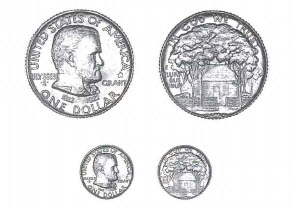
Two More Gold Dollar Varieties
Two varieties of 1922 Grant commemorative gold dollars were made, one with a star on the obverse and one without, both in approximately equal quantities. These were companions to the half dollars of the same general style, the first instance in which silver and gold denominations were both produced of the same design for the same event. (Refer to the earlier listing under 1922 Grant half dollars for information concerning Ulysses S. Grant's life and his connection with Ohio and the buildings depicted on the coins.)
On February 22, 1922, legislation was passed which provided: "That for the purpose of aiding and deferring the cost of erecting a community building in the village of Georgetown, Brown County, Ohio, and a like building in the village of Bethel, Clermont County, Ohio, as a memorial to Ulysses S. Grant, late president of the United States, and for the purpose of constructing a highway five miles in length from New Richmond, Ohio, to Point Pleasant, Clermont County, Ohio, the place of birth of Ulysses S. Grant, to be known as the Grant Memorial Road, there shall be coined in the mints of the United States, Grant Memorial gold dollars in the number of 10,000 and Grant Memorial silver half dollars in the number of 250,000 ...." The buildings and highway were never constructed.
In its original form before emendation the bill proposed that the immense quantity of 200,000 gold dollars be made, but this was reduced in the final draft to just 10,000 coins so as not to disrupt the nation's gold supply (the official reason given). Originally half dollars were not proposed, but, when the authorized quantity of gold dollars was reduced, the addition to the bill of a provision for the coinage of a maximum of 250,000 silver half dollars was felt to be a suitable compensation.
Design and Production
Laura Gardin Fraser had earlier designed the 1921 Alabama Centennial half dollar and was selected to design the new Grant Memorial half dollar and gold dollar. As created by Fraser, the obverse and reverse designs of the gold dollar were identical to those of the silver half dollar, except for the inscription indicating the denomination. The obverse of the Grant Memorial gold dollar depicted the bust of Grant in a military uniform, facing right, and on the reverse was shown the president's boyhood home, a frame dwelling in Point Pleasant, Ohio.
In March 1922 the Philadelphia Mint struck 5,000 gold dollars with a small incuse star in the right field, and 5,016 without this feature. The gold dollars with star were sold for $3.50 each and the "plain" coins for $3 each beginning in April 1922. All were eventually distributed. The purpose of the star was to create a variety for collectors. It had no other meaning or connection with Grant's life.
Sales and Distribution
Few details are known about the sales of the gold dollars, except that Texas dealer B. Max Mehl eventually came into possession of thousands of coins, paying little over face value for them. In the opinion of the present writer, only a few were sold to the general public, and not many were sold to numismatists at the time of issue. Most were wholesaled to dealers, who parceled them out for a long period of time thereafter.
Collecting 1922 Grant Gold Dollars
Today nearly all known Grant gold dollars are in varying degrees of Mint State, evidence that very few were ever sold to the general public. Nearly all of the original mintage still exists. Most coins grade in the MS-62 to MS-64 range, and MS-65 coins are not difficult to find. To be sure, there are plenty of lesser grade coins around, pieces from AU-55 to MS-60, grades often attributable to careless handling or cleaning.
GRADING SUMMARY: Most specimens are very lustrous and frosty and are in higher grades. Some show friction on the cheek and hair of General Grant. To locate this evidence of friction turn the coin carefully at several angles under strong light and medium magnification. Some specimens have dull surfaces; avoid these.
1922 Grant Memorial, "Plain" Gold Dollar
SUMMARY OF CHARACTERISTICS
Commemorating: Centennial of the birth of Ulysses S. Grant
Obverse motif: Portrait of Grant
Reverse motif: Grant's boyhood home
Authorization date: February 2, 1922
Dates on coins: 1922 (also 1822)
Date when coins were actually minted: 1922
Mint used: Philadelphia
Maximum quantity authorized: 10,000 (total for both varieties)
Total quantity minted (including assay coins): 5,000 of the "plain" variety
Assay coins: None
Quantity melted: None
Net number distributed: 5,016 of the "plain" variety
Issued by: U.S. Grant Centenary Memorial Commission (mail orders were serviced by Hugh L. Nichols, chairman, Batavia, Ohio)
Standard original packaging: Apparently, none
Official sale price: $3
Designer of obverse and reverse: Laura Gardin Fraser
Interesting fact: The identical motifs used on the Grant Memorial gold dollar were also used on the Grant Memorial half dollar, the only instance of such design duplication in the U.S. commemorative series.