Commemorative Coins of the United States
Q. David Bowers
1915-S Panama-Pacific Gold Dollar
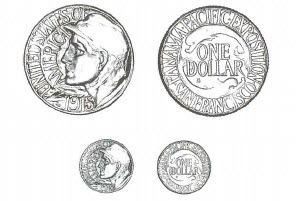
A Grand Array of Coins
The 1915 Panama-Pacific International Exposition saw the production of five different commemorative coins, including the silver half dollar, gold dollar, quarter eagle, and two varieties of $50 gold pieces, a dazzling and unprecedented panorama of numismatic diversity and art. (Refer to the earlier listing under the 1915-S Panama-Pacific half dollar for general information concerning the Exposition and its coinage.)
As was the case with all other 20th-century commemorative gold issues to this point, sales of the Panama-Pacific commemoratives were accomplished under the advice and management of Farran Zerbe, who by 1915 had served as president of the American Numismatic Association, as temporary owner of The Numismatist (having purchased it from the heirs of Dr. George F. Heath after the latter died in 1908), and who with B. Max Mehl shared the title of being America' s most aggressive promoter of coin collecting. Years later the American Numismatic Association would name its highest award after Zerbe to the consternation of some who felt that the Heath Award would have been a more appropriate name. (However, Dr. George F. Heath, founder of the American Numismatic Association, is not forgotten and is remembered by the Heath Literary Awards given yearly for outstanding contributions to The Numismatist.) Notwithstanding that Zerbe was not liked by everyone in his own time (refer to early commentary under the 1903-dated Louisiana Purchase Exposition gold dollars), his contributions to numismatics were incalculable; and certainly had Zerbe never lived, the story of American gold commemoratives would be vastly different from the way we know it today.
Zerbe devised a price schedule for Panama-Pacific coins as follows: silver half dollars $1 each, gold dollars ($2, later $2.25), quarter eagles $4, and $50 pieces, octagonal and round, $100 each. A number of the three smaller coins-the half dollar, gold dollar, and quarter eagle-were sold in velvet-lined leather cases. A complete set consisting of one each of the half dollar, gold dollar, quarter eagle, and choice of $50 (round or octagonal) could be had for $100, the same price asked for a single $50 coin, so it seems reasonable to assume that most $50 pieces were sold as part of sets. A complete set of one each of the five different types, one silver and four gold, cost $200, or a double set could be bought for $400. (This is a curious pricing schedule, for the buyer for $100 of a half dollar, gold dollar, quarter eagle, and his choice of a $ 50 type would receive four coins. The buyer of a $200 set would, in effect, be paying the full extra $100 to gain an additional $50, a coin which, if bought separately, would be accompanied by the lower denominations as well.) Farran Zerbe ordered glass-fronted hammered copper frames from Shreve & Co., a San Francisco jeweler, to display the sets offered at $200 and $400, although some of the $200 sets were sold in velvet-lined leather cases as well. About300 five-piece sets were sold primarily to banks.
The enabling act passed by Congress on January 16, 1915, noted the following with regard to the gold issues (see the earlier listing under silver commemoratives for information concerning the Panama-Pacific silver half dollars):
"The secretary of the Treasury shall cause to be coined at the United States Mint at San Francisco not exceeding 3,000 gold coins of the denomination of $50 each, 10,000 of the denomination of $2.50 each, 25,000 gold coins of the denomination of $1 each ... said coins to be struck in commemoration of the Panama-Pacific International Exposition .... One-half of the issue of $50 gold coins herein authorized shall be similar in shape to the octagonal $50 gold pieces issued in California in 1851; and the entire issue of said $50, $2.50, and $1 coins herein authorized shall be sold and delivered by the secretary of the Treasury to the Panama-Pacific International Exposition Company at par, under rules and regulations and in amounts to be prescribed by him.
"The coinage shall be executed as soon as it may be and the delivery of said coins to begin not later than the day of the opening of the Exposition.... The secretary of the Treasury is hereby authorized to obtain a suitable design for the coins and medals herein authorized, the sum of $5,000, or so much thereof as may be necessary, is hereby appropriated to defray the cost of said designs; provided that the Panama-Pacific International Exposition Company shall reimburse the Treasury Department for the amount thus expended."
Selecting Artists to Design the Coins
The Treasury Department assumed that Chief Engraver Charles E. Barber, who had designed the Louisiana Purchase Exposition and Lewis and Clark Exposition gold dollars, would create motifs for the different Panama-Pacific coins. However, the Commission of Fine Arts in its first cooperation with the Treasury Department in the matter of coin designs felt differently and submitted the names of Robert I. Aitken, Miss Evelyn Beatrice Longman, Paul H. Manship, and Charles Keck, all of New York City, as its first choices. The Commission suggested as alternate coin designers in the event that satisfactory arrangements could not be made for those first named the following: John Flanagan, Augustus Lukeman, Sherry Fry, and Miss Janet Scudder, all of New York City, plus Leonard Grunelle of Chicago and Bela Lyon Pratt of Boston.
The Commission, formed of recognized personalities in the arts, was intended to have a significant input into the selection of final designs. In practice, beginning with the Panama-Pacific coins, the wishes of the Commission were often considered only in passing as a formality. Charles E. Barber strongly resented the intrusion of outside artists, and skirmishes developed between Barber and artists selected by the Commission. At the time and earlier, Barber had been the object of much public criticism involving his designs for the dimes, quarters, and half dollars which had been produced since 1892.