Commemorative Coins of the United States
Q. David Bowers
Chapter 9
Gold Commemoratives
Introduction
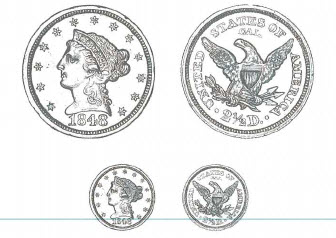
While the 1848 CAL. $2.50 gold quarter eagle is rightfully the first United States commemorative gold coin, the first souvenir issues produced in quantity for wide sale at a premium were two varieties of gold dollars dated 1903 and issued at the Louisiana Purchase Exposition in 1904. From then until 1926 nine varieties of gold dollars, two different quarter eagles, and two varieties of $50 gold coins were produced.
Decades later, beginning with Olympic $10 pieces struck at four different mints in 1984, a modern series of commemorative gold coins was created, employing for the first time the distinctive W mintmark seen on some varieties of $5 and $10 pieces. Gold commemoratives, especially the early issues, have a rich numismatic tradition and are highly desired by collectors.
1848 CAL. Quarter Eagle
A Souvenir of the Gold Rush
From a technical and historical view-point the first United States commemorative gold coin was the 1848 quarter eagle produced at the Philadelphia Mint with the counterstamp "CAL." on the reverse to create a souvenir of the California Gold Rush.
Gold was discovered in quantity in Californian January 1848 when James Marshall, an employee of John Sutter, spotted gold flecks in the race of a sawmill he was helping to construct at Coloma on the American River. Soon additional deposits were discovered up and down the river, and the area attracted dozens, then hundreds of miners. Word soon spread further, and by autumn 1848 newspapers in the East contained many articles on the alluring prospect of becoming rich overnight. In November 1848 several ships left the East to go to San Francisco. By December a veritable stampede was in progress. Old schooners, transport steamers, and virtually any other vessels considered remotely seaworthy were pressed into service. Between December 14, 1848, and January 1849, 61 ships with an average of 50 passengers each left Boston Salem, New York, Philadelphia, Baltimore, and Norfolk. Additional vessels left from Charleston, New Orleans, and other ports.
Interest in gold had been fueled by President James Knox Polk's annual address in December 1848 and by news of the arrival of gold at the Philadelphia Mint in the same month. The first deposit in 1848 of California gold from the American River was given to the Philadelphia Mint by David Garter on December 8th for evaluation. Mint Director Robert M. Patterson reported in due course that the gold, amounting to 1,804.59 ounces, assayed slightly over $18 per ounce.
On December 9th, the following day, 228 ounces averaging .894 fine were deposited at the Philadelphia Mint from gold sent by R. B. Mason, Jr., in California. This unrefined metal had been purchased at the bargain rate of $10 per ounce (pure gold was worth $17.15 net per ounce at the mint) by an army quartermaster in California under the sanction of the acting governor, using money from a civil fund. This gold was transmitted from California with a letter dated August 17, 1848, via a messenger, Lt. L. Loeser. When Loeser arrived at the trading port of New Orleans on November 24th on his way to Washington, the Commercial Times of that city printed an account which attracted wide interest among citizens.
When Loeser subsequently arrived in the capital, The Washington Union informed readers of the following: "We readily admit that the account so nearly approached the miraculous that we were relieved by the evidence of our own senses on the subject. The specimens have all the appearance of the native gold we had seen from the mines of North Carolina and Virginia; and we are informed that the Secretary will send the small chest of gold to the Mint, to be melted into coin and bars, and most of it to be subsequently fashioned into medals commemorative of the heroism and valor of our officers.
"Several of the other specimens he will retain for the present in the War Office as found in California in the form of lumps, scales, and sand; the last named being of different hues, from bright yellow to black, without much appearance of gold. However skeptical any man may have been, we defy him to doubt that if the quantity of such specimens as these be as great as has been represented, the value of gold in California must be greater than has been hitherto discovered in the old or new continent; and great as may be the immigration to this new El Dorado, the frugal and industrious will be amply repaid for their enterprise and toil."
A Commemorative Quarter Eagle Is Created
Secretary of War W. L. Marcy wrote the following to Mint Director Patterson on December 8, 1848, concerning the first official government deposit of 228 ounces, which subsequently arrived via Lt. Loeser on December 9th: "If the metal is found to be pure gold, as I doubt not that it will be, I request you to reserve enough of it for two medals ordered by Congress and not yet completed, and the remainder, with the exception of one or two small bars, I wish to have coined and sent with the bars to this department. As many may wish to procure specimens made with California gold, by exchanging other coin for it, I would suggest that it be made into quarter eagles with a distinguishing mark on each, if any variation from the ordinary issues from the Mint would be proper and could be conveniently made .... "
Nothing was heard from the Mint, and Marcy inquired concerning the progress of the coinage. On January 5, 1849, Mint Director Patterson replied: "The amount of your deposit of gold, made on the 15th ult., is now ready for delivery in California gold. It is our practice to pay for deposits as soon as their value is ascertained; but this could not be done in the present case because payment was required in coins made of the bullion deposited. Before the Cal. gold could be used it had to undergo the process of parting in order to separate it from the excess of silver which it contains. This was one source of delay. Another occurred by the time required for stamping the letters CAL. on the quarter-eagles as you desired. Your payment of $3910.10 will be made up of $3474.64 in coins and $435.46 in two bars of gold as melted from the grains. The California gold reserved for the medals is from another deposit .... "