Commemorative Coins of the United States
Q. David Bowers
1986-W Statue of Liberty $5 Gold Coin
The Statue of Liberty Commemorated
In connection with the 100th anniversary of the dedication of the Statue of Liberty (refer to the general description in the present text under the 1986 Statue of Liberty half dollar for details), the government authorized on July 9, 1985, the production of up to 500,000 Statue of Liberty gold half eagles in addition to commemorative clad half dollars and silver dollars.
The Design
Elizabeth Jones related the following. (Letter to the author, March 15, 1991.)
"The Statue of Liberty coins were an in-house competition. Numerous designs were submitted by the entire staff, but only I submitted drawings, about 10, for the gold. My staff got together when it was announced that there were to be three Statue of Liberty coins made and told me that they had discussed it amongst themselves and decided that I, as chief engraver, should do the gold. I was truly appreciative of their gesture, so that is why only I entered drawings for the $5 gold. Philip Fowler did part of the beginning work on the model for the reverse."
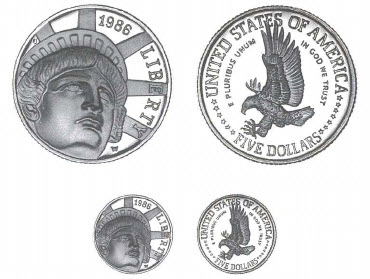
The secretary of the Treasury reviewed her designs and made final selections. In the words of a news release issued by the Mint: "[The obverse] is a view of the head of the Statue from below, chosen to symbolize the Statue's gaze toward a future of freedom and opportunity. [The reverse] design pays homage to U.S. gold coinage of the 19th century by combining traditional layout and lettering with a contemporary treatment of the customary eagle emblem."
Elizabeth Jones Discusses Her Design,
In a speech to collectors Elizabeth Jones discussed her design: (As reported in "Mint Participation Vital to Design Committee;" "Chief Sculptor-Engraver Jones Speaks About Modem Coin Designs," by P. Bradley Reed, Coin World, July 16, 1986, p. 34.) "Of the Statue of Liberty coin, she said, 'I had to portray on a tiny surface the significance, the timelessness, of the Statue as a symbol of hope to immigrants.' She said the obverse is a modern approach with a bold design and little wording, comparing it with the double eagle reverse design of Augustus Saint-Gaudens. On the reverse, she played it more traditionally, down to the style of the lettering, to link the coin historically to past gold coinage. She terms the coin a 'combination of modern and historical' ...
"She pointed to Secretary Regan and his successor James A. Baker III as taking un-usually active interests in coinage designs. Jones said she would like to see juried competitions 'like Canada has' for 'certain special occasions' but not to take all the work away from the Mint staff, which she describes as 'very competent and talented. In principle, I would like to see limited competitions. I think we would get a lot of new ideas.' She said, though, that the Mint is generally placed under short deadlines to produce coins or medals, and time usually does not allow for competitions."
Another article in Coin World toldmore: ("Chief Engraver Strives for 'Sculptural Effect,' " by Richard Gicdroyc, February 28, 1990, p. 16; slightly modified by Elizabeth Jones in a letter to the author, April 4, 1991.) "Her Liberty obverse design accepted for the Statue of Liberty half eagle was inspired by a photograph. 'I was determined immediately it would have a very bold head,' she said, because of the coin's being about the same diameter as a 5-cent coin. 'I determined after the Olympic coin I would have as little writing on the obverse as possible.' Jones wanted to show some of the hair curls on the Statue of Liberty in her design. Government officials did not agree, and the curls were removed, but she got what she wanted by leaving the obverse design uncluttered.
"'I decided to throw everything onto the reverse, but I wanted to make it harmonious,' she said. The legends on the reverse were carefully blended with the design by Jones. The legend LIBERTY remained on the obverse. 'It was a design solution to keep the head large and keep the word LIBERTY in,' she said. The obverse legend has some letters which are incuse in order to keep the lettering below the rim."
The Coin World Almanac (6th edition, p. 211.) printed excerpts from an interview with Ms. Jones, which noted in part: "You simply have to have a bold concept when you do such a tiny coin. I didn't want to cut the Statue in half. I had seen that on some medals and I think that's a very graceless design on a small coin.... If you look at a group of photographs of the Statue, from some angles her nose looks very Roman, in other photographs her forehead is very pronounced. She changes in many photographs; in some her face looks oval, in some her chin is very square and her face is very full. One photograph is never enough. When I did portraits of people I would do the photographs myself. I would take four or five rolls of 36 frames each. I would take them from all angles, on different days and in different lights...."
Elizabeth Jones's concept of the head of the Statue of Liberty on the $5 gold coin met with a tremendous enthusiasm among members of the public and the numismatic fraternity. The comment of historian Walter Breen is representative: "This is a tremendous triumph, one of the best designs in modern coinage." (The Encyclopedia of U.S. Silver & Gold Commemorative coins, p. 369.) Ms. Jones's Statue of Liberty $5 gold coin was designated as the "Coin of the Year" in a competition sponsored annually by Krause Publications.