Commemorative Coins of the United States
Q. David Bowers
1915-S Panama-Pacific $50 Gold Coins
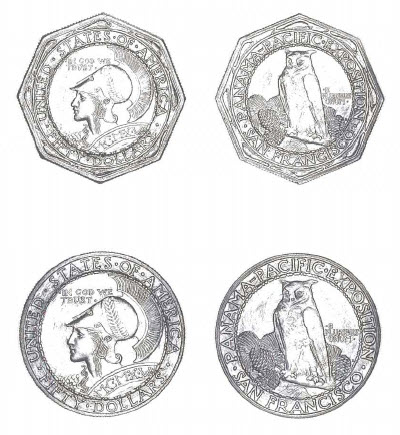
The Design
Robert I. Aitken, a New York artist, designed the octagonal and round 1915-S Panama-Pacific International Exposition $50 pieces, both of which have the same design, except that unlike the round issue, the octagonal coins display dolphins in the angles on the obverse and reverse between the inscription and the points 'of the border.
The obverse depicts Minerva, according to the official description "The Goddess of Wisdom, Skill, Contemplation, Spinning, Weaving and of Agriculture and Horticulture"-obviously, an all-around, ideal type of mythological person. The reverse, according to the original publicity, depicts an "owl, sacred to Minerva, the accepted symbol of wisdom, perched upon a branch of west em pine." The dolphins in the angles of the octagonal piece were placed there, "suggesting as they encircle the central field, the uninterrupted water route made possible by the Panama Canal." Both varieties of coins bore the date as MCMXV perhaps following the Roman numeral dating precedent set by Saint-Gaudens' beautiful $20 MCMVII of 1907.
On January 23, 1915, Robert Aitken wrote to T.P. Dewey, acting director of the Mint, enclosing sketches of the obverse and reverse, noting that his design was to represent the Exposition theme of the products of wisdom and industry. The symbols of Minerva and the owl, "all full of beauty in themselves" express "the larger meaning of the Exposition, its appeal to the intellect." Daniel Chester French, chairman of the Commission of Fine Arts, was enthusiastic concerning Aitken's designs as well as those submitted by others for the lower denominations and recommended that the Treasury go ahead with the production.
Concerning the original design for the $50 coin, Secretary of the Treasury William Gibbs McAdoo had the following to say:
"The design of the $50 gold piece was appropriate enough in the Greek coin from which it is evidently copied. The head of Pallas and the owl, sacred to her, conveyed some meaning on that coin, but none, so far as I can see, in the present instance, except as the head of Pallas may be identified with that of our own Goddess of Liberty. This spider-web is not accepted today as a symbol of industry, if that was the artist's meaning, but the contrary; and the miniature dolphins floating in the air in front of Minerva's face seem to be very inappropriate. So too, does the legend 'In GodWeTrust-1915' on the rim of Minerva's shield." Other critics jested by saying that the dolphin design suggested that the Panama Canal had been constructed for the convenience of these aquatic mammals.
However, William Malburn, assistant secretary of the Treasury, was determined that all designs should be prepared by the Engraving Department at the Philadelphia Mint, undoubtedly a sentiment encouraged by Chief Engraver Charles E. Barber. Within the next month Barber was asked to furnish ideas for the $50 piece, but before much was done on this, Robert Aitken deleted the spider web from his early design and made a few other changes to the satisfaction of McAdoo.
A Contemporary Opinion of the Design
The 1916 volume of the American Journal of Numismatics reviewed the Panama-Pacific coins of the preceding year, noting that in creating the $50 pieces in round and octagonal form, "the artist had really two important American events to draw upon and a coin with an unusually large field in which to elaborate a composition. But the types of the coin reveal no American influence, the subjects being as appropriate for any other country and event as for California or the United States of America and the completion of the Panama Canal. The criticism often heard that 'there is nothing American about the coin except the inscription' is fully warranted, for the artist, instead of working out a specially American theme, drew from the vast armory of classical symbolism and presented a really fine Athena bust as typical of the industry, and a capital representation of Athena's owl as a symbol of the wisdom that built the canal.
"So many have inveighed against the medalist's too frequent resort to the now commonplace classical symbolism-a weakness of which the art is happily working free-that to discuss the subject here would be running the risk of repeating what others have said. Without doubt classical subjects commend themselves as appropriate to the few of academic culture and taste, and yet the majority of people, and including, too, the majority of the cultivated, cannot but entertain the feeling that coins specially issued on the occasion celebrating one of the nation's greatest achievements should have borne types having a distinct reference to our national history and national spirit." The same reviewer went on to say that other pieces in the series deserved somewhat less criticism than the $50 pieces, and some of them no criticism at all.
A Modern Opinion of the Design Art historian Cornelius Vermeule commented on the design in 1971: (Numismatic Art in America, p. 136.) "Robert Aitken tried to create modern, pseudo Athenian coins, in an idiom of archaeological classicism popular among many American sculptors trained partly at the American Academy in Rome before and after the First World War. His ideas were laudable. There were a minimum of inscriptions, classic Greco-Egyptian profile of Athena in full panoply, the date in Roman numerals, and a naturalistic owl in a mass of western pine cones. Dolphins fill the corners of the octagonals.... In an overall view, the arresting feature of the giant gold coins was their archaistic treatment of details and relief. Athena's crest, wreath, curls, and aegis imitate the work of an ancient bronze. The bead and reel between the outside rims comes from Greek architecture, and a form of the lettering around the rim recalls Roman sestertii of the Empire or papal medallions of the Cinquecento. These coins were a tour de force, dated to be sure, but unusual enough in all respects to be worthy of what American numismatic art could achieve when creativity and Mint technique worked in unison."