The History of United States Coinage As Illustrated by the Garrett Collection
Q.David Bowers
A Survey of Coinage
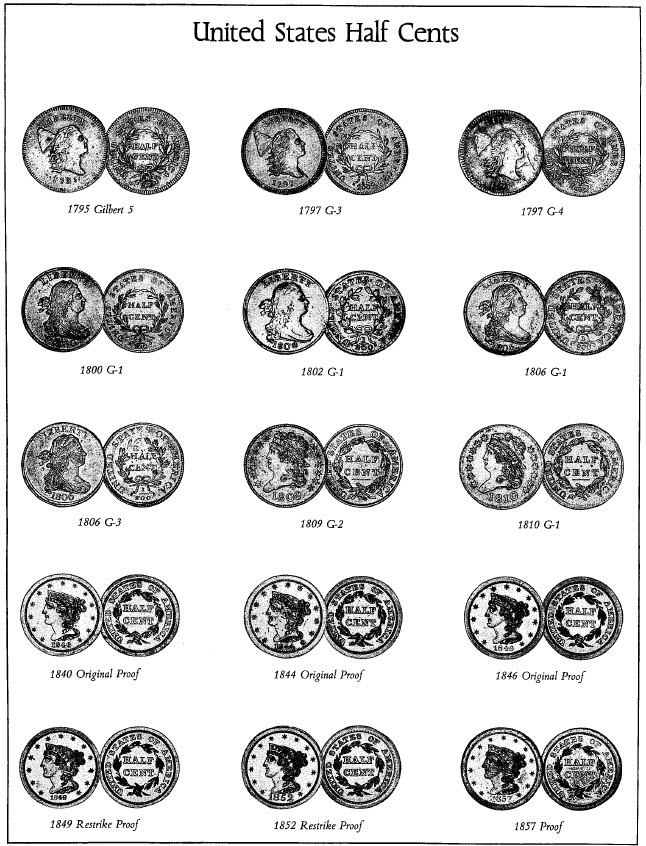
The copper half cent, the lowest denomination United States coin, made its debut in 1793. The first design, a type made only in 1793, featured the head of Liberty facing to the left with a Liberty cap on a pole behind her tresses. The Liberty cap, a symbol of freedom derived from the cap given to freed slaves in Roman days, was subsequently used on several other coinage designs of various denominations. Dies for the 1793 half cent may have been cut by Adam Eckfeldt. W. Elliot Woodward's catalogue of the Jeremiah Colburn Collection, October 20-24, 1863, Lot 2021, consisted of a 1793 half cent which Eckfeldt had presented to a gentleman" as a sample of his work." Eckfeldt did certain die forging and turning. It is possible that he also may have engraved dies.
In 1794 the design was changed to a large Liberty head facing to the right. The engraver was Robert Scot. From 1795 through 1797 a variation of the 1794 design, but with the obverse motif in reduced scale, probably the work of John Smith Gardner, an assistant engraver at the Mint, was used. From 1793 until 1795 half cents were struck on thick planchets with the edge lettered TWO HUNDRED FOR A DOLLAR. From 1795 onward pieces were made with a plain edge, with the exception of a variety of 1797 which occurs on a thin planchet with a lettered edge. In 1795 and 1796 varieties were made with pole to cap and without pole. The absence of the pole on the 1795 variety was due to resurfacing a die which removed this feature, the pole being in shallow relief. The omission of the pole on a rare variety of 1796 half cent was an engraving error.
Robert Scot's draped bust design was used in the half cent series from 1800 to 1808. Earlier this configuration had been introduced on cents in 1796. Throughout the half cent series, designs followed closely those used on cents, but often the first appearance on half cents was several years later. Among half cents of the early years there are many interesting varieties to intrigue the numismatist. Certain issues of 1795 and 1797 were struck on planchets cut from Talbot, Allum & Lee tokens which were acquired by the Mint during its continuing search for copper, a problem which plagued the early coinage operations. Sometimes planchets were also cut from misstruck large cents.
On one die of 1797 the engraver punched the first date numeral, 1, far too high. Then the date was cut in the proper position, resulting in the so-called 1 above 1 variety. Vagaries and inconsistencies in die cutting accounted for several varieties in 1804-1806 without stems on the reverse wreath and with variations in the date numerals. Overdates among early half cents include 1802/0 and 1808/7.
In 1809 John Reich's classic head style was adopted. This was continued through 1836. One variety of 1809 has the final digit cut over an inverted 9, the so-called 9 over 6 die error. A variety of 1828 half cent has 12 stars instead of the usual 13.
The Mint stopped producing half cents in 1811 as banks did not want them. The last delivery was on July 9th of that year and consisted of 62,140 coins. A lapse ensued from then until 1825, in which year Jonathan Elliott & Sons, of Baltimore, Maryland, requested a supply of the denomination. The design hub used during the 1809-1811 years was resurrected, and 63,000 1825 half cents were produced. The Mint apparently sensed that a new demand for half cents would be forthcoming, for large quantities were struck June 19, 1833, the number had been reduced to 9 casks containing 141,000 pieces.